Have you ever looked up at a clear night sky and felt that gnawing curiosity about whether something’s staring back? The cosmos stretches impossibly far. Billions of galaxies, trillions of stars, and who knows how many planets.
It’s hard to believe we’re the only ones here. Humanity has wondered about life beyond Earth for centuries, but only now do we have the tools, technology, and scientific rigor to actually search. From powerful telescopes peering at distant worlds to rovers drilling into Martian rock, the hunt for extraterrestrial life has never been more intense or more promising.
You might think this is all science fiction. It isn’t. Real scientists are dedicating their entire careers to answering one of existence’s most profound questions.
Listening for Cosmic Whispers
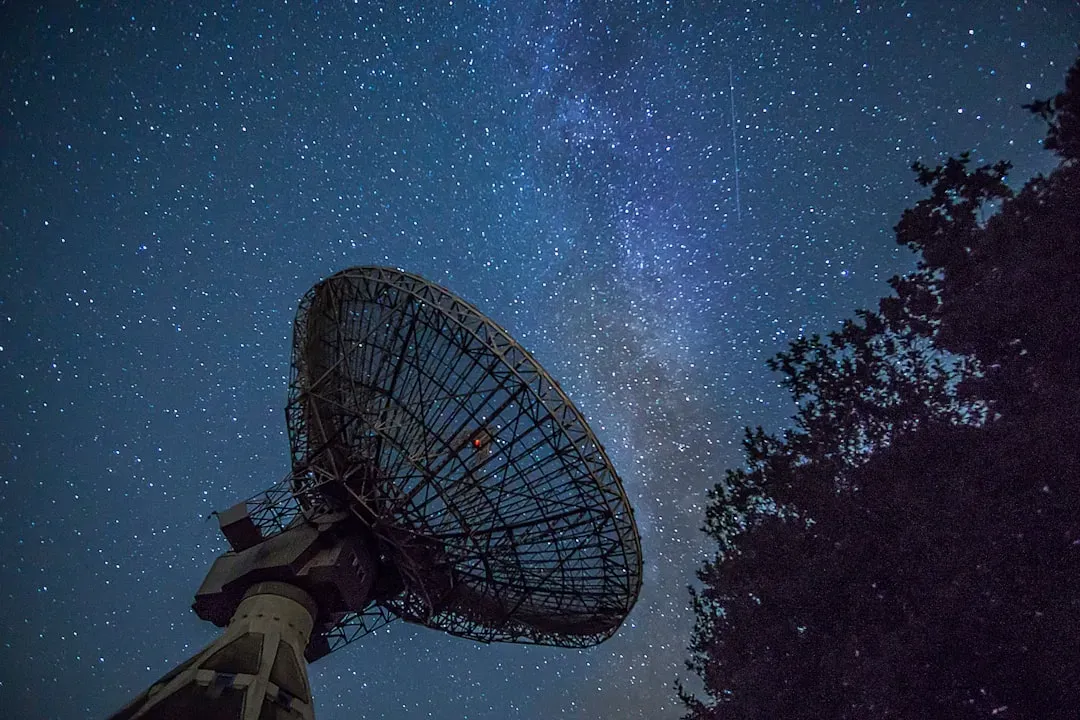
The search for extraterrestrial intelligence, or SETI, encompasses diverse scientific projects intended to detect extraterrestrial signals or any evidence of intelligent life beyond Earth by monitoring electromagnetic radiation and searching for optical signals. Scientists essentially eavesdrop on the universe, hoping to catch a deliberate transmission from another civilization.
The Breakthrough Listen initiative announced in 2015 observes thousands of hours every year on major radio telescopes, with SETI surveys now listening in on hundreds of thousands, potentially millions, of star systems at frequencies between 0.75 and 50 GHz. This is orders of magnitude deeper than all previous SETI searches combined. The new COSMIC project will enable a detailed SETI search of roughly four-fifths of the entire sky.
Here’s the thing, though. We haven’t heard anything convincing yet. Recent radio investigations, including a highly sensitive search of the interstellar object 3I/ATLAS, found no credible detections of narrowband radio technosignatures. That doesn’t mean nobody’s out there. Maybe we’re looking in the wrong places, at the wrong frequencies, or civilizations communicate in ways we haven’t imagined.
Hunting for Alien Technology

What if we can’t hear aliens but could see what they’ve built? We may be able to find alien life by detecting technosignatures, which are signs of advanced technology on a distant planet. Think massive energy-harvesting structures or artificial atmospheric pollution.
Through Project Hephaistos, researchers identified potential Dyson spheres, hypothetical structures built by intelligent beings to harness a star’s energy, with the discovery detailed in the Monthly Notices of the Royal Astronomical Society. The project analyzed data from multiple space telescopes, scanning millions of stars for infrared excesses, pinpointing seven candidates exhibiting unusual infrared emissions unexplained by natural phenomena.
That said, high-resolution radio observations found that some signals thought to be from Dyson spheres were actually caused by background active galactic nuclei or dust-obscured galaxies. False alarms happen. Still, the fact that we can now systematically hunt for alien megastructures is remarkable.
Discovering Habitable Worlds
Since 1992, over six thousand exoplanets have been discovered in over four thousand planetary systems. Many orbit within what scientists call the habitable zone, that Goldilocks region where temperatures allow liquid water to exist on a planet’s surface.
A newly detected super-Earth just 20 light-years away is giving scientists one of the most promising chances yet to search for life beyond our solar system, with the exoplanet orbiting in the habitable zone of its star. University of California, Irvine astronomers identified an exoplanet where surface conditions might support liquid water, an essential ingredient for all known life, with the exoplanet having a rocky composition like Earth and being several times more massive.
Roughly one in five Sun-like stars have an Earth-sized planet in the habitable zone, with the nearest expected to be within 12 light-years from Earth. That’s incredibly close in cosmic terms. We could have habitable neighbors right in our backyard.
Reading Alien Atmospheres

You can learn a lot about a planet by studying the light that filters through its atmosphere. Powerful telescopes like the James Webb Space Telescope have given scientists new abilities to use chemical clues to study far-off worlds, with spectra of chemicals called biosignatures potentially being the only evidence of life we can collect from planets light-years away.
Venus’s atmosphere recently produced tantalizing readings of phosphine, a compound typically linked to biological activity on Earth, while Mars continues to yield traces of methane that fluctuate mysteriously with the seasons. In April 2025, news reports linked the stinky gas dimethyl sulfide in the atmosphere of exoplanet K2-18b to possible life, with astronomer Nikku Madhusudhan’s team at the University of Cambridge finding biosignatures.
However, one later analysis concluded there is no evidence of DMS in K2-18b’s atmosphere. The interpretation of atmospheric data remains contentious. What looks biological might just be weird chemistry.
Mars: The Red Planet’s Secrets

Mars has captivated us for generations. It’s relatively close, once had flowing water, and might have hosted life billions of years ago. A sample collected by NASA’s Perseverance Mars rover from an ancient dry riverbed contains potential biosignatures, according to a paper published in the journal Nature.
Acting NASA Administrator Sean Duffy stated this finding is the closest we have ever come to discovering life on Mars, calling the identification of a potential biosignature a groundbreaking discovery. Scientists investigating a rock nicknamed Cheyava Falls found colorful spots that could have been left behind by microbial life if it had used organic carbon, sulfur, and phosphorus as an energy source.
Let’s be real, though. The minerals can be generated abiotically, without the presence of life, including through sustained high temperatures, acidic conditions, and binding by organic compounds, though the rocks at Bright Angel do not show evidence of high temperatures or acidic conditions. It’s promising but not definitive proof.
Ocean Worlds: Life Beneath the Ice

Some of the most exciting places to search for life aren’t planets at all. They’re moons. Europa, a moon of Jupiter, and Enceladus, a moon of Saturn, have evidence of oceans beneath their ice crusts, with a NASA experiment suggesting that if these oceans support life, signatures in the form of organic molecules could survive just under the surface ice despite harsh radiation.
The presence of an internal global salty ocean with complex organic compounds in contact with Enceladus’s rocky core may advance astrobiology studies, with phosphates detected from a cryovolcanic plume and the presence of organic compounds and ammonia indicating sources similar to water-rock reactions known to support life on Earth. There’s a very real chance that tiny creatures are swimming around in the dark, frigid seas of Enceladus and Europa today, with momentum building to look for that possible life by getting life-hunting robots into those buried oceans.
These moons are now priority targets. Future missions could sample plume material or even drill through the ice to reach those hidden oceans.
The Drake Equation and Cosmic Odds
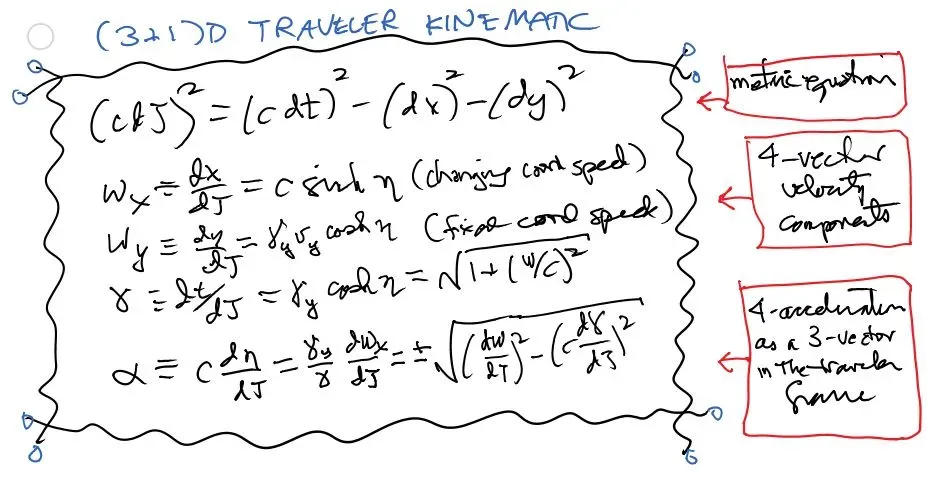
How many alien civilizations are actually out there? In 1961, astronomer Frank Drake devised the Drake equation as a way to stimulate scientific dialogue, using a probabilistic argument to estimate the number of active, communicative extraterrestrial civilizations in the Milky Way galaxy.
Based on Kepler space telescope data, astronomers reported there could be as many as 40 billion Earth-sized planets orbiting in the habitable zones of Sun-like stars and red dwarfs in the Milky Way, with about 11 billion potentially orbiting Sun-like stars. That’s a staggering number of potential homes for life.
We now know that planets, including temperate, water-bearing worlds like Earth, are plentiful, and the carbon-based building blocks of life are all over the place in the Universe, making it seem incredibly unlikely that life has only emerged once. The universe feels less lonely when you think about it that way.
The Cosmic Silence and What It Means

Here’s the uncomfortable truth: No extraterrestrial life has yet been scientifically or conclusively detected. Despite decades of searching, we haven’t found a single microbe, let alone received a radio message from an advanced civilization. This puzzling absence is sometimes called the Fermi Paradox.
SETI Institute astronomer Andrew Siemion admits anthropocentrism is a real problem in our thinking about SETI and extraterrestrial technology, noting there’s no guarantee we will ever find extraterrestrial intelligence. Maybe life is rarer than we think. Maybe civilizations destroy themselves before becoming interstellar. Maybe they’re just really good at hiding.
Or perhaps we’re simply not looking correctly. The universe is unimaginably vast, and we’ve barely scratched its surface. The year 2025 might not have brought an answer to the question of whether we are alone in the universe, but it has gotten us a little closer.
What if we do find something? Would it change everything? You’d probably think yes, and honestly, you’d be right. Discovering we’re not alone would be the most profound revelation in human history, reshaping philosophy, religion, and our understanding of our place in the cosmos. The search continues, and every new telescope, every rover mission, every atmospheric analysis brings us one step closer to an answer. So keep looking up. The truth might be out there, waiting for us to finally notice.