The Ring Nebula, a luminous remnant of a dying star about 2,300 light-years from Earth, has long captivated observers with its ethereal glow, but recent observations have revealed an unexpected feature deep within its structure.
A Startling Find at the Nebula’s Core
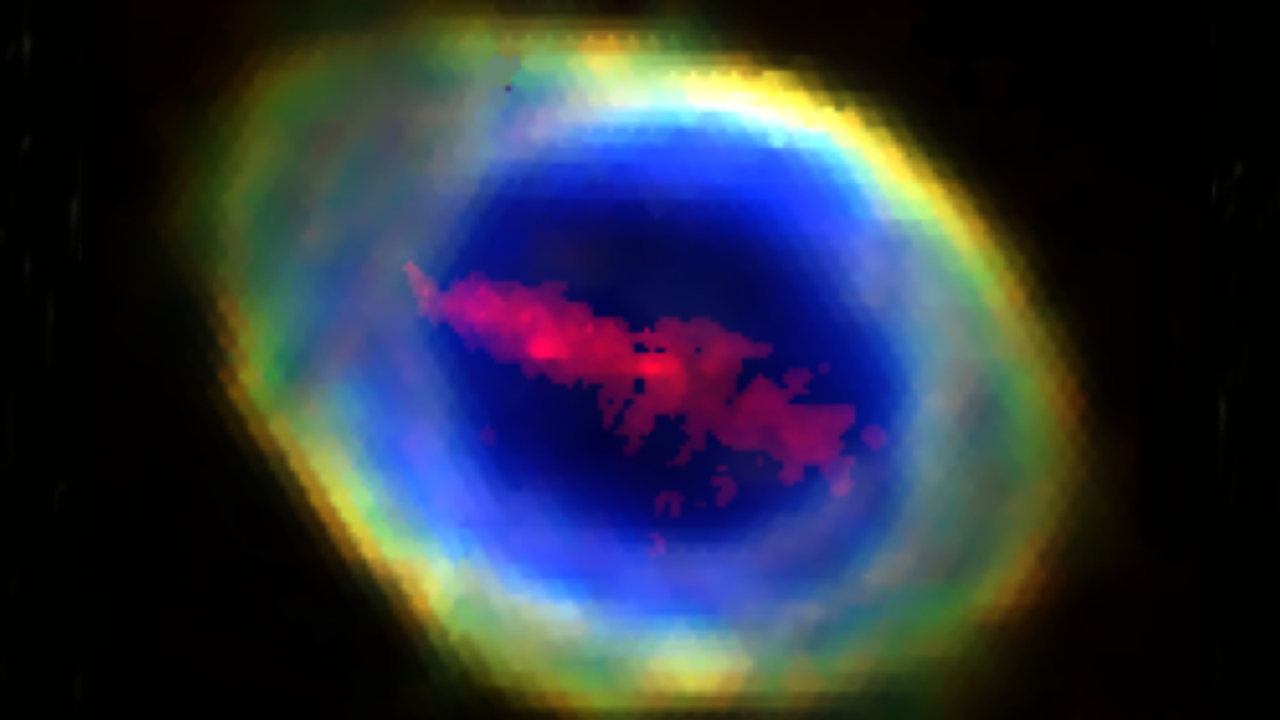
A Startling Find at the Nebula’s Core (Image Credits: Cdn.mos.cms.futurecdn.net)
Researchers detected a massive bar-shaped cloud of ionized iron atoms nestled inside the Ring Nebula’s inner layers. This structure, spanning roughly 3.7 trillion miles – equivalent to about 500 times the distance of Pluto’s orbit around the Sun – marks a significant surprise in a celestial object studied for centuries.
The discovery came through the WHT Enhanced Area Velocity Explorer (WEAVE), a new instrument on the William Herschel Telescope in the Canary Islands. Astronomers from institutions including University College London and Cardiff University led the effort, mapping the nebula’s composition in unprecedented detail. The iron cloud’s mass rivals that of Mars, suggesting it holds clues to the violent processes that shaped the nebula. While the Ring Nebula formed as a sun-like star shed its outer envelope, this iron feature defies simple explanations. Initial analysis points to its elongated form fitting precisely within the nebula’s elliptical core, visible primarily in infrared wavelengths.
Origins of the Mysterious Iron Bar
One leading theory posits that the iron bar consists of remnants from a rocky planet vaporized during the star’s expansion. As the central star ballooned into a red giant, it likely engulfed and destroyed nearby worlds, leaving behind ionized iron that condensed into this bar-like cloud. This scenario echoes potential fates for our own solar system billions of years from now, when the Sun undergoes a similar transformation.
Alternatively, the structure could have emerged from the star’s own collapse, with iron atoms ejected and aligned by magnetic fields or stellar winds. Another possibility involves space plasma, a diffuse material that coalesced under the nebula’s dynamic conditions. Researchers noted the bar’s position aligns with the nebula’s inner shell, hinting at interactions between ejected material and the central white dwarf. Though the exact mechanism remains unclear, the find underscores the complexity of planetary nebulae formation. Ongoing studies aim to refine these hypotheses through spectral analysis.
Implications for Understanding Dying Stars
The Ring Nebula, first cataloged by Charles Messier in 1779, exemplifies the end stages of stars like our Sun. This iron discovery adds a new layer to models of how such stars expel heavy elements, enriching the interstellar medium for future generations of stars and planets. By revealing concentrated iron in such a form, astronomers gain insights into metal distribution in the galaxy.
Previous observations, including those from the James Webb Space Telescope, had hinted at complex chemistry in the nebula, but WEAVE’s capabilities allowed for this targeted detection. The instrument’s ability to survey large areas at high resolution proved crucial in isolating the iron signature. Experts emphasized that while the bar’s presence is confirmed, its stability and evolution warrant further investigation. This could influence predictions about how nebulae sculpt surrounding space over time.
Key Takeaways from the Discovery
- The iron bar spans 3.7 trillion miles, with a mass comparable to Mars, fitting snugly inside the Ring Nebula’s core.
- Possible origins include vaporized planetary remnants, stellar collapse ejecta, or coalesced plasma, each offering glimpses into stellar death throes.
- This find, made using the WEAVE instrument, highlights advanced tools’ role in unveiling hidden structures in familiar cosmic landmarks.
As astronomers continue to probe the Ring Nebula’s secrets, this iron bar serves as a reminder of the universe’s untamed intricacies. What implications might it hold for our Sun’s distant future? Share your thoughts in the comments below.