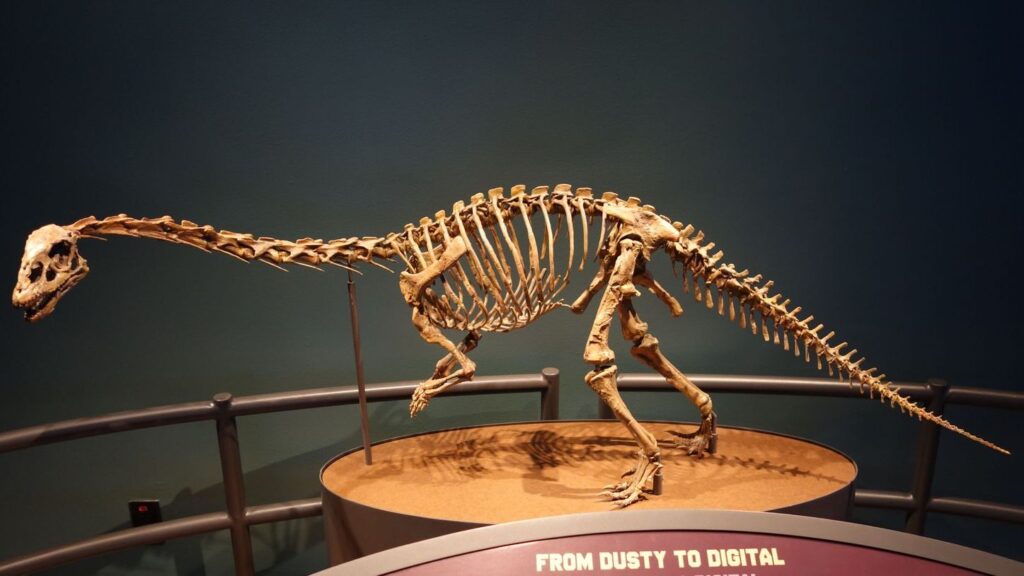
Southwestern China has yielded a partial skeleton that adds a crucial piece to the story of how some of the largest land animals ever to walk the Earth first emerged. The specimen dates to the Early Jurassic and belongs to a massopodan sauropodomorph, a group of plant-eating dinosaurs that preceded the true sauropods. Its identification as a new genus and species named Xiangyunloong fengming shows how transitional forms helped shape the lineage that would later produce the colossal four-legged giants of the Mesozoic.
The Setting of the Find
The bones were recovered from rock layers that preserve a snapshot of life roughly 200 million years ago. At that time, the region formed part of a landscape dotted with rivers and floodplains where early dinosaurs shared space with other reptiles. The partial skeleton includes enough diagnostic elements for scientists to recognize it as distinct from previously known species. Such discoveries in southwestern China continue a long pattern of important vertebrate fossils emerging from the same geological formations.
Traits That Set Xiangyunloong Apart
Xiangyunloong fengming displays a combination of features seen in both smaller early plant-eaters and the later giant sauropods. Its limb proportions and vertebral structure suggest an animal that could move on all fours yet retained some flexibility in its neck and back. The teeth indicate a diet focused on vegetation, consistent with its place among massopodan sauropodomorphs. These mixed characteristics help explain how the group gradually shifted toward the extreme body plans of true sauropods.
Why the Discovery Matters
The new species occupies a position in the fossil record that has long been poorly sampled. Earlier plant-eating dinosaurs were generally smaller and more lightly built, while the famous sauropods that followed grew to enormous sizes with long necks and tails. Xiangyunloong fengming supplies direct evidence of the anatomical changes that occurred during this transition. Its presence in Early Jurassic deposits of China also underscores how Asia contributed to the broader pattern of dinosaur diversification after the end-Triassic extinction. The find reinforces the value of continued fieldwork in areas with continuous sedimentary sequences. Each new skeleton refines the timeline of when key traits such as increased body size and specialized feeding adaptations first appeared. Researchers can now compare Xiangyunloong fengming with related forms from other continents to trace migration routes and evolutionary rates more precisely.
Looking Ahead
Further preparation and study of the specimen will likely reveal additional details about its growth and ecology. Paleontologists expect that similar transitional fossils will surface as exploration expands in the same basins. The story of how sauropods became the dominant herbivores of their time is still being assembled bone by bone, and this latest addition from southwestern China keeps that narrative moving forward.