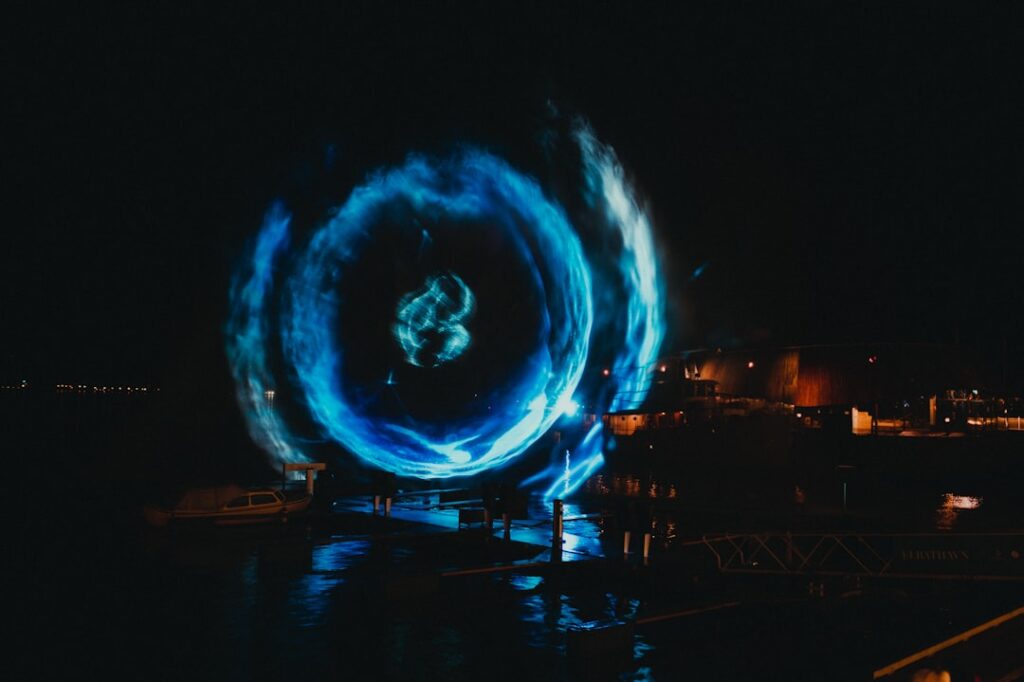
In the realm of quantum physics, a provocative idea suggests that the universe we perceive might emerge from information encoded on a distant boundary, much like a hologram projects a three-dimensional image from a flat surface.
The Origins of a Radical Concept

The Origins of a Radical Concept (Image Credits: Unsplash)
Physicists first encountered the holographic principle in the early 1990s, when Gerard ‘t Hooft proposed that the information within a volume of space could be fully described by data on its boundary. This notion gained traction through the work of Leonard Susskind, who interpreted it within string theory. Susskind emphasized that the familiar three-dimensional world, filled with stars, planets, and everyday objects, functions as a hologram derived from a two-dimensional encoding. The principle arose from efforts to reconcile quantum mechanics with gravity, particularly in understanding black holes. Earlier insights from Charles Thorn in 1978 hinted at string theory’s potential for lower-dimensional descriptions where gravity emerges naturally. By the mid-1990s, this idea had evolved into a cornerstone of theoretical physics, challenging traditional views of space and time.
The principle’s development marked a shift in how scientists approached quantum gravity. Researchers recognized that paradoxes in black hole entropy, such as the apparent loss of information during evaporation, demanded innovative solutions. Holography offered a framework where the entropy of a region aligns precisely with the area of its boundary, rather than its volume. This boundary-area relationship resolved longstanding puzzles and opened doors to deeper explorations of the universe’s fundamental structure.
Bridging Quantum Worlds and Gravity
A pivotal advancement came in 1997 when Juan Maldacena introduced the AdS/CFT correspondence, demonstrating that a five-dimensional anti-de Sitter space with gravity mirrors a lower-dimensional quantum field theory without it. This duality provided concrete evidence for holography, showing how gravitational effects in higher dimensions could arise from quantum interactions on the boundary. The correspondence has since influenced numerous studies, from particle physics to cosmology. It implies that our four-dimensional spacetime might project from a three-dimensional quantum reality, blurring the lines between geometry and information.
Quantum entanglement plays a central role in this framework, linking distant particles in ways that mirror wormhole connections. Recent experiments using quantum computers aim to simulate these holographic scenarios, testing whether black hole interiors behave as predicted. Such efforts highlight the principle’s potential to unify disparate areas of physics. Still, applying holography to our flat universe remains a challenge, as the original models focused on curved anti-de Sitter spaces.
Implications for Black Holes and Beyond
Black holes serve as the ultimate testing ground for the holographic principle, where the event horizon acts as the encoding surface. Information falling into a black hole does not vanish but gets stored on this boundary, preserving quantum rules. This resolution to the information paradox has reshaped debates in theoretical physics. Observers outside the horizon perceive a two-dimensional projection that captures the full complexity of the interior. The principle also suggests that spacetime itself emerges from entangled quantum states, offering clues to the universe’s origin.
Extending these ideas, some physicists explore whether the entire cosmos operates holographically. The cosmic microwave background and large-scale structures might reflect boundary encodings from the early universe. Collaborations like the It From Qubit project continue to probe these connections, funded by initiatives seeking a grand unified theory. Yet uncertainties persist, particularly in translating anti-de Sitter results to realistic cosmologies.
Key Takeaways
- The holographic principle posits that three-dimensional reality encodes on a two-dimensional boundary, rooted in string theory and quantum gravity.
- AdS/CFT duality provides a mathematical bridge between gravity and quantum fields, influencing black hole research and entanglement studies.
- While promising, the principle’s application to our universe requires further validation through experiments and theoretical refinements.
The holographic principle invites us to reconsider the fabric of existence, transforming abstract quantum ideas into a unified vision of reality. As research progresses, it holds the promise of unlocking profound truths about the cosmos. What aspects of this theory intrigue you most? Share your thoughts in the comments below.