Have you ever wondered what invisible forces shape our planet’s most dramatic landscapes? Think about the towering peaks of the Himalayas or the mysterious depths of ocean trenches plunging deeper than Mount Everest stands tall. These aren’t random features frozen in time. They’re dynamic, living scars carved into Earth’s surface by relentless movements happening beneath your feet right now.
The planet you stand on isn’t as solid as it appears. Beneath the seemingly permanent ground lies a restless puzzle of massive plates, drifting and colliding in a slow-motion dance that’s been choreographing our world for billions of years. Let’s dive in and explore the extraordinary mechanics that build mountains and carve the deepest canyons on Earth.
The Restless Lithosphere: Understanding Plate Movements
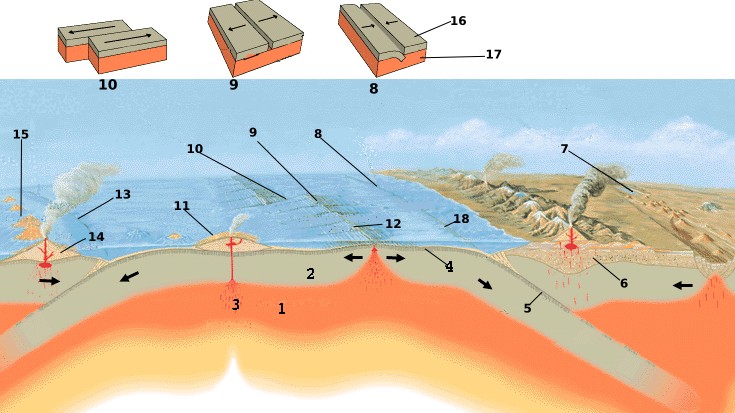
Earth’s lithosphere has been slowly moving since about three to four billion years ago, constantly reshaping the face of the planet. The rigid outer shell of the planet, which includes the crust and upper mantle, is fractured into seven or eight major plates along with numerous smaller ones. These aren’t stationary slabs, either.
These plates move relative to each other at rates between five to ten centimeters per year, roughly the speed your fingernails grow. That might sound insignificant, yet over millions of years, this relentless motion has split continents apart, slammed them back together, and continuously rewritten the geography you see on maps today. The boundaries where these plates meet become geological theaters where the most spectacular Earth processes unfold.
Convergent Boundaries: Where Worlds Collide
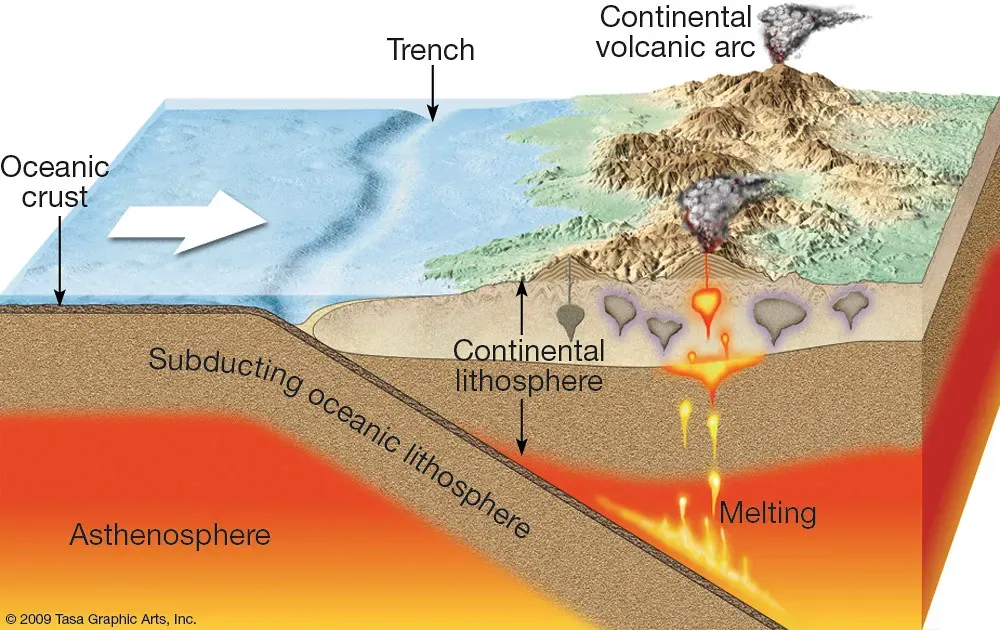
When tectonic plates move toward one another, they create what geologists call convergent boundaries. These are areas where two or more lithospheric plates collide, with one plate eventually sliding beneath the other in a process known as subduction. The type of collision depends entirely on what kinds of crust are involved.
Plate boundaries are where geological events occur, such as earthquakes and the creation of topographic features such as mountains, volcanoes, mid-ocean ridges, and oceanic trenches. Honestly, it’s hard to overstate how much drama happens at these boundaries. Picture two massive crustal blocks, each carrying entire continents or ocean floors, grinding against each other with unimaginable force. The results? Mountains that scrape the sky and trenches that plunge into darkness.
Subduction Zones: The Engine of Trench Formation
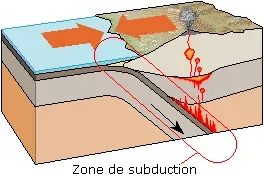
Subduction is a geological process where oceanic lithosphere is recycled into Earth’s mantle at convergent boundaries, with the heavier plate diving beneath the other and sinking into the mantle. This is where ocean trenches are born. Oceanic trenches are narrow topographic lows that mark convergent boundaries, averaging between fifty to one hundred kilometers wide and stretching several thousand kilometers long.
The Challenger Deep, at the southern end of the Marianas Trench, plunges nearly eleven thousand meters into Earth’s interior, making it deeper than Mount Everest is tall. Let’s be real, that’s almost incomprehensible. The pressure at those depths would crush almost anything, yet these trenches exist as testament to the immense forces driving plate tectonics.
Ocean-to-Continent Convergence: Building Coastal Mountain Ranges
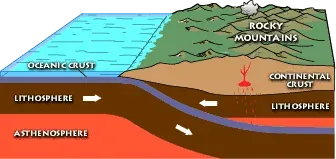
When an oceanic plate collides with a continental plate, something extraordinary happens. The thinner, denser, and more flexible oceanic plate sinks beneath the thicker continental plate in a process called subduction, causing deep ocean trenches to form. The sinking plate doesn’t just disappear quietly, though.
Along the Peru-Chile trench, the oceanic Nazca Plate is pushing into and being subducted under the continental South American Plate, and the overriding plate is being lifted up, creating the towering Andes mountains. The diving plate melts and is often spewed out in volcanic eruptions such as those that formed some of the mountains in the Andes. This isn’t just mountain building – it’s a complete recycling system for Earth’s crust.
Ocean-to-Ocean Convergence: Island Arcs and Deep Trenches
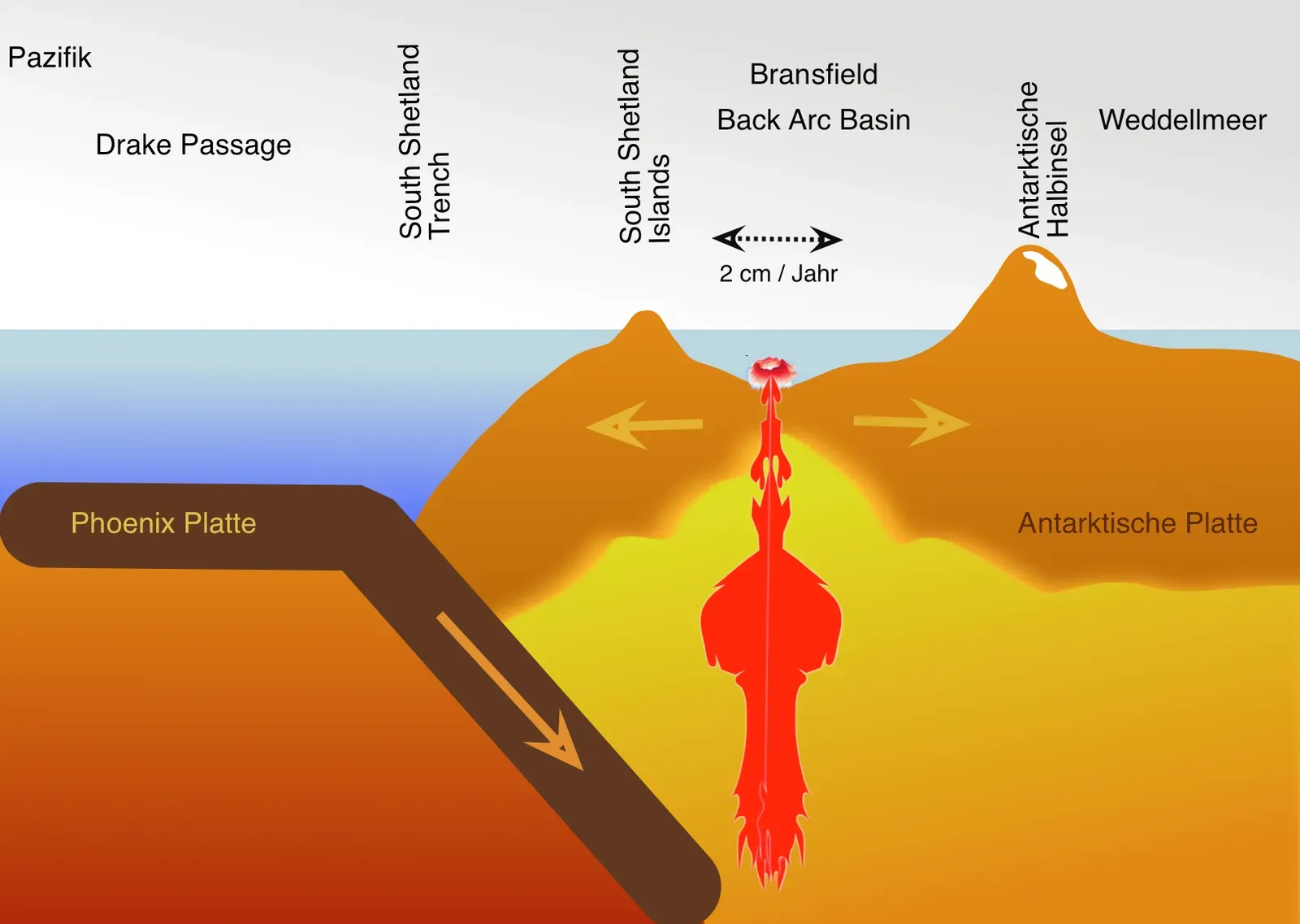
At zones of ocean-to-ocean subduction a deep trench forms in an arc shape, and the upper mantle of the subducted plate then heats and magma rises to form curving chains of volcanic islands. These volcanic island chains, called island arcs, are some of the most geologically active places on Earth.
At ocean-ocean convergences, one plate usually dives beneath the other, forming deep trenches like the Mariana Trench in the North Pacific Ocean, and these types of collisions can also lead to underwater volcanoes that eventually build up into island arcs like Japan. The pattern repeats across the Pacific: trench, subduction, volcanic arc. It’s a geological assembly line that’s been operating for hundreds of millions of years.
Continental Collision: Uplift Without Subduction
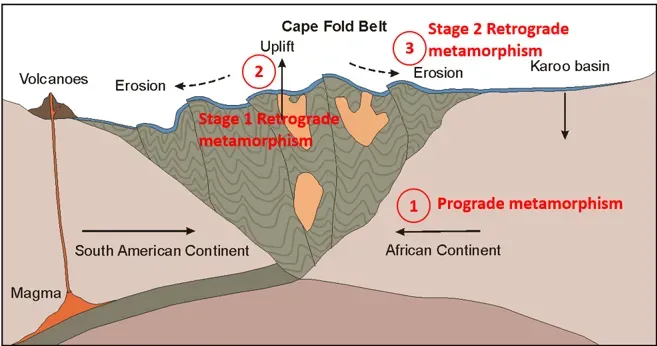
Here’s where things get interesting. At continental collision zones there are two masses of continental lithosphere converging, and since they are of similar density, neither is subducted; instead, the plate edges are compressed, folded, and uplifted forming mountain ranges like the Himalayas and Alps. Continental crust is simply too buoyant to sink into the mantle.
The collision of India into Asia fifty million years ago caused the Indian and Eurasian Plates to crumple up along the collision zone, and the slow continuous convergence of these two plates over millions of years pushed up the Himalayas and the Tibetan Plateau to their present heights. Most of that growth happened relatively recently. Collision zones are characterized by tall, non-volcanic mountains, a broad zone of frequent large earthquakes, and very little volcanism. The absence of volcanoes distinguishes these collision zones from subduction zones.
Orogenesis: The Art of Mountain Building
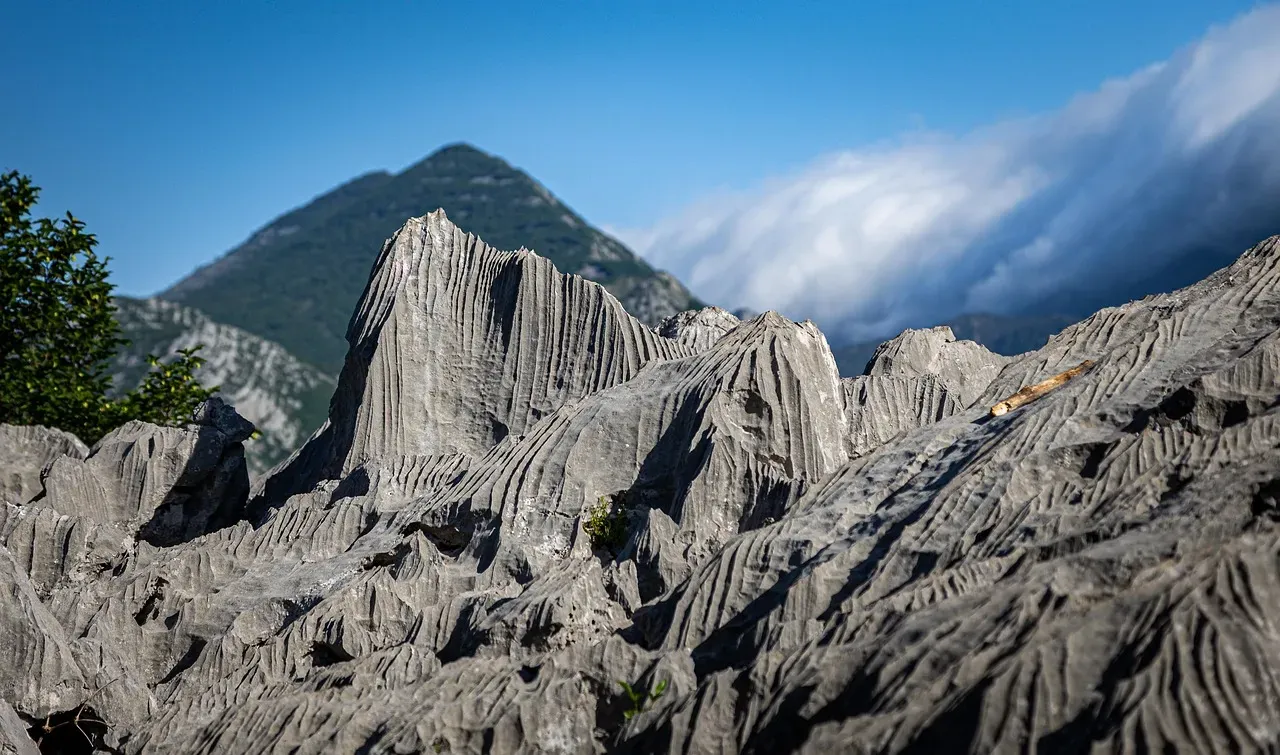
Orogeny is a mountain-building process that takes place at a convergent plate margin when plate motion compresses the margin, developing as the compressed plate crumples and is uplifted to form one or more mountain ranges. Mountain formation in orogens is largely a result of crustal thickening, with compressive forces produced by plate convergence resulting in pervasive deformation of the crust.
Crustal thickening raises mountains through the principle of isostasy, which is the balance of downward gravitational force upon an upthrust mountain range and the buoyant upward forces exerted by the dense underlying mantle. Think of it like icebergs floating on water – mountains have deep roots extending into the mantle, balancing their towering peaks above. The processes of orogeny can take tens of millions of years and build mountains from what were once sedimentary basins.
The Dynamic Balance: Creation and Destruction
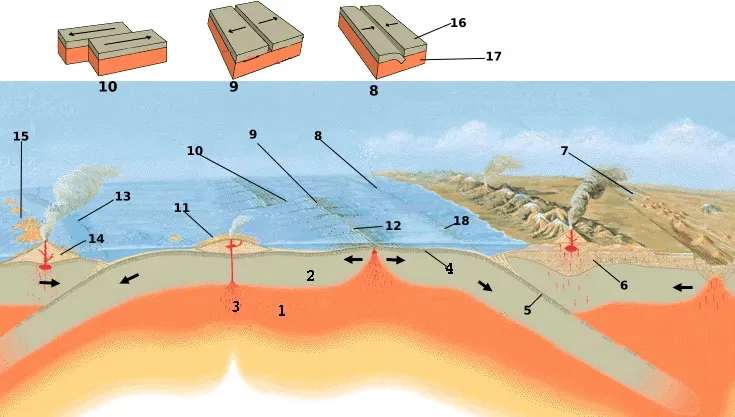
New crust is generated along divergent plate boundaries at rates on the order of a few centimeters a year, and as new crust is created, an equal amount must be destroyed at roughly the same rate for the size of Earth to remain unchanged, with subduction along the trenches of convergent plate boundaries maintaining that balance. It’s a planetary equilibrium that’s been maintained for eons.
The beauty of plate tectonics lies in this balance. Dry land exists only because of subduction, as continents are born from the destruction of oceanic crust, with magma produced at subduction zones hardening into granite, the bedrock of all continents. Without this continuous cycle of creation and destruction, Earth would be a very different world. What do you think your world would look like without these titanic forces sculpting the surface beneath you?