Earth’s oceans endured unimaginable devastation 252 million years ago during the end-Permian extinction, the most severe mass die-off in history. Massive volcanic eruptions in Siberia unleashed global warming, ocean deoxygenation, and other perils that erased more than 80 percent of marine species.[1][2] Yet, new analysis reveals that top predators, including sharks like Hybodus, persisted in many regions, preventing a total breakdown of food webs as ecosystems began to rebuild. This unexpected resilience highlights how species traits and geography shaped recovery from catastrophe.
Devastation Without Total Trophic Breakdown
Devastation Without Total Trophic Breakdown (Image Credits: Wikimedia)
Researchers examined fossil records from seven marine sites spanning equatorial to high-latitude regions, including South China, Greenland, Tibet, and others. They reconstructed food webs before and after the extinction using a model that integrated species traits and interactions. Species losses reached 96 percent in some areas, yet five of the seven ecosystems maintained at least four trophic levels – from primary producers to apex hunters.
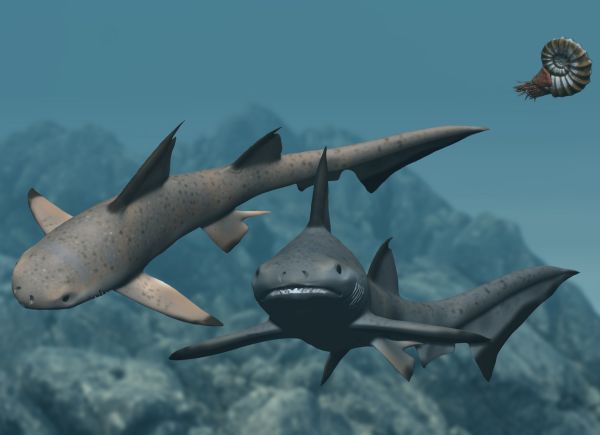
Top predators proved surprisingly hardy. Mobile swimmers like fish, conodonts, ammonoids, and sharks such as Hybodus, which evolved late in the Permian, endured where others faltered. These survivors filled critical roles, preying on mid-level carnivores and stabilizing chains that might otherwise unravel.
Vulnerable Prey, Resilient Hunters
Extinction patterns revealed clear winners and losers. Benthic herbivores – slow-moving, bottom-dwellers with limited respiratory capacity – suffered the heaviest toll. Groups like brachiopods, bryozoans, and foraminifera vanished disproportionately, especially amid warming waters and disrupted productivity.
In contrast, nektonic predators with higher mobility and better oxygen tolerance persisted. Pre-extinction food webs showed fragility, where removing a few key species could trigger cascades. Post-extinction, however, higher trophic levels held firm in most places, with no uniform global truncation.
- Benthic herbivores: Up to 90 percent loss due to physiological limits.
- Midwater fish and cephalopods: Minimal impact, rapid recolonization.
- Apex sharks like Hybodus: Continued dominance, supporting complexity.
- Conodonts and temnospondyls: Migrated to higher latitudes, adding levels.
Latitude Shaped the Recovery Path
Recovery varied sharply by location. Tropical sites, such as Meishan in South China and the Dolomites, remained “bottom-heavy,” dominated by surviving low-trophic herbivores on the seafloor. These networks proved less robust, vulnerable to further disruptions.
Higher latitudes told a different story. Ecosystems in Greenland and Tibet grew “top-heavy,” with influxes of predatory fish and cephalopods fleeing equatorial heat. Metrics like connectance, omnivory, and chain length increased, fostering more stable structures. Environmental severity – fiercer in tropics – drove this split, alongside pre-extinction architectures.
| Region Type | Post-Extinction Structure | Key Survivors |
|---|---|---|
| Tropical (e.g., South China) | Bottom-heavy, shorter chains | Seabed herbivores |
| Mid-High Latitude (e.g., Greenland) | Top-heavy, complex | Fish, sharks, ammonoids |
Insights from a Preprint Study
Baran Karapunar at the University of Leeds led the effort, published as a preprint on bioRxiv. Collaborators included experts from Sheffield, California, Yale, and Zurich. Peter Roopnarine at the California Academy of Sciences praised the scope: “I am not aware of any other study that’s pulled so many regions together.”[1] He cautioned, however, that fossil gaps limit precision, such as grouping all primary producers together.
The work challenges assumptions of universal simplification. Instead, traits like motility and latitude buffered top predators, allowing ecosystems to rebound without starting from scratch.
Modern Echoes in Ancient Waters
Key Takeaways
- Top predators like Hybodus sharks survived >80 percent marine losses, retaining trophic complexity.
- Herbivores bore the brunt; mobile hunters thrived.
- Polar shifts bolstered recovery; tropics lagged.
The Permian aftermath underscores ecosystem diversity in crisis. As oceans warm today, similar patterns – poleward predator migrations, trait-based vulnerabilities – may unfold. Unique species mixes will dictate fates, urging tailored conservation.
One clear lesson emerges: resilience often hides in the survivors at the top. What parallels do you see with current ocean threats? Share in the comments.