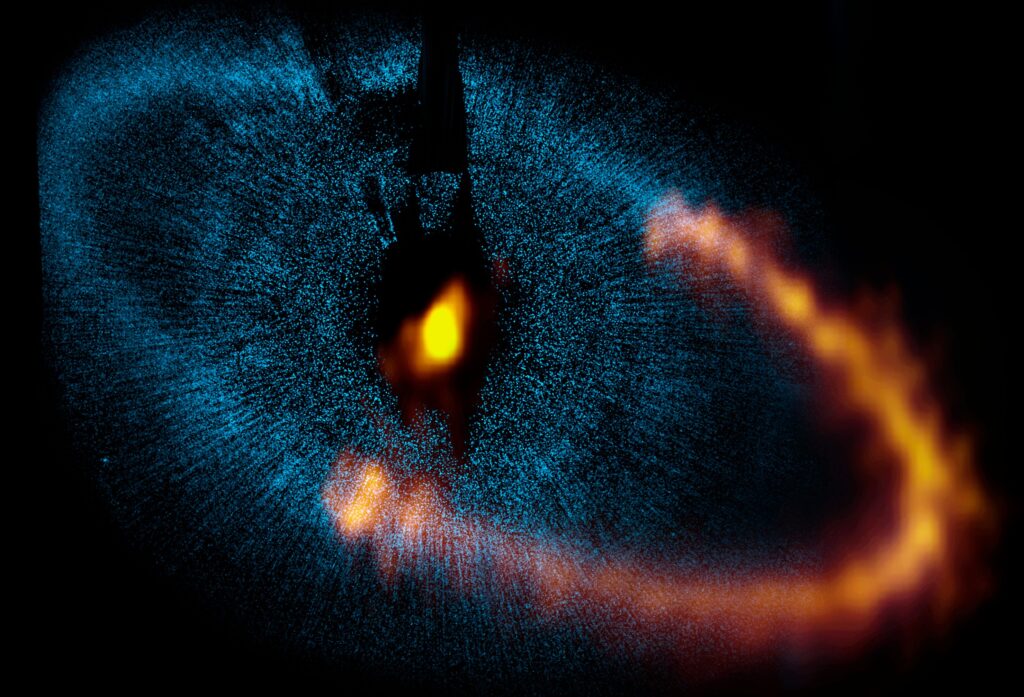
NASA’s Hubble Space Telescope has delivered groundbreaking images of massive asteroids smashing together in the debris disk surrounding Fomalhaut, a brilliant star located 25 light-years from Earth.
A Bright Anomaly Sparks Planet Hopes

A Bright Anomaly Sparks Planet Hopes (Image Credits: Substackcdn.com)
In 2004, Hubble first detected a vivid point of light within Fomalhaut’s outer debris ring. Astronomers initially hailed it as Fomalhaut b, the first exoplanet imaged directly in visible light.
Follow-up observations in 2006 and 2013 revealed a different story. The object, labeled circumstellar source cs1, expanded rapidly and faded over time. Scientists determined that stellar radiation pressure pushed the fine dust grains outward, causing the cloud to disperse by 2014.
This behavior matched models of debris from a high-speed collision between planetesimals roughly 60 kilometers across. Such impacts grind rock into microscopic particles, creating transient glows that mimic planets.
Second Cloud Emerges Nearby
Astronomers returned to the scene in 2023 with Hubble, led by Paul Kalas of the University of California, Berkeley. The original cs1 had vanished, but a new point-like feature, cs2, appeared close to the same location.
Cs2 exhibited similar traits to its predecessor: exceptional brightness in optical light and rapid changes suggesting ongoing dispersal. Kalas described the moment: “This is certainly the first time I’ve ever seen a point of light appear out of nowhere in an exoplanetary system.”
Both clouds formed within a 20-year span, defying expectations of collisions every 100,000 years or more. Researchers now estimate 300 million such objects orbit Fomalhaut, fueling frequent smash-ups.
Timeline of Hubble’s Observations
| Year | Observation | Key Finding |
|---|---|---|
| 2004 | Initial detection | Cs1 appears; mistaken for planet |
| 2006-2013 | Follow-ups | Cs1 expands, fades, moves outward |
| 2014 | Final check | Cs1 disappears |
| 2023 | New search | Cs2 emerges nearby |
These events unfolded in Fomalhaut’s inner debris belt, part of a larger disk sculpted possibly by unseen planets or the star’s companion stars.
- Collisions produce dust clouds visible for years before radiation disperses them.
- Objects involved: Asteroid-scale planetesimals, not full planets.
- Frequency: Far higher than predicted, indicating a crowded, chaotic disk.
- Detection challenge: Dust mimics exoplanets in reflected light.
- Future monitoring: Hubble and JWST to track cs2’s evolution.
Insights into Chaotic Planet Building
Fomalhaut, at about 500 million years old, offers a snapshot of youthful solar systems. Mark Wyatt of the University of Cambridge noted, “The system is a natural laboratory to probe how planetesimals behave when undergoing collisions.”
Such violence echoes Earth’s own history during the Late Heavy Bombardment, when asteroid barrages pocked the inner planets. Fomalhaut’s disk suggests ongoing instability, herded by gravitational influences.
Details emerge from NASA’s Hubble mission page.
Key Takeaways
- Hubble marked the first direct sighting of planetesimal collisions beyond our solar system.
- Two events in two decades highlight unexpectedly dynamic debris disks.
- Findings caution against mistaking dust clouds for exoplanets in future surveys.
These glimpses into Fomalhaut’s turmoil reshape views of planetary genesis as a brutal grind rather than gentle accretion. As Hubble continues its watch, more flashes may illuminate the universe’s creative destruction. What do you think these collisions reveal about our cosmic neighborhood? Tell us in the comments.