Comal County, Texas – Paleontologists snorkeling through a submerged cave stumbled upon a remarkable collection of Ice Age fossils scattered across the streambed. The discovery in Bender’s Cave offered the first evidence of certain megafauna species in central Texas, challenging long-held views of the region’s prehistoric landscape. Researchers collected dozens of bones and fragments over multiple expeditions, uncovering clues to a warmer, forested past.
Bones Littered the Streambed Like Treasure
Bones Littered the Streambed Like Treasure (Image Credits: Wikimedia)
John Moretti, a paleontologist from the University of Texas at Austin’s Jackson School of Geosciences, described the scene vividly during his initial exploration. “There were fossils everywhere, just everywhere, in a way that I haven’t seen in any other cave,” he said. “It was just bones all over the floor.”
Moretti and local caver John Young made six trips to the site between March 2023 and November 2024. They donned wetsuits, goggles, and snorkels to navigate the shallow underground stream, just a few feet deep. Fossils appeared polished and rounded, coated in rusty red mineralization, suggesting they had been swept into the cave together through ancient sinkholes during erosion and flooding events. No excavation proved necessary; the researchers simply picked specimens from 21 distinct zones along the streambed.
A Diverse Array of Extinct Giants
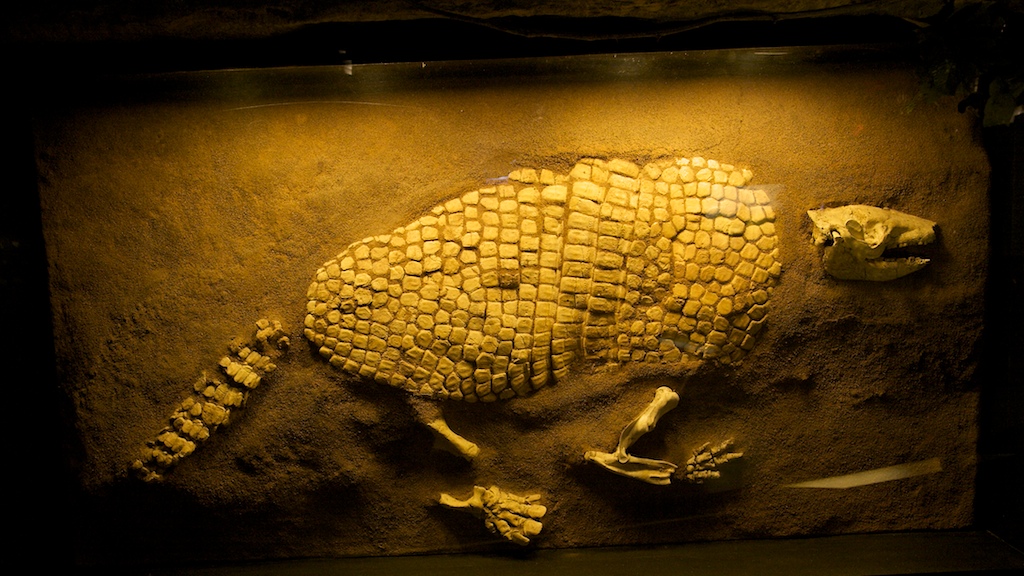
The haul included remains rarely documented in central Texas. Specimens from a giant tortoise, marked by shell fragments, represented a species from the genus Hesperotestudo. Armor plates belonged to Holmesina septentrionalis, a pampathere—an extinct armadillo relative that grew as large as a lion and featured a shield-like covering of scales.
Other finds comprised a claw from the giant ground sloth Megalonyx jeffersonii, bones from mastodons, North American camels, and saber-toothed cats. Mammoth remains also surfaced among the collection. These megafauna thrived during the Pleistocene epoch, but their presence here marked novel regional records.
- Giant tortoise (Hesperotestudo sp.): Shell fragments, first central Texas record.
- Pampathere (Holmesina septentrionalis): Armor scales, lion-sized armadillo kin.
- Giant ground sloth (Megalonyx jeffersonii): Claw, forest dweller.
- Mastodons: Bones, indicating wooded habitats.
- Camels and saber-toothed cats: Additional megafauna bones.
- Mammoths: Common in area but contextual here.
Evidence of a Warmer Interglacial Era
The fossils pointed to the last interglacial period around 100,000 years ago, a warm interval within the Ice Age. Ground sloths and mastodons favored forested environments, while giant tortoises and pampatheres required subtropical temperatures. Central Texas during glacial times resembled open grasslands, but this assemblage suggested temporary forests and milder climates.
Statistical analysis linked the site to interglacial deposits in the Dallas area and Gulf Coast, absent from younger Edwards Plateau records. Precise dating eluded researchers due to the lack of surrounding sediment for radiometric methods. Still, the uniform condition of the bones supported a single depositional event.
Why This Discovery Matters
Published in the journal Quaternary Research, the study titled “Novel occurrences of Late Pleistocene megafauna from Bender’s Cave on the Edwards Plateau of Texas may include evidence of the last interglacial” detailed the findings. Quaternary Research paper Despite nearly a century of research in the region, water caves like Bender’s had yielded only anecdotal fossil reports until now.
Moretti emphasized the role of collaboration: “These connections and partnerships make possible a lot of the natural science that gets done in Texas.” Access to private property proved crucial. David Ledesma, a professor not involved in the study, called it exciting: “Some of the fossils… are species that we didn’t think would occur in this part of Texas.” The site opens a new window into prehistoric ecosystems, reminding scientists that surprises linger even in well-explored areas.
Key Takeaways
- First central Texas records of giant tortoise, pampathere, and certain sloth remains.
- Suggests warmer, forested interglacial landscape ~100,000 years ago.
- Highlights water caves as untapped fossil repositories through snorkeling surveys.
This underwater trove reshapes understanding of Ice Age Texas, proving that hidden streams can preserve slices of deep time. What ancient secrets might other caves hold? Tell us in the comments.