Picture a long‑necked dinosaur, but not the gentle, smooth‑backed giant you see in children’s books. Instead, imagine a sauropod bristling with twin rows of towering spines along its neck, like a prehistoric punk rocker frozen in mid‑strut. That startling image is Amargasaurus, a relatively small member of the sauropod family whose bizarre neck has puzzled paleontologists for decades and still refuses to give up all its secrets.
What makes Amargasaurus so compelling is not just that it looked strange, but that every part of its anatomy hints at a story we have not fully decoded yet. Its fossils whisper about ancient environments, survival strategies, and evolutionary experiments that once played out in deep time. The fun part is that we get to piece that story together from a handful of bones and a lot of careful reasoning. Let’s dive into what we really know, what we strongly suspect, and where the mystery is still wide open.
A Short‑Necked Sauropod in a Long‑Necked World
At first glance, Amargasaurus breaks the mold of what most people think a sauropod should be. It lived during the Early Cretaceous in what is now Patagonia in Argentina, but unlike the skyscraper‑necked titans that hog the spotlight, this dinosaur was relatively modest in size, probably closer to a city bus than a small office building. Its neck was comparatively short, especially when you remember it belonged to the same broader group that includes giants like Diplodocus and Apatosaurus. That compact build alone suggests a different lifestyle, or at least a different way of moving through its world.
When its fossils were first described, the contrast with classic long‑necked sauropods was immediately obvious. Instead of an endless, graceful arc stretching toward the treetops, Amargasaurus carried a more balanced silhouette, with its neck not dramatically out of proportion to its body. To me, that already hints at a dinosaur that may not have been specialized for extreme high browsing like some of its relatives. It feels more like the difference between a ladder truck and a delivery truck: still big, still powerful, but designed for a different everyday job.
The Double Row of Spines: Anatomy of a Mystery
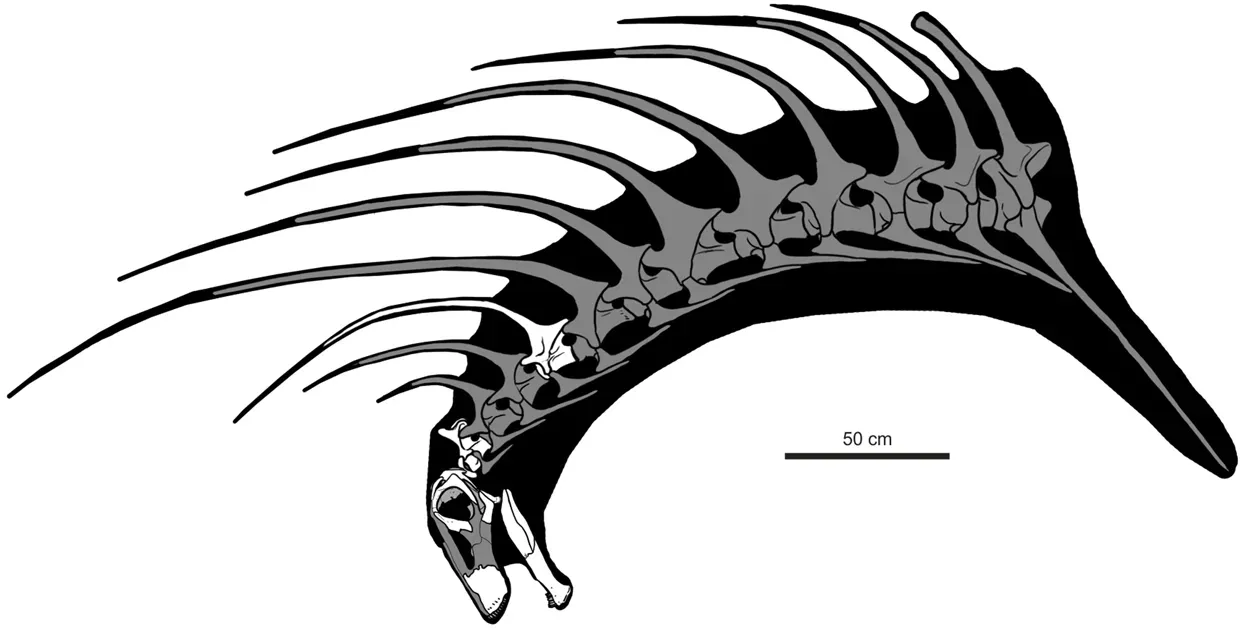
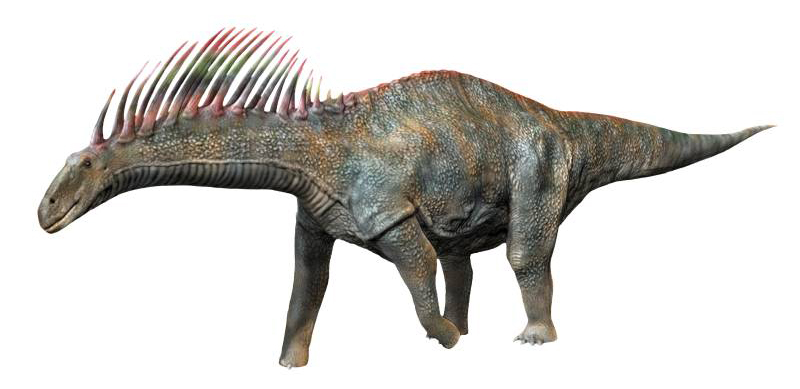
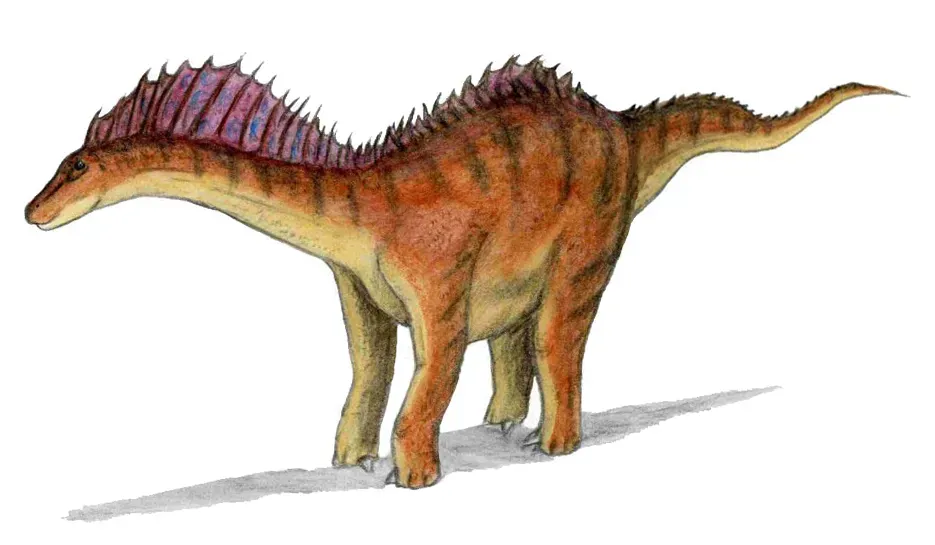
The real showstopper is the double row of elongated neural spines rising from its neck vertebrae. In many sauropods, those spines are short projections that help anchor muscles and ligaments, but in Amargasaurus they stretch dramatically upward, paired left and right, almost like rails on a bridge. The spines are bone, part of the vertebrae themselves, which means they were permanent structures, not flimsy decorations. Their shape and spacing suggest they were not simple spikes thrown on at random but carefully integrated into the skeleton.
If you look at reconstructions based on the actual fossils, you can see how these spines likely ran in two parallel rows along the neck, then gradually shortened as they approached the back. Some are long and slender, others a bit thicker, and a few even show grooves or surface textures that hint at soft tissue attachments. The arrangement makes them look more like architectural supports than weapons at first glance. They had to withstand the stresses of movement, muscles pulling, ligaments stretching, and daily life in a harsh environment, so whatever their function, they were not just fragile ornaments.
Sail, Spikes, or Something in Between? Competing Theories
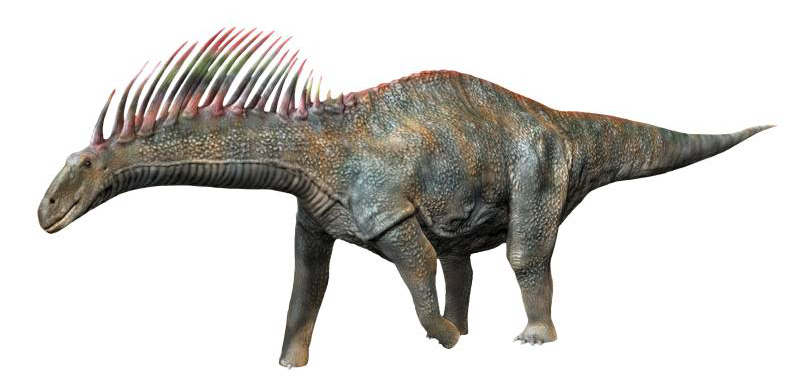
Those dramatic spines immediately raise the question: what were they for? One popular idea is that the spines supported a skin sail, a bit like the one sometimes proposed for Spinosaurus or the classic sail‑backed Dimetrodon from much earlier in Earth’s history. In that scenario, a membrane of skin stretched between the paired spines, perhaps helping with body temperature regulation, display, or species recognition. The sail hypothesis is visually striking and shows up often in paleoart, but the hard evidence for a large, thin membrane is limited, and some researchers see the spines as too close together or oddly shaped for a broad, floppy sail.
Another camp prefers the “spikes” interpretation, where the spines were mostly exposed or perhaps covered by a thinner sheath of keratin, like oversized quills. This would make Amargasaurus look fiercely armed, especially from the side, which raises the possibility of defense against predators or intimidation of rivals. The truth may sit somewhere between these extremes: partial membranes, thick ligaments, or smaller soft tissue structures making the neck look complex and visually dramatic without requiring a full billboard‑sized sail. Personally, I think it is safer to treat all these reconstructions as educated guesses rather than settled fact, because the bones on their own only tell part of the story.
Defense System or Social Signal? Reading Behavior from Bones
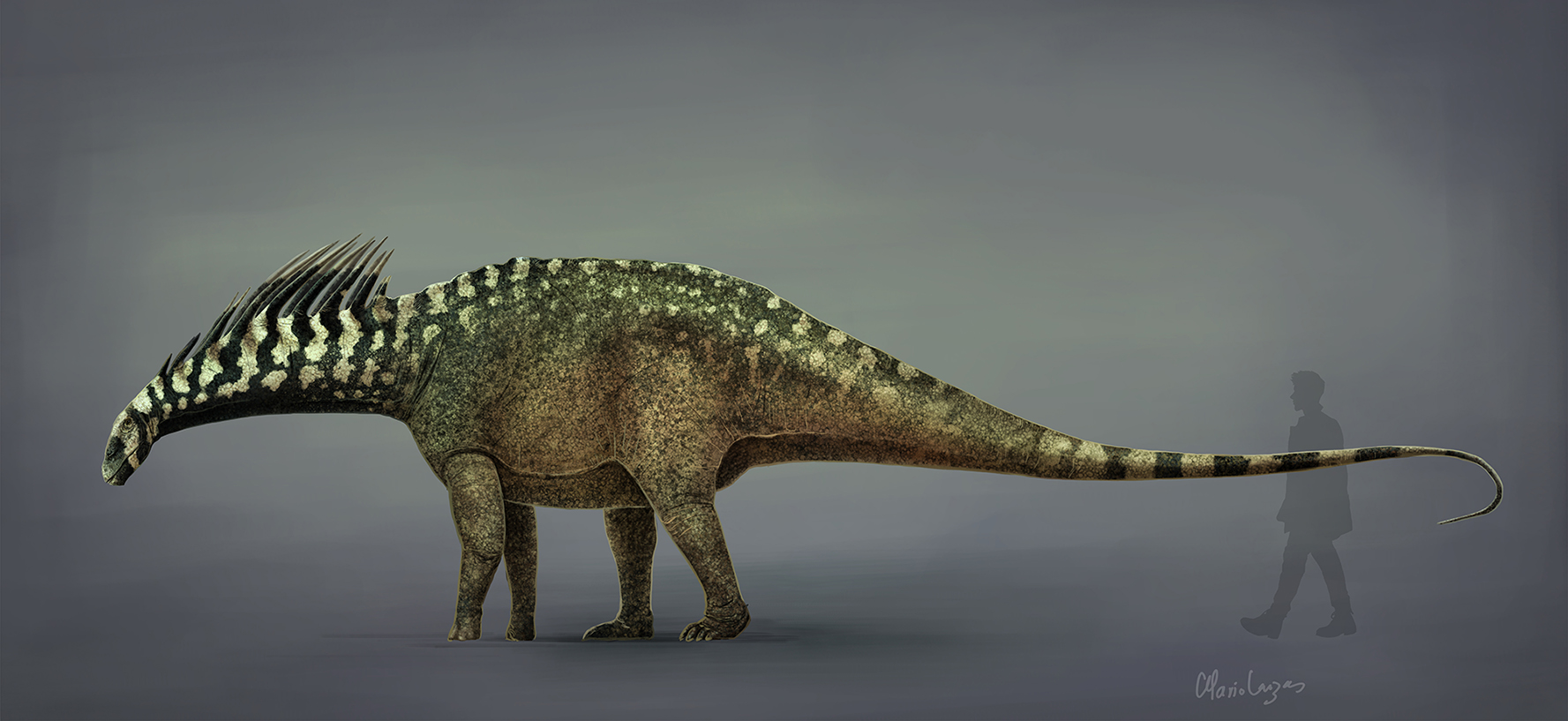
It is tempting to look at those spines and immediately declare them weapons, like built‑in spears lining the neck. If a large predator tried to grab on from above, it could easily get a face full of bone, so a defensive role is certainly plausible. The height and orientation of the spines would have made the top of the neck a dangerous place to bite, possibly nudging predators to go for less risky targets. In a world where even a brief injury could mean death, any feature that made an attack more complicated might have been worth the evolutionary investment.
But defense is not the only game in town when it comes to strange structures. Many paleontologists think display and social signaling are at least as likely, maybe even more so. Herd animals today often have showy features that help them recognize each other, attract mates, or sort out dominance without constant fighting. Those twin spines could have made Amargasaurus stand out visually in a herd or across a landscape, helping individuals signal identity, health, or maturity. I lean toward the idea that the neck spines did double duty: useful enough as passive protection, but also key to whatever social dance these dinosaurs were performing over their lifetimes.
Life in Early Cretaceous Patagonia: Why the Spines Might Have Mattered
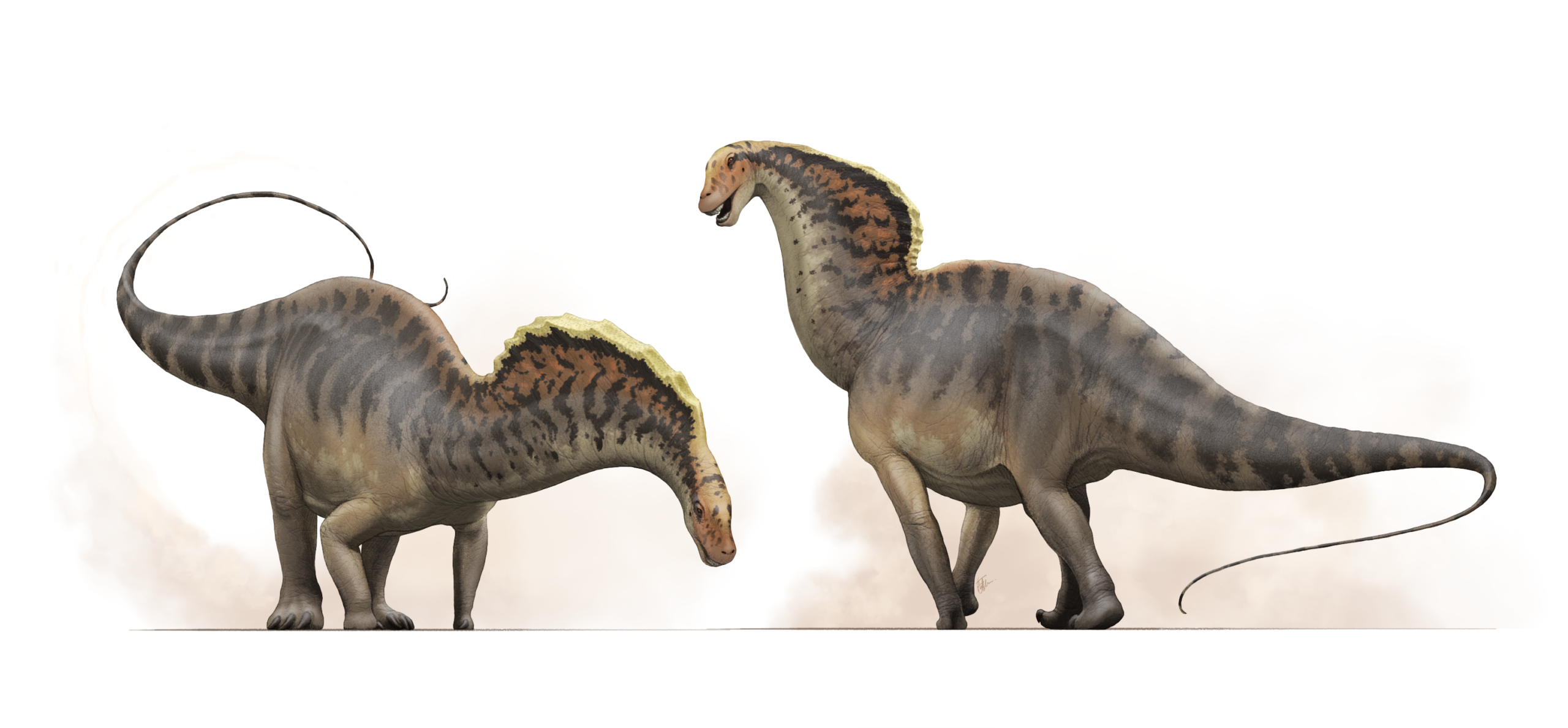
To really understand those spines, it helps to picture the world Amargasaurus walked through. Early Cretaceous Patagonia was not some empty wasteland; it was a dynamic ecosystem with rivers, forests, and a mix of plants that were shifting from older fern‑ and conifer‑dominated communities towards the rising diversity of flowering plants. Amargasaurus would have shared its environment with other herbivores and a scary cast of predators, all competing for space, food, and survival. In that busy setting, any feature that improved recognition, intimidation, or resilience could tip the balance ever so slightly in its favor.
Maybe the spines helped herd members keep track of each other in dense vegetation or low light, like flags bobbing above the crowd. Or perhaps they were most important during mating seasons, when individuals needed to advertise their fitness to potential partners and rivals. Environmental pressure does not design features in a neat, intentional way, but over time, natural selection can amplify structures that offer even slight benefits. In that sense, Amargasaurus feels like an evolutionary experiment written into the rock record, a test case in how far a sauropod body plan could be stretched without breaking.
What Amargasaurus Teaches Us About Evolution’s Wild Experiments
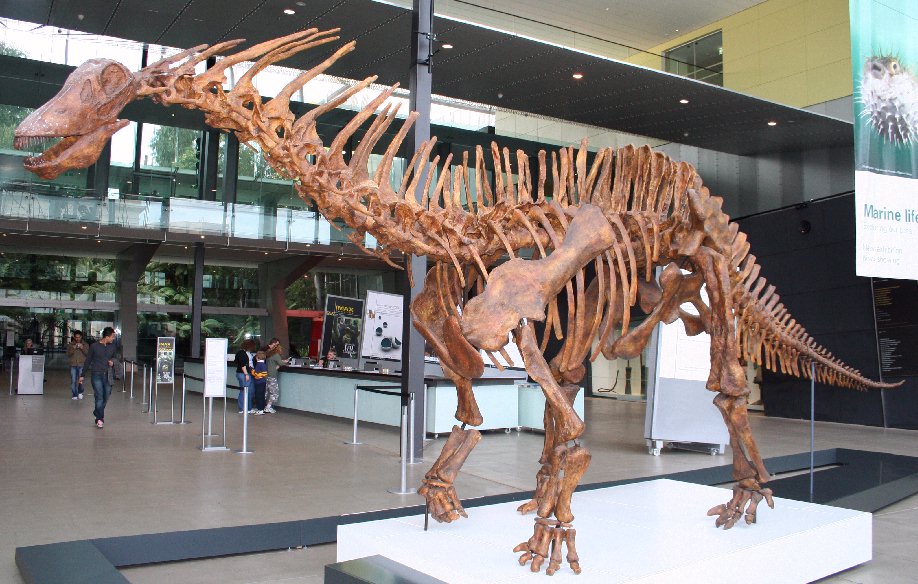
Every time I look at a reconstruction of Amargasaurus, I am reminded that evolution is far stranger and more adventurous than most of us expect. We often picture dinosaurs as a few standard types: big meat‑eaters, classic long‑necked plant‑eaters, horned frills, duck‑bills. But then a creature like this shows up, with its double row of neck spines and compact frame, and suddenly the mental picture explodes into something much more diverse. It is a quiet reminder that what we see in museums is only a tiny sliver of the true range of forms that once roamed Earth.
In my view, the most honest conclusion right now is that we still do not know exactly what those neck spines looked like in life or what they primarily did, and that uncertainty is not a failure – it is the point. Amargasaurus forces us to hold space for multiple possibilities at once, to admit that our reconstructions are well‑informed but provisional. That humility is part of good science, and it keeps the story of this dinosaur alive and evolving as new fossils and methods appear. When you think about it, is there anything more fitting for such a strange animal than to remain a little bit mysterious, always hinting that there is more to learn if we are willing to keep asking questions?