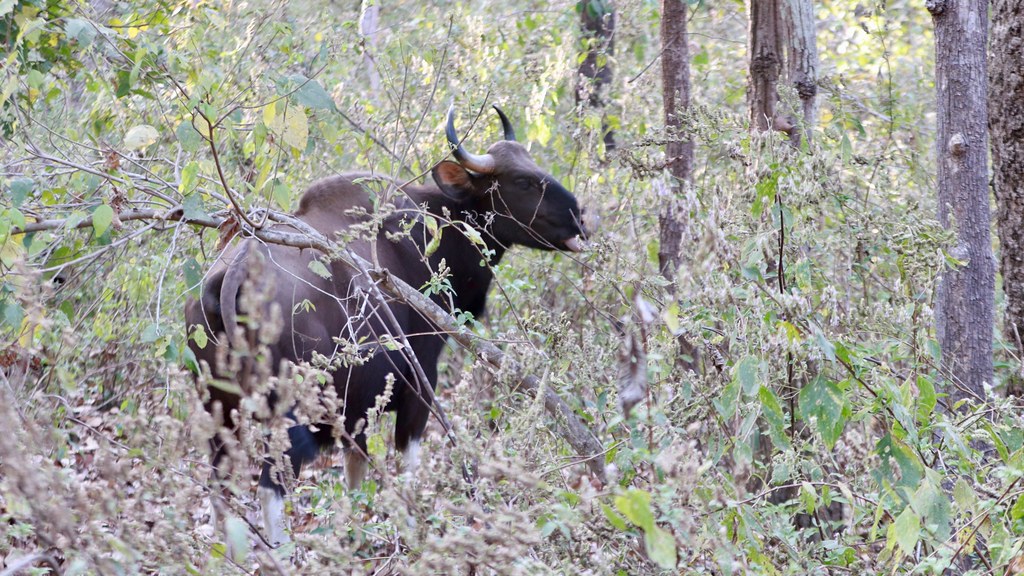
Sanjay Tiger Reserve, Madhya Pradesh – A wildlife veterinarian stumbled upon a heartbreaking sight at the forest’s fringe: a gaur, normally a towering symbol of power, reduced to a scrawny shadow of itself. Ribs protruded sharply from its wasting frame, a stark reminder of threats lurking beyond poachers and predators. This encounter years ago with Dr. Himanshu Joshi proved pivotal, transforming one animal’s demise into a blueprint for protecting entire ecosystems.
A Shocking Discovery in the Shadows
A Shocking Discovery in the Shadows (Image Credits: Flickr)
Dr. Himanshu Joshi, senior programme manager at the Wildlife Conservation Trust’s Human Wildlife Interface Management team, described the gaur’s condition vividly. “Scrawny, extremely weak, ribs sticking out, his entire body wasting away. That is how I found him,” he recalled. The team recognized the advanced stage of illness immediately. They knew intervention came too late for this individual. Still, the hope lingered that documenting the case could prevent similar fates.
The gaur had succumbed to bovine tuberculosis, a pathogen jumping from domestic livestock to wild bovines in shared forest-edge habitats. Such interfaces abound in Sanjay Tiger Reserve, spanning 1,674.50 square kilometers across northeastern Madhya Pradesh near the Chhattisgarh border. Gaur populations had vanished locally around 1998, likely due to past outbreaks, before reintroduction efforts in 2023-24.
Unseen Enemies at the Wildlife-Livestock Frontier
Bovine tuberculosis thrives silently, evading notice until devastation strikes. Transmission peaks in village-adjacent forests where cattle graze alongside wildlife. Dr. Joshi explained, “This gaur was suffering from tuberculosis; a disease transmitted between wild and domestic bovines. Such transmission primarily occurs in forests adjoining villages, which are utilised by both domestic animals and wildlife.”
Other culprits compound the risk, including Foot-and-Mouth Disease (FMD), Peste des Petits Ruminants (PPR), and Lumpy Skin Disease (LSD) for herbivores. Free-ranging dogs spread rabies and Canine Distemper Virus (CDV) to carnivores. Past incidents underscored urgency: CDV claimed 28 lions in Gir National Park in 2018 and surfaced in Panna Tiger Reserve in 2016.
Mounting a Coordinated Defense
The stricken gaur’s story ignited the Wildlife-Livestock Disease Interface Management programme, launched in Sanjay Tiger Reserve in 2020-21. Wildlife Conservation Trust collaborated with forest and animal husbandry departments, plus ICAR-National Institute of Foot and Mouth Disease. Efforts prioritized surveillance in 170 villages across core and buffer zones.
Teams deployed radio telemetry to track wildlife movements, pinpointing high-risk villages and hotspots. Dr. Prashant Deshmukh, head of the programme, noted, “We don’t just track where the animal is; we use their movement data to decide where we need to be.” Vaccinations targeted 1.5 to 2 lakh cattle, boosting herd immunity dramatically over four years. Gosewaks, local cattle caretakers turned volunteers, bridged community gaps alongside officials.
Navigating Resistance and Building Trust
Initial pushback proved fierce. Villagers clung to myths that vaccinations killed cattle or slashed productivity, sparking near-violent clashes. Dr. Joshi reflected, “It was quite tough initially… One has to be patient and careful at making their case convincingly.” Persistence paid off as early successes swayed skeptics, who then rallied neighbors.
Dr. Abhay Sengar, a reserve veterinarian, highlighted telemetry’s role: “By analysing telemetry data, we can see exactly which villages lie within a predator’s movement path. We then prioritise those specific locations for sample collection and vaccination.” This data-driven approach turned potential disasters into managed risks.
Triumphs and a Lasting Legacy
Results speak volumes. No FMD outbreaks have occurred in five years among wild herbivores or the vast cattle population. Dr. Vinay Pandey celebrated, “You can imagine how big an achievement it is for us; we are talking of no detected outbreaks of FMD in both wild herbivores and nearly 1.5 to 2 lakh cattle across 170 odd villages and across a nearly 1,700 sq. km. area.”
Reintroduced gaurs now flourish in monitored areas. The programme embedded itself in annual management plans, equaling threats like poaching. A new memorandum of understanding fosters statewide expansion to other tiger reserves. Dr. Joshi closed with solace: “I still think of that emaciated gaur from all those years ago, but now I take solace that his suffering and death was not in vain. We might have failed to save him, but he in many ways acted as a catalyst in saving the lives of countless others.”
- No FMD outbreaks in five years across vast areas and populations.
- 1.5-2 lakh cattle vaccinated, herd immunity surged.
- Telemetry guides precise interventions at human-wildlife interfaces.
One gaur’s unseen battle reshaped conservation strategies, proving vigilance against invisible foes safeguards biodiversity. How can such models expand nationwide? Share your thoughts in the comments.