
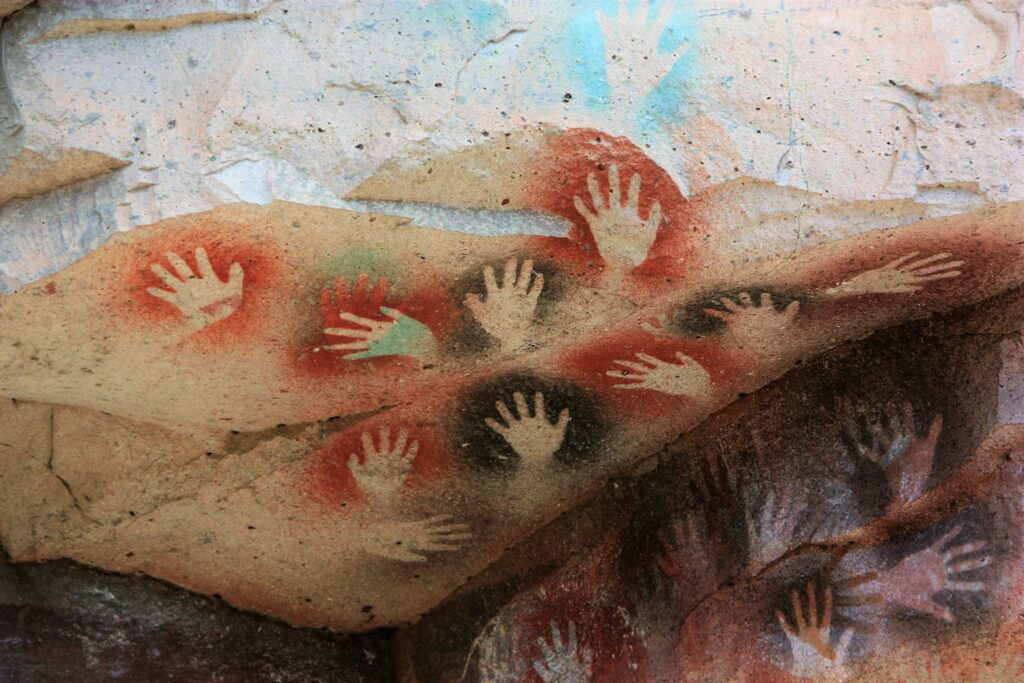
Those faint, rust-red handprints on the ceiling of a cave in Borneo look fragile, almost shy – as if they could disappear with one careless breath. Yet they have outlived entire ice ages, continents of forests, and every kingdom and empire humans have ever built. When scientists dated the rock art in Lubang Jeriji Saléh, a remote cave in East Kalimantan on the island of Borneo, they found something quietly explosive: hand stencils at least around forty thousand years old, with some evidence that similar stencils in the region might reach back beyond fifty thousand years. These images are at least as old as, and arguably older than, the famous handprints and animal scenes in Europe, upending the once‑popular story that artistic genius was born in French and Spanish caves. What makes those Borneo handprints so gripping is not just their age, but their intimacy. They are not majestic bison or galloping horses, but the negative outline of a person pressing their palm to stone and spraying pigment around it. It is one of the oldest surviving gestures we have: here I am, this is my body, I was in this place. When you look at them, you are not just staring at archaeology; you are looking at the echo of a mind remarkably like your own. And that raises a big question: what kind of people made these marks, and what were they trying to say?
The cave in the jungle: what was actually found in Borneo
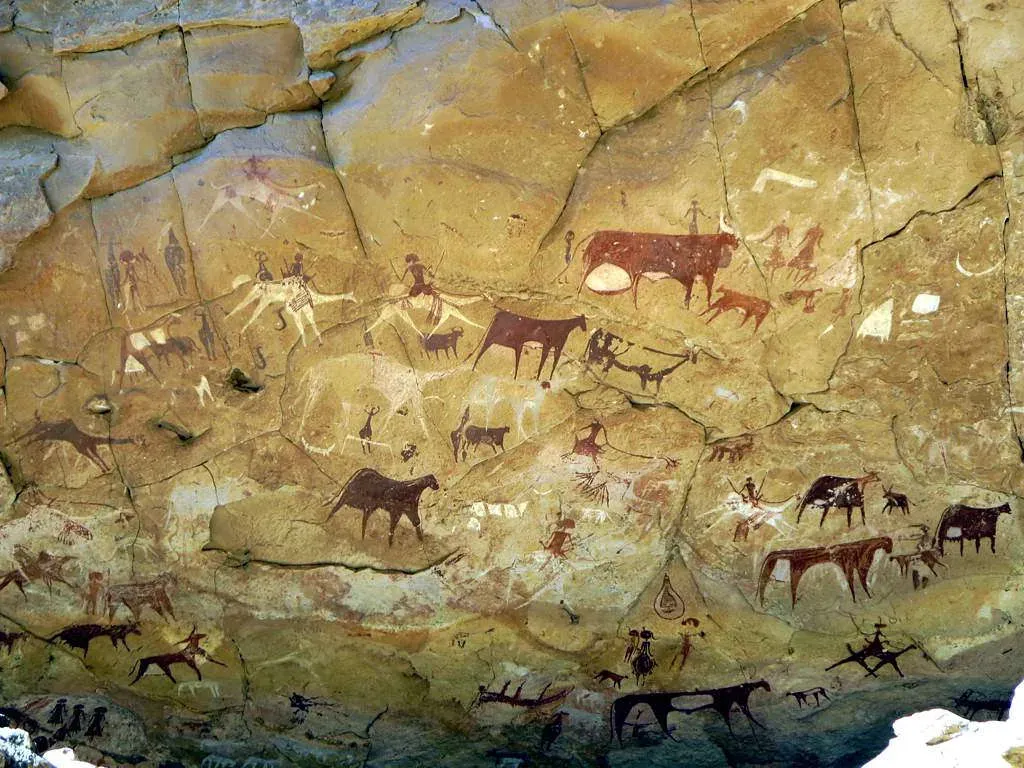
Step into Lubang Jeriji Saléh, and you are not walking into a tidy museum display; you are entering a damp, echoing limestone maze in the middle of dense tropical forest. On its walls and ceilings, researchers have recorded hundreds of images: red‑orange hand stencils, large animals that look like wild cattle, later mulberry-colored handprints with inner decorations, and finally darker, almost stick-figure humans that seem to dance or hunt. The cave is not a single frozen moment in time: it is a layered gallery, built up over tens of thousands of years as different generations kept returning to the same stone canvas. Using uranium‑series dating on thin crusts of mineral deposits that formed over the pigments, scientists estimated that one of the big animal paintings is at least about forty thousand years old, and that the earliest phase of red‑orange hand stencils likely falls in roughly the same window or earlier. In some analyses, one hand stencil appears to have a maximum age of more than fifty thousand years. Even if we stick to the most cautious readings, the rock art in this Borneo cave belongs to the earliest-known wave of figurative and symbolic painting on Earth, comparable to or slightly older than the famous works at European sites like Chauvet or El Castillo. That already tells us something profound: whatever sparked the urge to paint was not a local European revolution; it was part of a much broader human story.
How do we know these handprints are so old? The science of dating a ghost
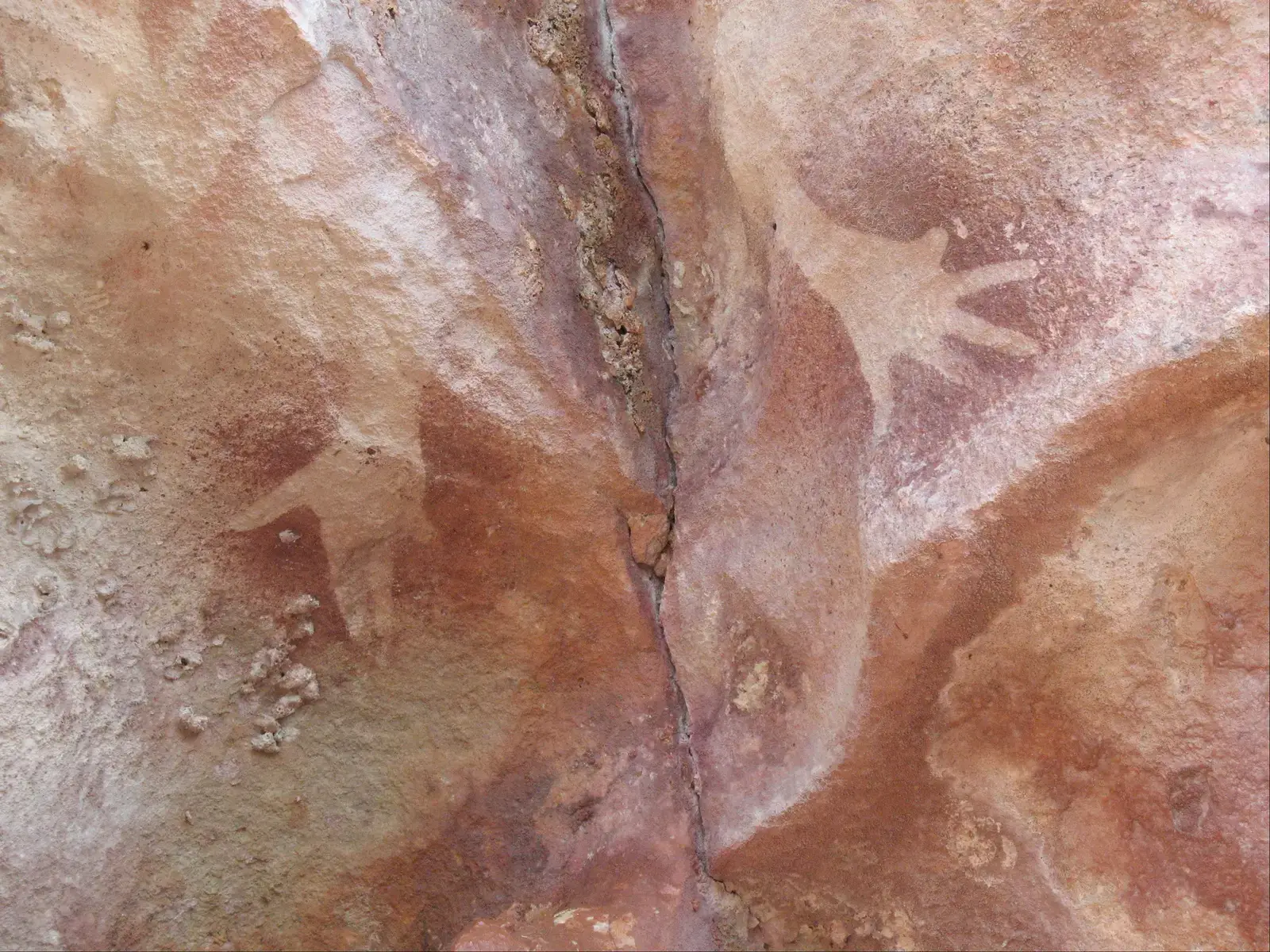
It sounds almost like magic: how do you pin a date on a faded hand outline sprayed onto rock tens of thousands of years ago, especially when you cannot directly carbon-date the pigment? The trick is not to date the paint itself, but the thin crusts of calcium carbonate that later grew over portions of it, a bit like limescale building up inside a kettle. When these mineral films formed, small amounts of radioactive uranium were trapped inside. Over time, uranium decays into thorium at a steady rate, like a built-in clock. By sampling these mineral layers with a careful laser-ablation technique and measuring the ratio of uranium to thorium, researchers can estimate when the crust formed. Because the crust overlays the art, its age sets a minimum: the painting underneath must be at least that old, and possibly much older. This approach has been used not only in Borneo but also in Sulawesi and Spain, revealing hand stencils that push the known history of rock art back far beyond what was once thought possible. It is not a perfect method – you usually get a range, and you are always talking in terms of “at least this old” – but the pattern is consistent: in Southeast Asia, people were mastering stable, deliberate painting traditions very early in our species’ story.
Asia, not just Europe: how these handprints rewrote the story of the “first artists”
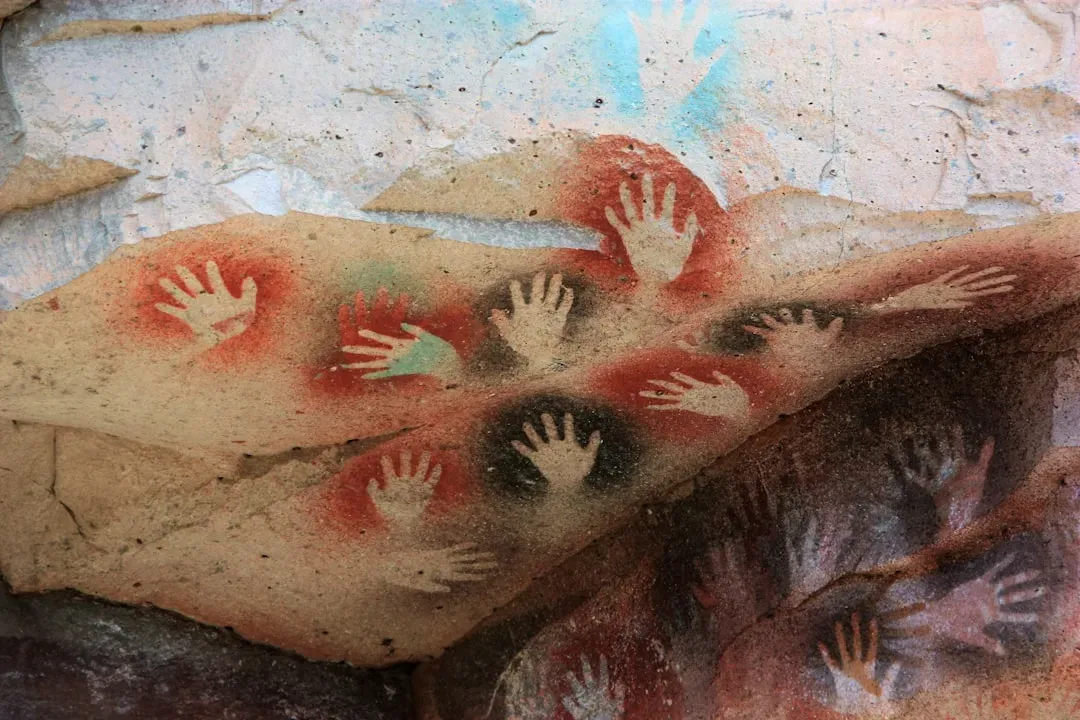
For much of the twentieth century, schoolbooks and documentaries presented a very Eurocentric tale: modern human creativity supposedly “exploded” in Ice Age Europe, with caves like Lascaux and Chauvet held up as the first great cathedrals of art. Anything outside Europe was often treated as an echo or a late flourish. The Borneo findings, alongside similar discoveries in Sulawesi and other parts of Indonesia, smashed that neat storyline. Here was a cave, cloaked in jungle thousands of kilometers from France or Spain, with paintings at least as old as Europe’s best-known examples, and a strong case that early figurative art began here just as early, if not earlier. The implication is uncomfortable for anyone who likes simple origin myths but liberating if you care about the real history of our species: artistic thinking was not a rare European mutation; it was baked into modern humans long before anyone ever walked into the Dordogne. Populations moving through Southeast Asia toward Australia were leaving intricate visual statements behind them while glaciers still loomed over northern Europe. In other words, the “first artists” were not a small band of cave geniuses in France. They were many different groups, scattered across continents, all discovering in their own ways how to turn inner images into lasting marks.
What a hand stencil really is: more than just a prehistoric selfie
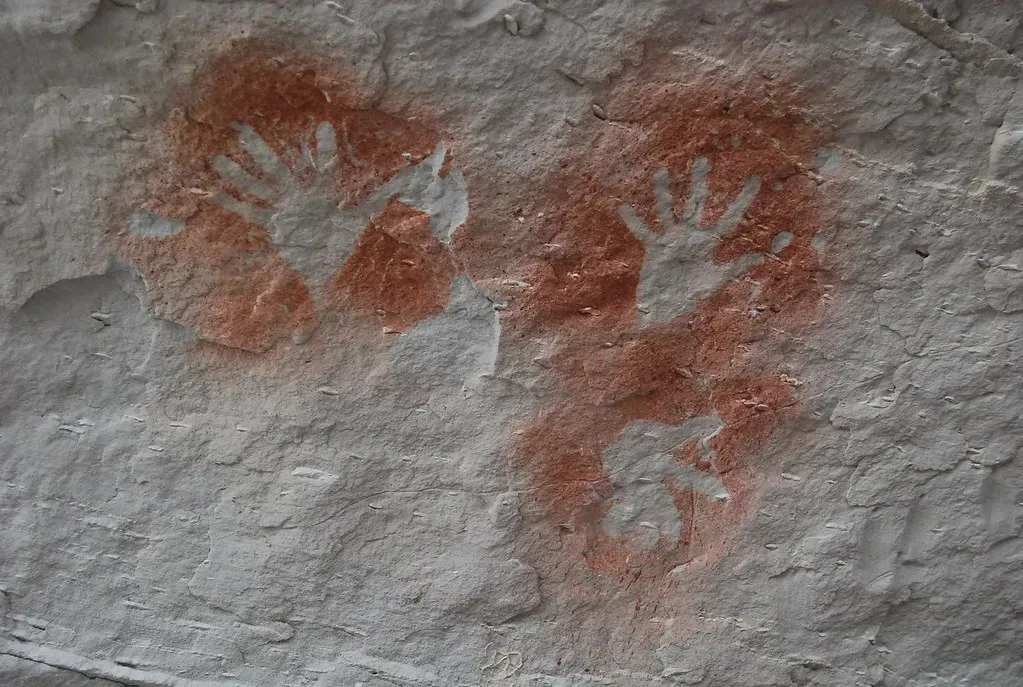
At first glance, a hand stencil can seem almost disappointingly simple. You press your hand on the wall, blow or spit pigment around it, and lift away, leaving a pale silhouette framed by color. But if you think about it, this is a deeply strange act. It requires the ability to see your own body as an object that can be represented, to understand negative space, and to think symbolically: the outline stands for the hand, and the hand stands for you. It is like a Stone Age version of tagging a wall with your handle – except your handle is your own anatomy. Psychologically, they are incredibly intimate. This is not a drawing of something “out there” like an animal or a landscape; it is a direct imprint of a person who once stood in that spot and chose to leave a trace. When I first really sat with a photo of the Borneo stencils, it felt oddly similar to finding an old handwritten note in a secondhand book: a small, personal signature that cuts through time. The people who made them were probably not thinking in terms of “art history,” but of making themselves present to their group, to their descendants, perhaps even to the spirits they believed inhabited the cave. In that sense, calling these images “prehistoric selfies” is catchy but too shallow; they look more like small, ritualized declarations of existence.
Signals, rituals, and stories: what the handprints might have meant
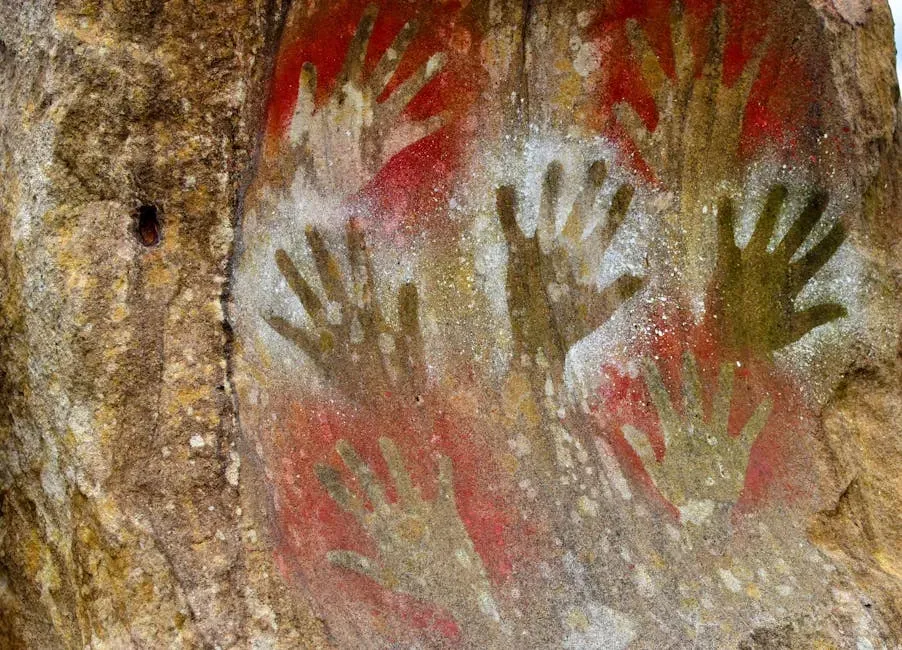
We will probably never know exactly what these specific Borneo handprints meant to the people who created them, and it would be dishonest to pretend otherwise. Still, archaeologists can make grounded guesses by looking at patterns. The hand stencils are often clustered, sometimes layered, sometimes arranged alongside animal figures or abstract marks. They tend to appear in similar ways across many regions, from Indonesia to Europe and the Americas, which suggests they filled some common human need. They might have marked membership in a group, served as a rite of passage, or functioned as a kind of signature for hunting parties or ritual gatherings. Consider how many cultures today use hands in symbolic ways: handprints in children’s art, palm marks on houses for blessing, ceremonial hand tracings in Indigenous communities. It is not hard to imagine that in a dark cave tens of thousands of years ago, pressing your hand against cool rock and seeing its ghostly outline appear in red might have felt like stepping briefly into another layer of reality. My hunch – and I admit it is an opinion, not provable fact – is that the Borneo handprints were not just casual doodles. They likely sat at the intersection of social identity, spiritual belief, and storytelling, anchoring the presence of individuals within a shared, maybe sacred, space.
Inside the Ice Age mind: planning, cooperation, and abstract thought
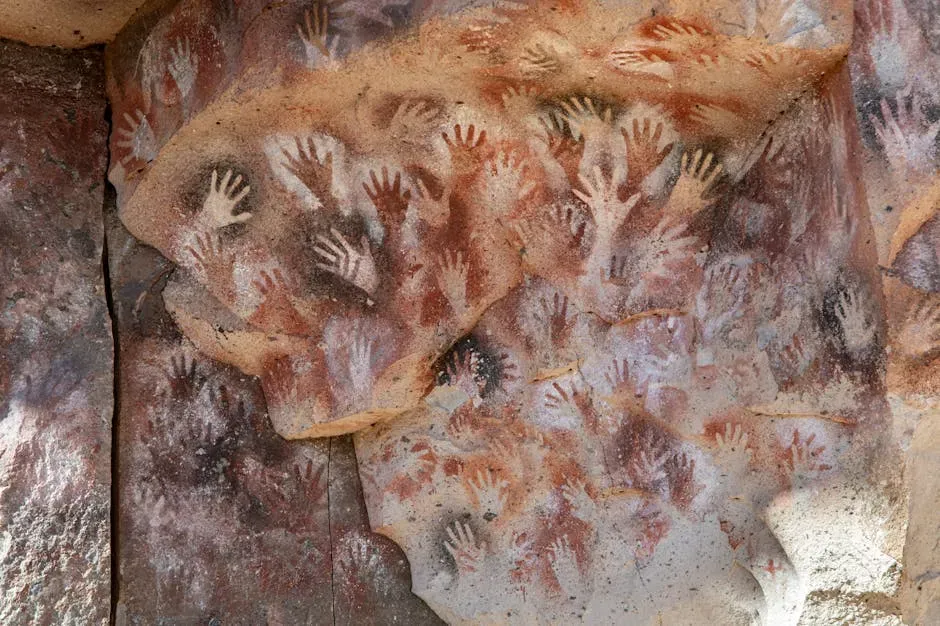
Beyond symbolism, the Borneo handprints show that their makers had some serious cognitive hardware. To produce these images, someone had to source pigment (probably iron-rich ochre), grind it, mix it with a binding liquid, and either spit or blow it through a tube over the hand. That is a multistep process involving planning, knowledge of materials, and the patience to prepare paint rather than just scratching the rock with whatever was at hand. It is not nuclear physics, but for a small foraging group living under harsh Ice Age conditions, it reveals a willingness to invest time and effort in something that is not directly about survival. This kind of artistic behavior also hints at rich social lives. Cave painting is almost always assumed to be a group activity: someone holds a torch, others watch, perhaps there is singing, storytelling, or ritual. The shifts in style over thousands of years in the same cave – from red animal figures and hand stencils to later geometric patterns and then black human shapes – suggest cultural traditions passed down, modified, and reinvented over many generations. You do not get that kind of continuity without teaching, shared norms, and a sense that “this is what our people do here.” In other words, the mental worlds of the Borneo painters were not primitive blank slates; they were full of history and inherited meaning.
What these ancient hands say about us today
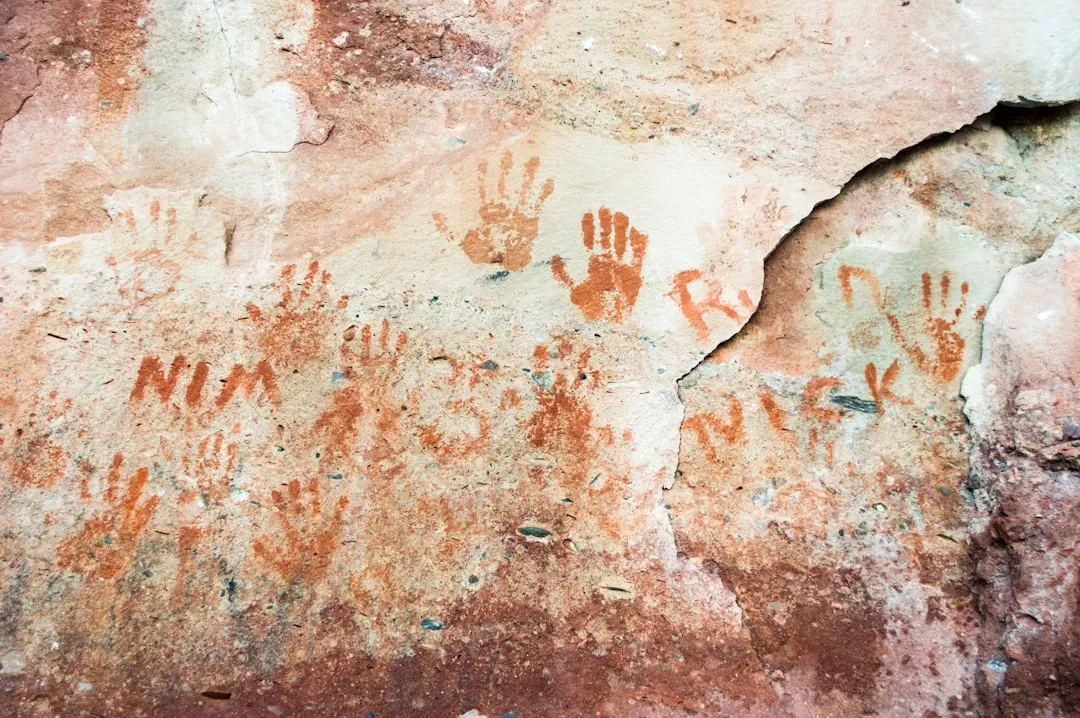
Standing in front of those hand stencils – or even scrolling past them on a screen – it is hard not to feel a jolt of recognition. The same species that leaves fingerprints on a cave wall now leaves digital traces on glass screens. The formats have changed, but the impulse is weirdly consistent: we want to be seen, to say we were here, to push back against the erasing tide of time. That continuity is, to me, the most humbling message of the Borneo cave. Those people, living in landscapes utterly unlike our urban present, were still wrestling with some of the same questions: Who am I in this group? How do we make sense of the animals we depend on and fear? How do we connect our fleeting lives to something that might outlast us? There is also a quieter lesson hiding in the science. For a long time, researchers focused their grand narratives on Europe and on whoever had the loudest academic voice. The Borneo handprints remind us that reality is much bigger and messier than one tidy story. When we finally started paying attention to caves in Indonesia with the same intensity, the picture of human creativity changed overnight. I think that should make us suspicious of any triumphalist claim that “the first” or “the greatest” anything belongs solidly to one region or culture. The past has a habit of surprising us whenever we bother to look more widely.
Conclusion: the stubborn, haunting power of a hand on stone
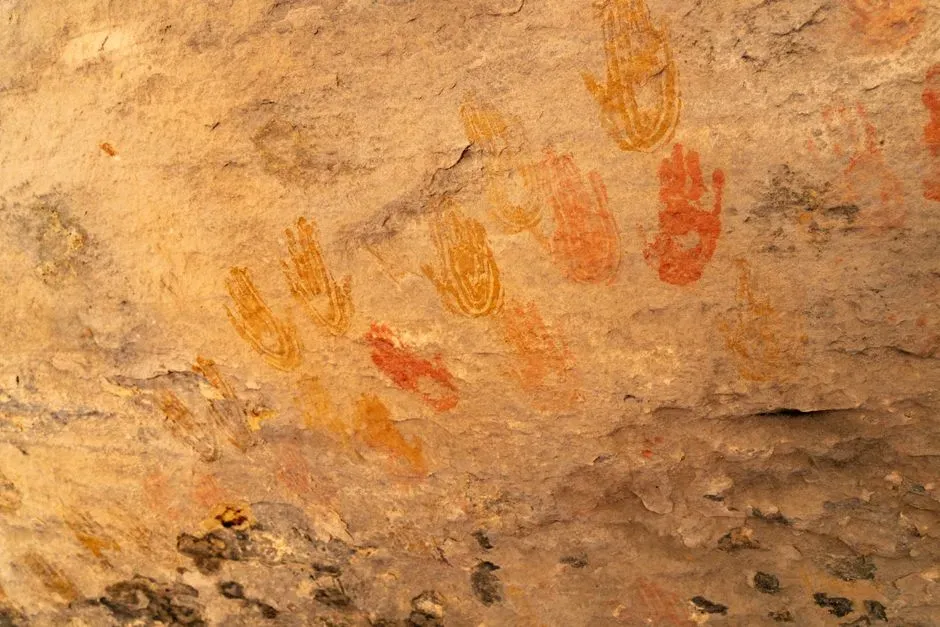
If you strip away the jargon, here is what those Borneo handprints are: stubborn marks left by people who refused to pass through the world without leaving a trace. They show that by at least forty thousand years ago – and likely earlier – humans in Southeast Asia were already thinking symbolically, crafting pigments, gathering in caves, creating images that blended body, belief, and place. In my view, they make the old idea of a uniquely European “creative explosion” look narrow at best, arrogant at worst. The urge to make meaning through images was never the property of one ice‑age tribe; it was a shared inheritance of our species. Personally, I find that oddly comforting. Somewhere in a jungle cave, far from the cities and screens that define our age, a ghostly hand still reaches out of the rock, as fresh and quiet as the day its owner sprayed ochre around their fingers. They knew nothing of us, yet what they did speaks directly to who we are. The next time you catch yourself taking a photo “just to prove you were there,” you might remember that you are part of a very old habit. Would you ever have guessed that the instinct behind your latest snapshot once meant kneeling in the dark, pressing your palm to stone, and breathing color into the void?