A dramatic BBC Reel clip from the Walking with Dinosaurs series captures the tense standoff between a Utahraptor pack and a Gastonia herd in Early Cretaceous Utah. The footage reveals how the pack leader employed a clever distraction to expose a vulnerable target, underscoring the high-stakes survival dynamics of prehistoric predators. Scientists have long speculated on the hunting prowess of these massive dromaeosaurs, and this recreation brings their strategies to life amid semiarid landscapes teeming with herbivores.
A Giant Among Raptors Emerges
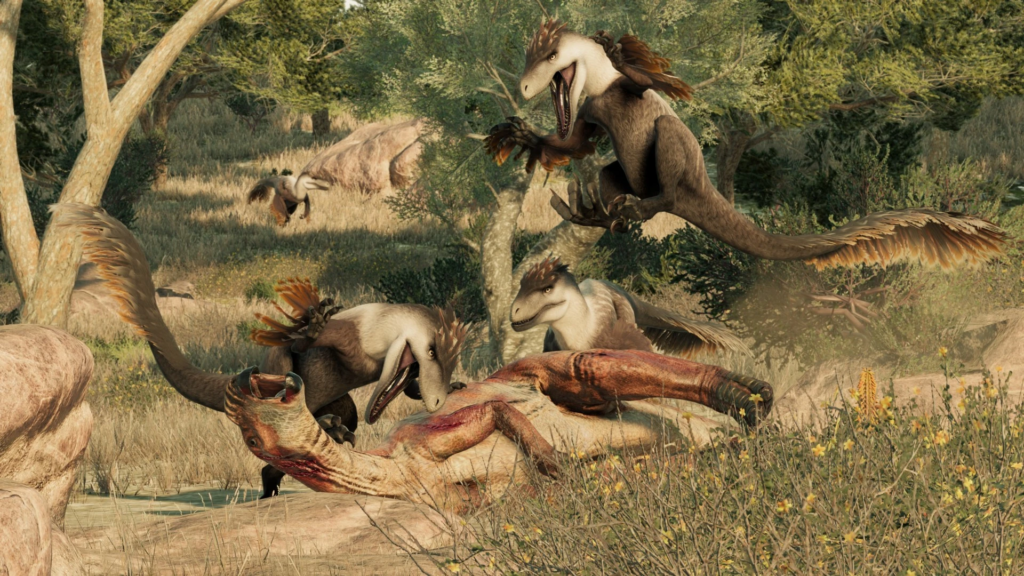
A Giant Among Raptors Emerges (Image Credits: Reddit)
Utahraptor stood as one of the largest dromaeosaurids ever unearthed, reaching lengths of 6 to 7 meters and weights approaching 500 kilograms. Paleontologists discovered its remains in the 1970s and 1990s within Utah’s Cedar Mountain Formation, naming the species Utahraptor ostrommaysi in 1993 after key researchers. This find challenged earlier views that sickle-clawed raptors remained small until later eras.
The dinosaur’s build emphasized power over speed. Its boxy skull housed serrated teeth suited for gripping, while the hallmark second-toe claw measured nearly 24 centimeters – ideal for slashing prey. Feathers likely covered much of its body, aiding in display or insulation, much like its smaller relatives. Fossil evidence from multiple age groups at one site hints at social behavior, possibly group living or cooperative efforts.
Gastonia’s Impenetrable Armor
Gastonia presented a nightmare matchup for any predator, armored head to tail with osteoderms and spikes. This nodosaurid measured 5 to 6 meters long and weighed nearly 2 tons, its body shielded by neck rings, thoracic spikes, and a fused pelvic plate. Large recurved thorns along its flanks deterred close approaches, complemented by a flexible tail for whipping threats.
These defenses proved effective in the shared Yellow Cat Member environment, where Gastonia grazed amid riverine forests and open prairies. Lacking a tail club like some kin, it relied on passive bulk and active maneuvers to survive encounters with carnivores. Herds offered further protection, forcing attackers to isolate individuals.
The Art of the Distraction Kill
In the BBC recreation, the Utahraptor pack leader boldly distracted a Gastonia from the herd, creating an opening for a stealthy flank attack. Another raptor capitalized by flipping the armored dinosaur, exposing its underbelly for a fatal strike. This tactic showcased intelligence over brute force, turning the Gastonia’s strengths into vulnerabilities.
Such strategies aligned with Utahraptor’s anatomy. The killing claw delivered devastating punctures, while strong legs pinned victims. Pack dynamics amplified success against larger prey, echoing modern wolf hunts but scaled to dinosaur proportions.
| Feature | Utahraptor | Gastonia |
|---|---|---|
| Length | 6-7 m | 5-6 m |
| Weight | ~500 kg | ~1,900 kg |
| Key Weapon | Sickle claw | Spikes & shield |
Thriving in a Savage Ecosystem
The Cedar Mountain Formation offered a mosaic of habitats – floodplains, conifer groves, and seasonal rivers – where Utahraptor navigated wet-dry cycles around 135 million years ago. It coexisted with iguanodonts like Hippodraco, sauropods such as Cedarosaurus, and fellow theropods, positioning itself near the top of the food chain.
Survival demanded versatility. Utahraptor likely ambushed herbivores, using its grip and claws to dispatch them swiftly. Evidence suggests it scavenged or trapped prey in soft sediments, bolstering group survival rates.
- Robust build for tackling large game
- Feathered for thermoregulation
- Serrated teeth for tearing flesh
- Possible social structure for cooperative hunts
- Signature 24 cm claw for precision kills
Key Takeaways
- Utahraptor redefined raptor scale, proving giants could wield deadly precision.
- Pack tactics overcame Gastonia’s armor through distraction and teamwork.
- Early Cretaceous Utah fostered intense predator-prey arms races.
Utahraptor’s legacy endures as Utah’s state dinosaur, with a dedicated state park highlighting its dominance. These ancient hunters remind us that in nature’s brutal arena, cunning often decided life or death. What prehistoric tactic fascinates you most? Share in the comments.