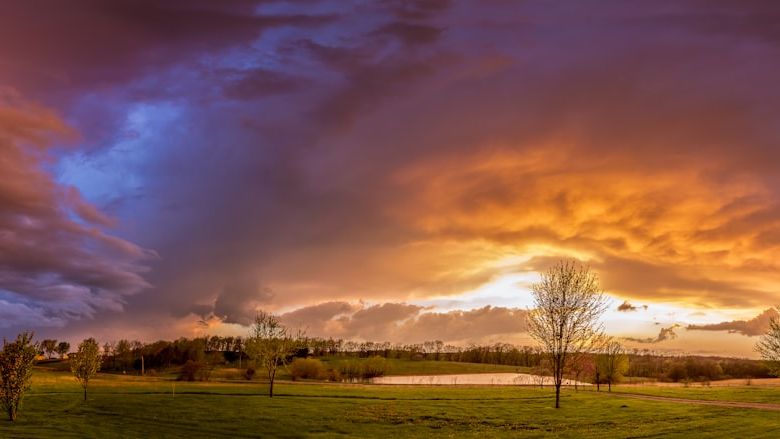
Everyone has that one kind of day where the sky feels oddly personal, like the atmosphere is secretly tuned to your inner radio. Maybe you feel most alive when thunder rattles the windows, or strangely peaceful when fog blurs the world into soft edges. This is more than poetic coincidence; our brains are wired to respond to light, temperature, sound, and color in surprisingly consistent ways, which is why certain weather patterns tend to resonate with certain emotional personalities.
Of course, you are more complicated than a forecast. Still, thinking about which weather feels like “you” can be a surprisingly sharp mirror: it reveals how you handle change, how you regulate feelings, and what kind of energy you bring into a room. As you read through these weather archetypes, notice where you feel called out, comforted, or a little exposed. By the end, you might see your emotional climate more clearly – and maybe even learn how to work with it instead of fighting it.
Sunny and Clear: The Quiet Optimist

When the sky is clear, the sun is bright, and everything looks high-definition, some people feel like they have finally stepped into their natural habitat. If you are the type who instinctively searches for the bright side, even in stressful situations, you probably resonate with sunny weather. Research on mood and light exposure shows that natural daylight tends to boost alertness and positive affect for many people, and sunny-personality types often act like walking daylight for those around them. You may be that friend others text when they are spiraling, because you are good at offering perspective without pretending everything is perfect.
But being sunny does not mean you are naive or shallow. Often, sunny emotional types are painfully aware of what can go wrong; they simply decide to invest their energy in what can go right. Like days with crisp blue skies, your presence can make things feel simpler and easier to navigate, even when the underlying problems are complicated. The challenge for you is allowing yourself “cloudy moments” without feeling like you have failed your role as the happy one. Just as no place on Earth has endless sunshine without break, your emotional ecosystem needs rest, shade, and days when you do not have to light up the whole room.
Overcast and Mild: The Thoughtful Realist

Some people feel most at home under a soft gray sky, when the brightness is dialed down and colors look muted but gentle. If this is you, you might be a thoughtful realist: not negative, not exactly cheerful, but deeply grounded. Overcast emotional personalities tend to see life in nuanced shades, like a long, quiet afternoon that never quite turns dramatic. You are the person who asks the uncomfortable – but necessary – questions, and who notices the tiny details that everyone else rushes past.
Psychologically, environments with diffused light and lower visual intensity can invite introspection; many people find it easier to focus or self-reflect when they are not overstimulated by extreme sun or storm. This fits your personality: you do not need fireworks to be engaged, you need substance. The risk is that others might misread your calm, understated vibe as disinterest or low mood. In reality, your emotional weather is steady and temperate, capable of holding complexity without swinging to extremes. You thrive in conversations that go a layer deeper, where people admit that things are not black-and-white – and you often become the safe harbor for those who are tired of pretending everything is either sunshine or chaos.
Thunderstorms: The Intense Empath

If you feel weirdly energized when the sky turns dark, the wind picks up, and thunder rumbles in the distance, you might be a storm personality. Emotionally, you run deep and intense; you do not just dip a toe into feelings – you dive. These are the people who feel music in their bones, who get goosebumps during movie scenes that barely register for others, and who can shift from laughter to tears in the same conversation without it feeling fake. Your inner world has lightning: sudden flashes of insight, passion, or anger that illuminate everything in an instant.
There is a psychological angle here too: people with strong emotional reactivity often notice their heart rate, breathing, and body sensations more vividly, which can mirror the way a thunderstorm makes the air feel electric and alive. You probably hate emotional small talk and prefer real, raw honesty, even when it is messy. The downside is that your intensity can feel overwhelming – to others and sometimes to yourself. Learning grounding strategies, boundaries, and pacing your emotional thunder is crucial, not to become “less,” but to avoid burning yourself out. Remember, storms are not just destructive; they also clear the air and water the ground. Your emotional power, used wisely, can be incredibly healing and transformative.
Gentle Rain: The Sensitive Nurturer

There is a certain kind of person who comes alive when it is raining softly, when the world sounds muffled and cozy and the air smells like wet earth. If this is your favorite kind of day, you may be a gentle-rain personality: highly sensitive, deeply caring, and quietly resilient. Soft rain has a regulating effect on many people – it creates a repetitive, soothing sound and encourages slower movement, both of which can help the nervous system calm down. Likewise, you often bring a calming, regulating presence to others, especially during emotional chaos.
You might be the friend who remembers birthdays, follows up on that offhand comment about someone not sleeping well, and quietly checks if everyone ate something at the party. You do not necessarily crave the spotlight; you prefer to create little pockets of safety and comfort, like a steady drizzle that nourishes without demanding applause. The challenge is that your sensitivity can make you prone to emotional overload, especially if you absorb everyone else’s problems without boundaries. You are most balanced when you combine your natural tenderness with firm self-care – like rain that nourishes the soil but knows when to stop before it turns into a flood.
Snowy and Still: The Reflective Introvert

When snow falls and the world turns quiet, many people feel uneasy or restless – but not you. If you are drawn to snow-blanketed streets, frosty windows, and that particular silence after a storm, you might be a snow personality: contemplative, introspective, and surprisingly strong beneath the surface. Snow changes how sound travels, absorbing noise and making everything feel hushed. In a similar way, your emotional style tends to filter out chaos; you often pull back from drama, preferring solitude or small, meaningful interactions.
There is something paradoxical about snow: it looks soft and delicate, yet it can be harsh and demanding when you are unprepared. People like you can seem gentle or distant on the outside, but you often have a backbone of steel when it really counts. You use quiet not as an escape, but as a tool for thinking, processing, and recharging. The risk is that others may interpret your need for space as coldness, when in reality it is how you stay emotionally honest and sane. Owning your preference for depth over constant connection – and finding people who respect that – is what makes your inner winter landscape not lonely, but peaceful.
Fog and Mist: The Dreamy Intuitive

Foggy mornings and mist-covered fields do something magical to some people’s minds. If you feel pulled toward that hazy, surreal vibe, you might resonate with the fog archetype: intuitive, imaginative, and comfortable with ambiguity. Fog obscures sharp lines and clear edges, which mirrors how you tend to think and feel. You often sense undercurrents in a room before anyone says a word, and you may find yourself daydreaming or drifting into creative ideas without fully knowing where they came from.
From a psychological standpoint, people with strong intuitive and imaginative traits often excel at pattern recognition, symbolic thinking, and creative problem-solving, even if they struggle with rigid routines or overly concrete tasks. Emotionally, you might find it easier to live in the in-between rather than commit to a single clear path. This is your gift and your challenge: while your vision can be profound, you may also battle with indecision or a sense of floating. Grounding habits – journaling, art, nature walks, or even simple lists – can act like beams of light in your personal fog, not to burn it off completely, but to help you move through it more confidently.
Windy and Unpredictable: The Energetic Free Spirit

If strong winds make you want to open all the windows, step outside, and feel your hair whip around, there is a good chance your emotional weather leans toward the windy side. Wind personalities are restless, curious, and change-loving. You thrive on movement: new ideas, new people, new challenges. Just as gusts can shift direction quickly, your moods and interests might pivot fast, which can feel exhilarating to some and exhausting to others. You are usually the first to suggest a spontaneous trip or a bold shift when things start to feel stale.
From an emotional regulation lens, high-energy individuals often have nervous systems that crave stimulation and novelty, which can be a superpower in creative, entrepreneurial, or fast-changing environments. At your best, you bring fresh air into stagnant situations, blowing away outdated assumptions and injecting life into group dynamics. The flip side is that consistency and follow-through may not come as naturally; you might struggle to stay with long, slow processes once the initial excitement fades. Your growth edge is learning how to channel your gusts into sustainable momentum – like wind turning turbines – so your energy not only shakes things up, but actually powers meaningful change.
Changing Seasons: The Adaptive Chameleon

Maybe you read all of the above and thought, annoyingly, that you kind of fit each one depending on the day. If that is you, might be best described as seasonal. You move through inner winters, springs, summers, and autumns with a natural rhythm, and you do not pretend to feel the same every week of the year. In psychology, emotional flexibility – being able to adapt your responses to different situations – is linked with better mental health than chasing constant happiness. Season-type personalities embody this: they instinctively adjust their outlook, pace, and energy depending on what life demands.
On some days, you are full-sun bold and social; on others, you are foggy and inward, or quietly reflective like a snowy night. At first, this can make you feel inconsistent or hard to pin down, especially in a world that loves fixed labels. In reality, your strength is your responsiveness. You are like a climate system that knows when to rest, when to grow, when to shed, and when to bloom. The key is to recognize your patterns and honor them, instead of forcing yourself into a permanent season to please other people. When you stop apologizing for your cycles and start working with them, your life begins to feel less like chaos and more like a rhythm that finally makes sense.
Conclusion: Owning Your Inner Forecast

If there is one thing I have noticed – in my own life and in people around me – it is that we often judge our emotional weather instead of listening to it. Sunny types get told they are too naive, stormy types too dramatic, foggy types too vague, seasonal types too inconsistent. But just like actual weather, these emotional climates serve a function. They shape how we connect, how we protect ourselves, and how we move through a world that is not exactly gentle. Instead of aiming for a single “ideal” state, it makes far more sense to understand your natural pattern and build a life that respects it.
That might mean setting firmer boundaries if you are a gentle rain, finding grounding practices if you are a windstorm, or giving yourself scheduled solitude if you are snow. None of these patterns are superior; they simply fit differently with different environments and people. The most powerful shift is this: moving from fighting your emotional weather to collaborating with it. Once you do that, you stop asking why you are not sunnier or calmer or more consistent and start asking a better question: given the sky I carry inside, how can I live in a way that actually suits me? So, if you had to choose right now – what does your emotional forecast really look like?