North Carolina coast – Partial remains of a 4-year-old North Atlantic right whale named Division floated amid scavenging sharks in late January, confirming the first confirmed death of the species in nearly two years.
A Youth Marked by Repeated Perils
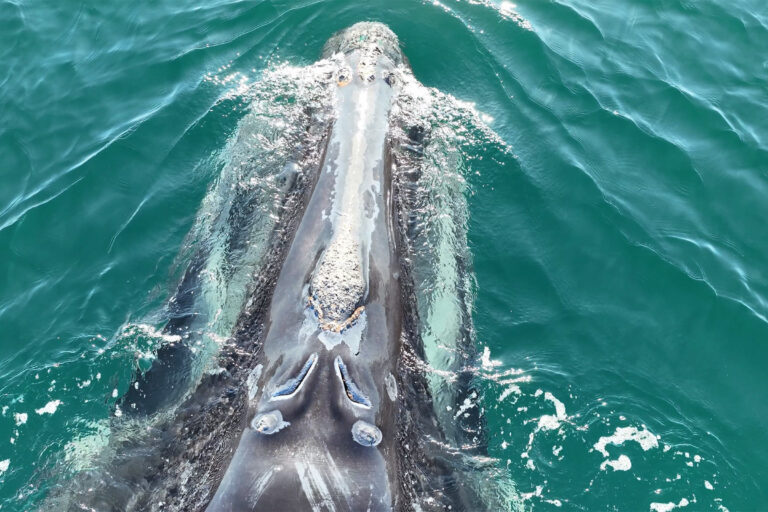
A Youth Marked by Repeated Perils (Image Credits: Imgs.mongabay.com)
Division entered the world in December 2021 as the youngest of four siblings born to mother Silt, catalog number 1817. Scientists named him in 2025 after a distinctive callosity pattern on his head that resembled the mathematical division symbol. He frequented Cape Cod Bay annually, following his mother, and even prompted a 21-hour closure of the Cape Cod Canal in March 2023 when he traversed much of its length.
Despite his tender age, Division endured three prior entanglements. Observers spotted him in July 2025 in the Gulf of St. Lawrence without gear. His familiarity with New England waters and beyond highlighted the wide-ranging life of these giants, yet also exposed him to persistent dangers from human activities.
The Snare That Proved Fatal
On December 3, 2025, aerial surveys off Jekyll Island, Georgia, revealed Division ensnared in fishing rope wrapped tightly around his head and mouth. The line cut deeply into his blowhole and embedded in his upper jaw, signaling a prolonged ordeal. This marked his fourth documented entanglement, a grim statistic for such a young whale.
Response teams mobilized swiftly. The next day, experts from NOAA Fisheries, the Georgia Department of Natural Resources, and the Florida Fish and Wildlife Conservation Commission, aided by the Clearwater Marine Aquarium Research Institute, conducted a partial disentanglement near St. Simons Island. They severed a key line over his head and blowholes, but complex gear remained, and harsh weather thwarted further efforts.
Tracking a Declining Giant
Telemetry tracked Division northward into New England waters before he turned south again. Aerial teams last confirmed him alive on January 21 off Cape Hatteras, where his body showed clear decline: emaciation, whale lice patches, and lingering gear. Scientists at the New England Aquarium’s Anderson Cabot Center noted worsening injuries.
On January 27, a Clearwater Marine Aquarium survey spotted his partial carcass 25 miles offshore near Avon, surrounded by over 20 sharks. NOAA Fisheries verified the identity on January 30. Dangerous seas prevented recovery or necropsy, though authorities analyzed retrieved gear to trace its origin.
Threats Loom Large for a Fragile Population
North Atlantic right whales number around 380, with just 72 reproductive females, making every individual vital. Entanglements and vessel strikes dominate as causes of mortality, with over 1,900 cases recorded since 1980 affecting 87 percent of the population.
- Entanglements drag whales down, hinder feeding, and cause fatal infections.
- Vessel strikes deliver blunt trauma at high speeds.
- Climate shifts alter prey distribution, pushing whales into riskier zones.
- Despite 21 calves this season – the most in 15 years – losses outpace births.
“While this outcome is not a surprise given the severity of the entanglement, it’s still incredibly disheartening to bear witness to the death of a critically endangered right whale,” stated Heather Pettis, senior scientist at the New England Aquarium. Experts urge ropeless gear, weaker ropes, and vessel slowdowns to avert such tragedies.
Key Takeaways
- Division’s death marks the first right whale fatality since May 2024, amplifying extinction risks.
- Partial rescues extend suffering but underscore prevention’s urgency.
- Innovations like on-demand fishing gear offer proven paths to recovery.
Division’s story reveals how one whale’s journey – from Cape Cod canals to Carolina currents – intersects with human impacts. Conservationists emphasize that tools exist to prevent these losses, yet implementation lags. What measures would you prioritize to save North Atlantic right whales? Share your thoughts in the comments.