
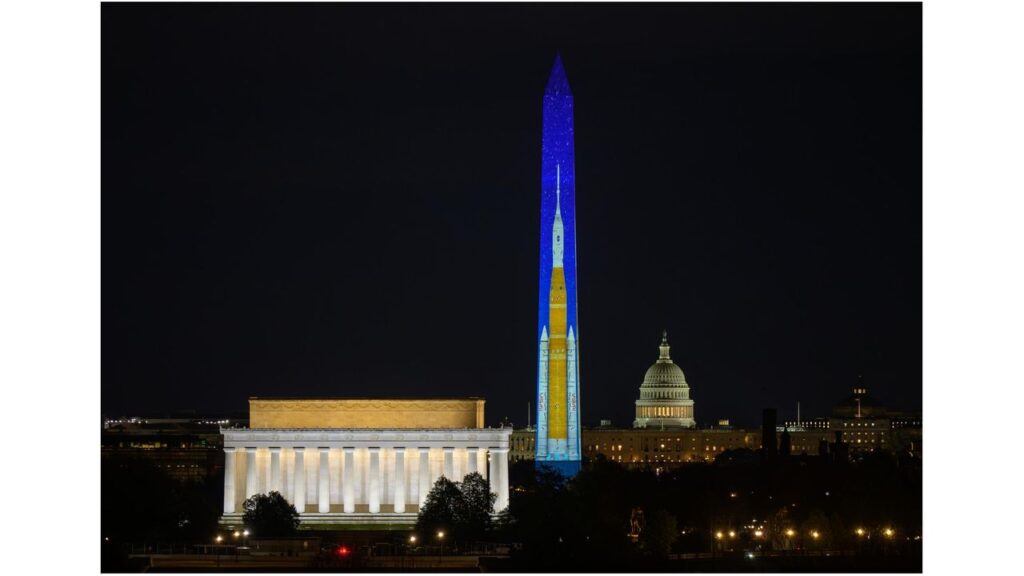
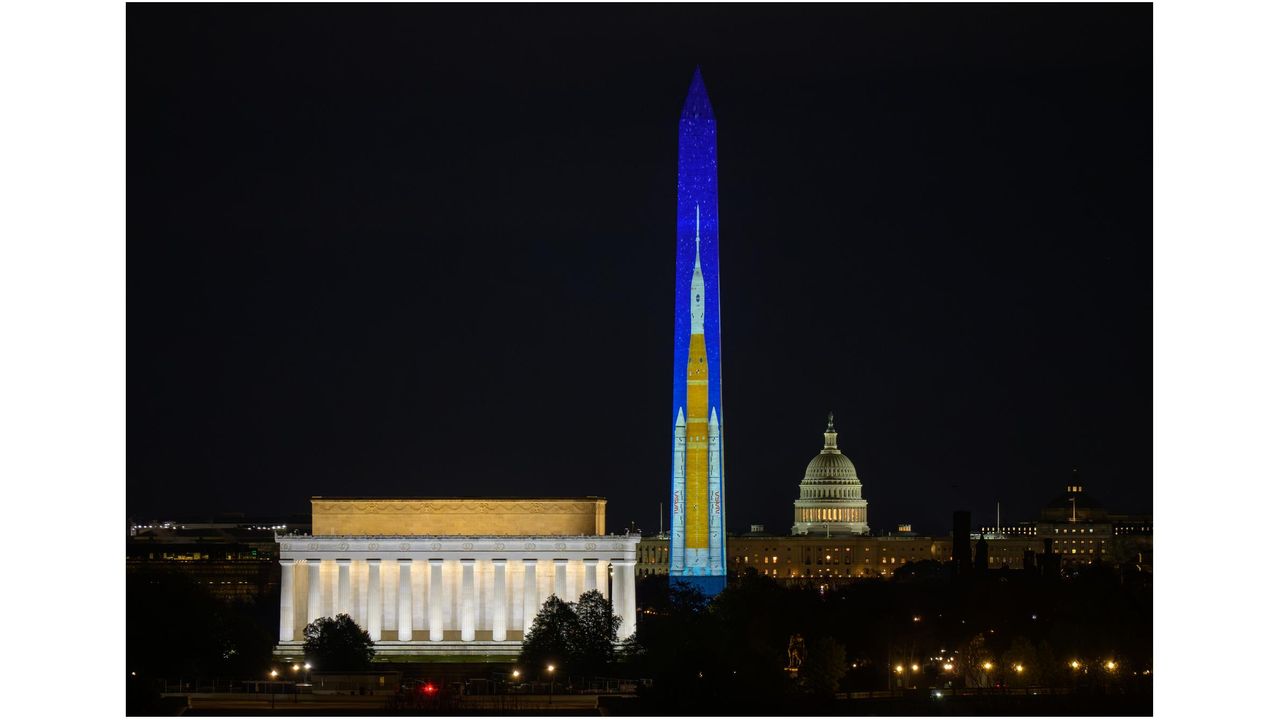
A Night of Illumination and Inspiration (Image Credits: Cdn.mos.cms.futurecdn.net)
Washington, D.C. – As the nation anticipates NASA’s next giant leap toward the moon, the Washington Monument transformed into a glowing tribute to the Artemis 2 mission on New Year’s Eve.
A Night of Illumination and Inspiration
The iconic obelisk, standing tall on the National Mall, served as a canvas for a projected image of the Space Launch System rocket, depicted as a massive candle with a flickering flame. This display marked exactly one month before the planned liftoff of Artemis 2, stirring excitement across the capital. Crowds gathered under the chilly winter sky, watching the monument light up in hues that evoked the vastness of space. The event blended historical reverence with futuristic ambition, drawing parallels between America’s founding ideals and its enduring quest for exploration.
Organizers timed the spectacle to coincide with the 250th anniversary of the Declaration of Independence, underscoring themes of innovation and unity. The projection lasted for several minutes, captivating onlookers who captured the moment on their devices. This visual homage not only celebrated the astronauts but also reminded viewers of the mission’s role in humanity’s return to lunar orbit. As the lights faded, applause echoed through the mall, signaling a collective sense of anticipation.
The Artemis 2 Mission at a Glance
NASA’s Artemis 2 stands as the agency’s first crewed flight in the program designed to establish a sustainable presence on the moon. The mission will send four astronauts – Reid Wiseman, Victor Glover, and Christina Koch from NASA, along with Jeremy Hansen from the Canadian Space Agency – on a 10-day journey around the moon without landing. Scheduled for launch no earlier than February 6 from Kennedy Space Center in Florida, the flight will test the Orion spacecraft and Space Launch System rocket in deep space for the first time with humans aboard. This step follows the successful uncrewed Artemis 1 mission in 2022, which validated key systems during its lunar loop.
The crew’s path will take them farther from Earth than any previous human mission, covering about 1.4 million miles in total. During the flight, the astronauts will conduct scientific experiments, capture stunning views of the lunar surface, and perform live broadcasts to engage global audiences. Engineers have completed extensive preparations, including stacking the rocket’s components and outfitting Orion with its crew module. Recent updates confirm the vehicle remains on track, though final weather and technical checks will determine the exact date.
- Launch vehicle: Space Launch System (SLS) Block 1 with Orion spacecraft
- Orbit: High-Earth orbit transitioning to lunar flyby
- Duration: Approximately 10 days
- Crew nationality mix: Three Americans and one Canadian
- Objectives: Verify life support, navigation, and reentry systems
From Preparation to Public Spectacle
Behind the scenes, teams at Kennedy Space Center prepared to roll out the full SLS rocket to Launch Pad 39B on January 17, a critical milestone in the countdown. This movement allows technicians to integrate final elements and conduct dress rehearsals for the crew. The monument’s lighting served as a public-facing counterpart to these technical efforts, amplifying NASA’s outreach. Partnerships with cultural institutions in D.C. ensured the event resonated with diverse audiences, from school groups to space enthusiasts.
The display highlighted how Artemis builds on decades of space achievements while fostering international collaboration. Canada’s involvement through Hansen exemplifies the growing coalition supporting lunar exploration. Public interest has surged, with NASA reporting increased website traffic and social media engagement since the announcement. Events like this one aim to inspire the next generation of scientists and engineers, much like the Apollo era captivated the world.
Looking Ahead to Lunar Horizons
As Artemis 2 approaches, the mission promises to reignite global wonder about space travel. It paves the way for Artemis 3, which will attempt the first human landing on the moon since 1972, targeting the lunar south pole. Challenges remain, including ensuring crew safety during the untested crewed phases, but optimism prevails among experts. The Washington Monument’s glow encapsulated this spirit, bridging past triumphs with future possibilities.
In a broader sense, the program advances technologies for Mars missions and beyond, emphasizing sustainable exploration. Viewers of the D.C. event left with a renewed appreciation for humanity’s place in the cosmos.
Key Takeaways
- Artemis 2 marks the first crewed lunar mission in over 50 years, launching as early as February 6.
- The Washington Monument projection symbolized unity between American history and space innovation.
- The mission tests critical systems for future landings and deep-space travel.
The Artemis 2 launch represents a pivotal moment in space history, reminding us that exploration unites us across generations. What are your thoughts on this return to the moon? Share in the comments below.