Walking through the dense rainforests of Southeast Asia, you might pass within meters of one of the planet’s most enigmatic predators and never know it was there. The clouded leopard moves like smoke through the canopy, a shadow with saber-like teeth and ankles that defy physics. While tigers and snow leopards capture global headlines, this spectacular feline has managed to remain almost completely hidden from human eyes, even as its world shrinks around it.
Let’s be real. Most people have never heard of this cat. Yet it’s been prowling Asian forests for millions of years, carrying secrets in its DNA that link it to ancient saber-toothed predators. What makes this creature so hard to find? Why do scientists know so little about it despite decades of research? The answers lie somewhere between the treetops and the forest floor, in a life lived almost entirely in the shadows.
A Living Ghost from Prehistoric Times
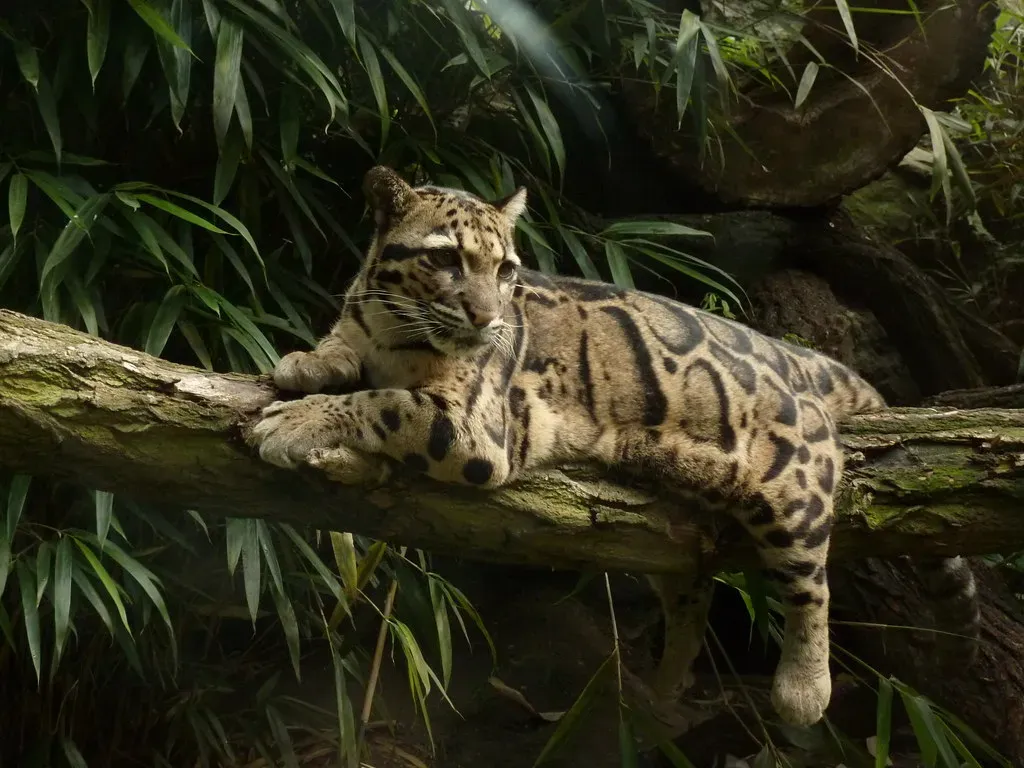
The clouded leopard branched from other members of the Pantherinae family first – over 6 million years ago, making it one of the most ancient feline species still walking the earth. Think about that for a moment. The clouded leopard is the sister taxon to other pantherine cats, having genetically diverged 9.32 to 4.47 million years ago. This cat was already evolving its unique traits when our own ancestors were just beginning to stand upright.
Here’s where it gets fascinating. Clouded leopards dwell in the cloud forests of Southeast Asia and are one of the most ancient cat species. However, they are neither a true great cat nor a true small cat, because they cannot roar or purr. They exist in their own evolutionary category, a bridge between two worlds. Scientists discovered in 2006 that what they thought was one species was actually two distinct ones, separated by millions of years of island isolation.
The Saber-Tooth Connection Nobody Saw Coming
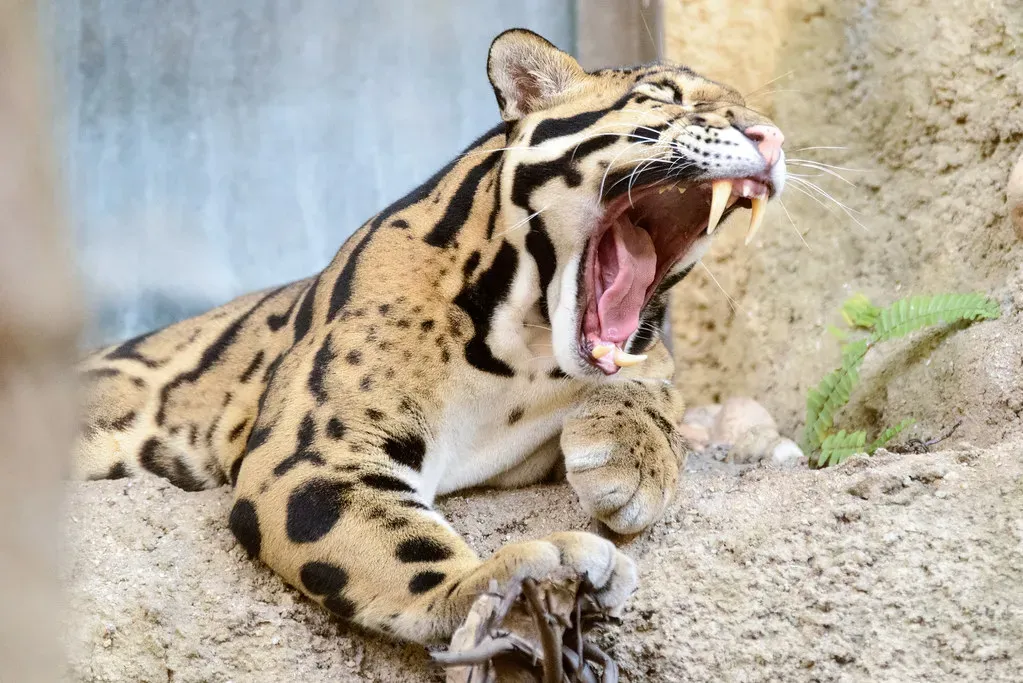
What sets clouded leopards apart from other wildcats is their long, sharp canine teeth. These canine teeth are proportionally the largest of any wild cat, reminiscent of the extinct sabertooth cat. I think this is genuinely shocking when you see it up close. While tigers are 10 times larger than them in body size, a clouded leopard’s 2-inch-long canine teeth are the same size as those of a tiger.
Research has shown that the skull of clouded leopards has a lot of similarities with that of saber-tooth cats in the Paramachairodus genus (which includes the Smilodon). Clouded leopards are also able to open their mouth at an angle of 100 degrees – just like saber-tooths. Even more remarkable, they kill differently than other big cats. Unlike most other big cats that kill their prey by biting the throat of their prey, clouded leopards kill by biting the back of the neck. This usually severs the spinal cord in one swift action. Sound familiar? That’s exactly how saber-toothed cats hunted tens of thousands of years ago.
Tree Acrobatics That Defy Gravity
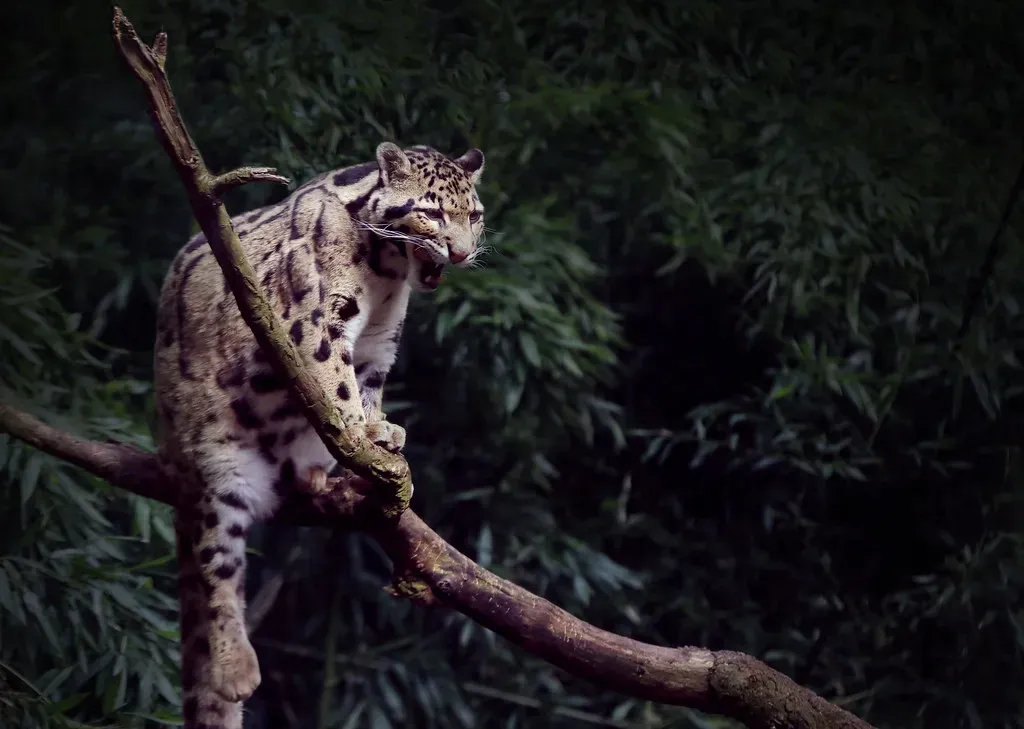
Honestly, if you told me a cat could hang upside down from tree branches using only its hind feet, I’d probably be skeptical. These big cats can even hang upside down beneath large branches, using their large paws and sharp claws to secure a good grip. Clouded leopards have short, powerful legs equipped with rotating rear ankles that allow them to safely downclimb in a headfirst posture – much like a common squirrel. No other big cat on Earth can do this.
They can descend head first down tree trunks, move along branches while hanging upside down and even hang from branches using only their hind feet enabling them to drop down and ambush prey on the ground. Their ankle joints rotate backward nearly 180 degrees, an adaptation so specialized that it seems almost impossible. It does, however, have an exceptionally long tail for balancing, which can be as long as the body itself, thick with black ring markings. Everything about their anatomy screams “built for the canopy.”
Cloud-Painted Coats and Mysterious Markings
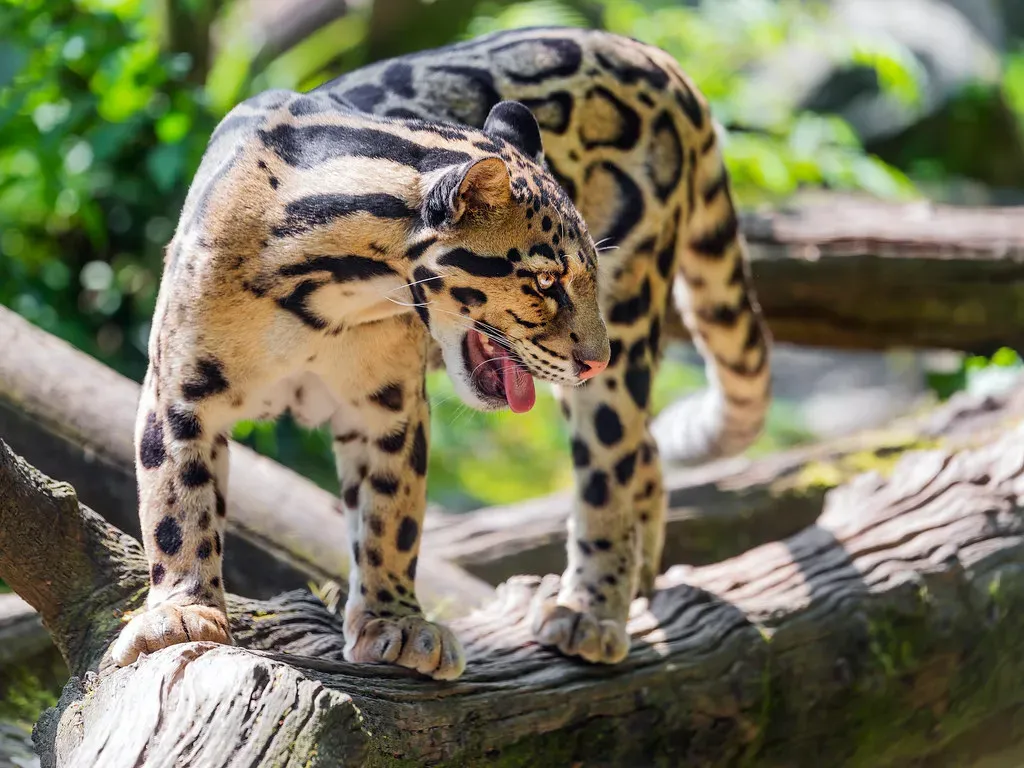
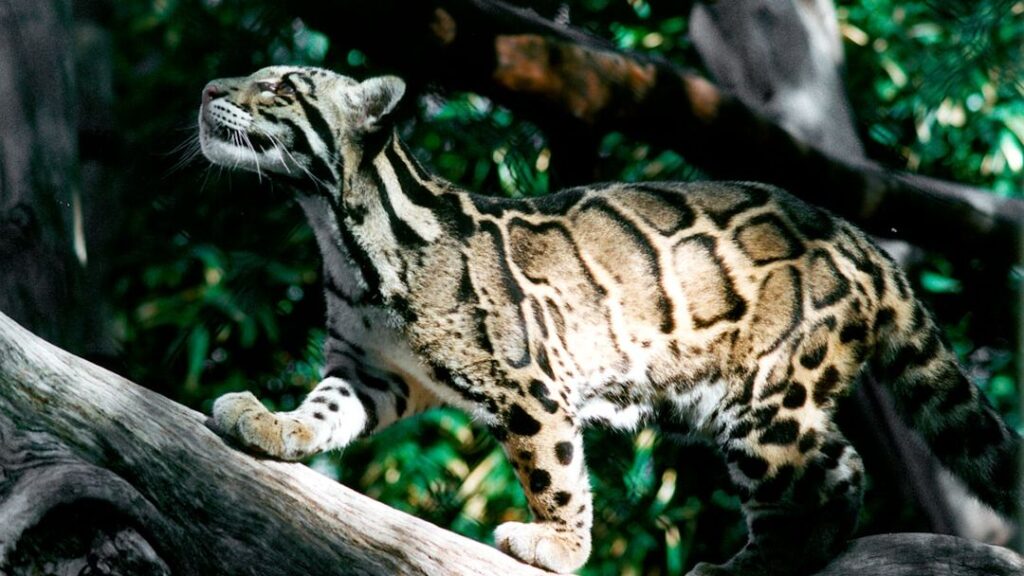
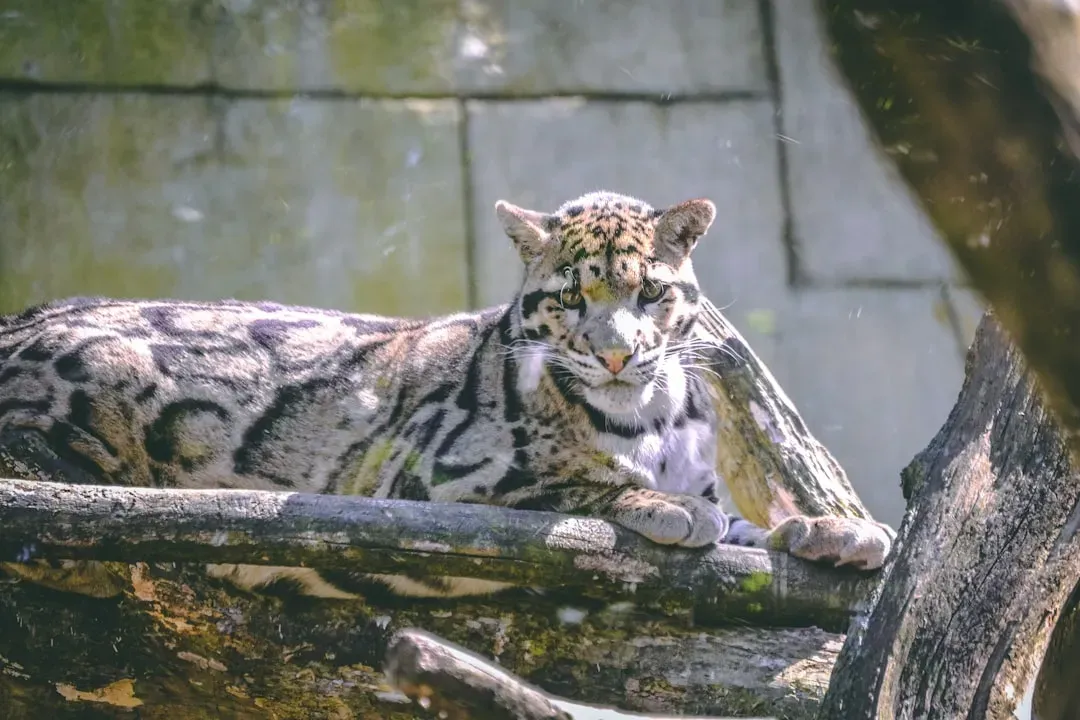
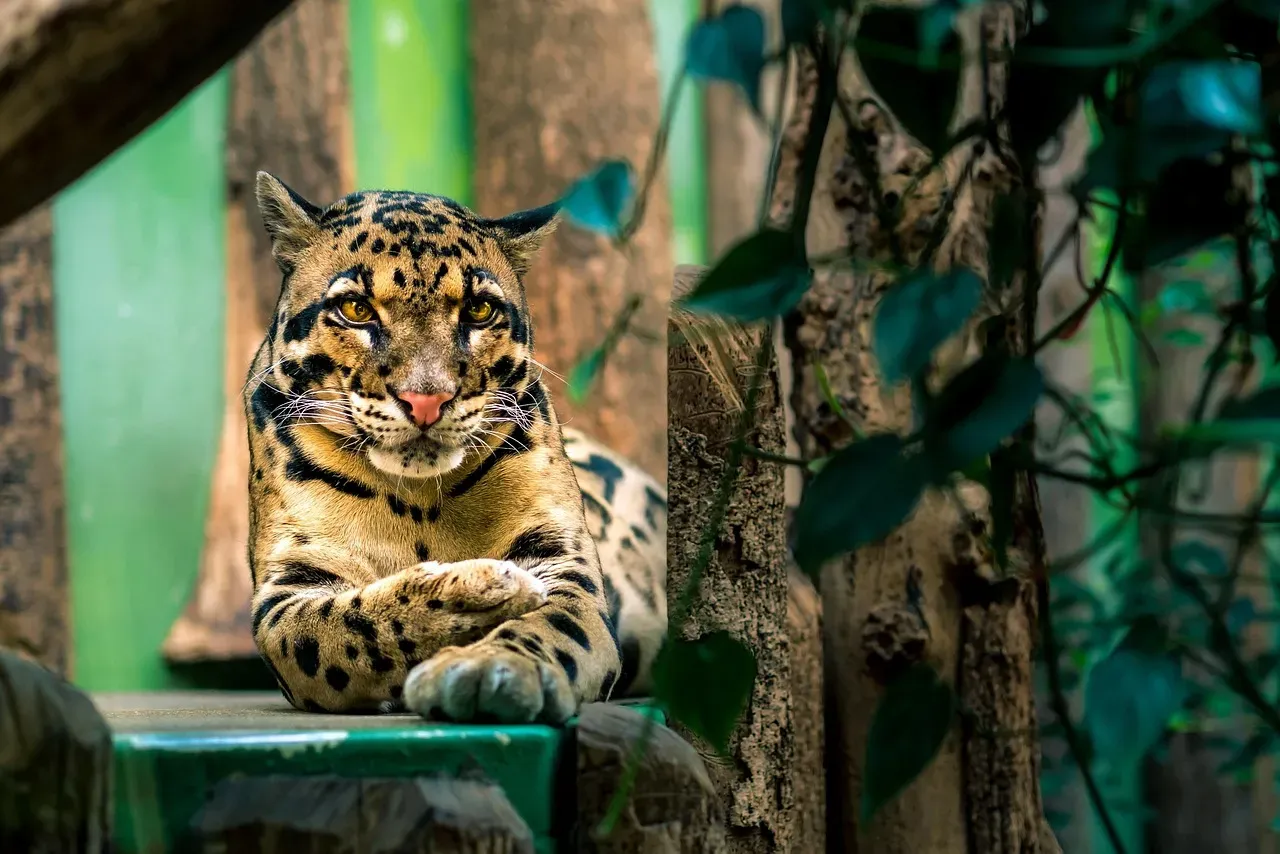
The clouded leopard is named after the distinctive ‘clouds’ on its coat – ellipses partially edged in black, with the insides a darker colour than the background colour of the pelt. The base of the fur is a pale yellow to rich brown, making the darker cloud-like markings look even more distinctive. In Malaysia, locals call them tree tigers. The Chinese have a more poetic name: mint leopards, because the spots supposedly resemble mint leaves.
These aren’t just pretty patterns. Stripes, spots, blotches or rosettes break up the outline of the cats helping them blend into their surroundings and concealing them from prey. The clouded leopards’ distinctive coloration and cloudlike spot pattern provide excellent camouflage in their forest habitat. When dappled sunlight filters through dense canopy, these cats become practically invisible. It’s hard to say for sure, but this camouflage might be one reason they’re so rarely seen in the wild.
Where Shadows Live and Hunt
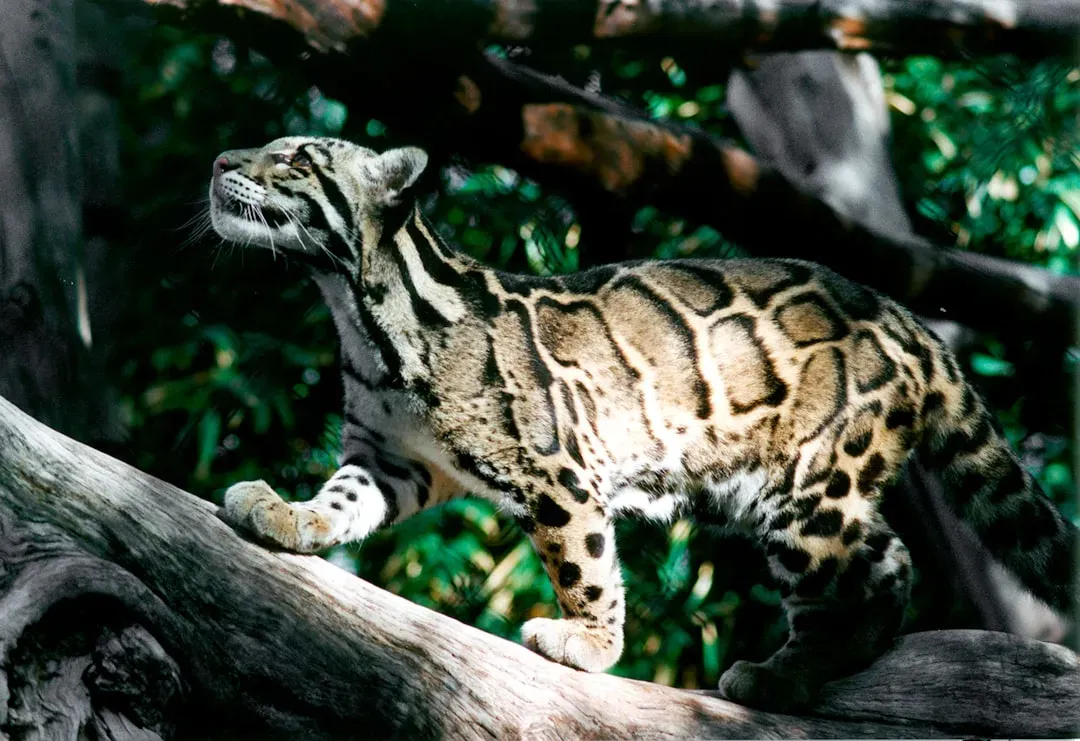
The clouded leopard (Neofelis nebulosa), also called mainland clouded leopard, is a wild cat inhabiting dense forests from the foothills of the Himalayas through Northeast India and Bhutan to mainland Southeast Asia into South China. Their range stretches across some of the most biodiverse and densely forested regions on the planet. Clouded leopards prefer to live in lowland tropical rainforests. However, they can also be found in dry woodlands and secondary forests, and in Borneo, they are reported to live in mangrove swamps. They have even been spotted in the foothills of the Himalayas at an elevation of 9,000 feet.
It rests in trees during the day and hunts by night on the forest floor. Yet recent research suggests they’re more flexible than originally believed. They are highly arboreal, using trees primarily for resting and also for hunting. However, they spend more time hunting on the ground than was originally believed. Their prey includes everything from monkeys and slow lorises to deer and wild boar, showing remarkable versatility for a medium-sized predator.
The Cat Science Barely Knows
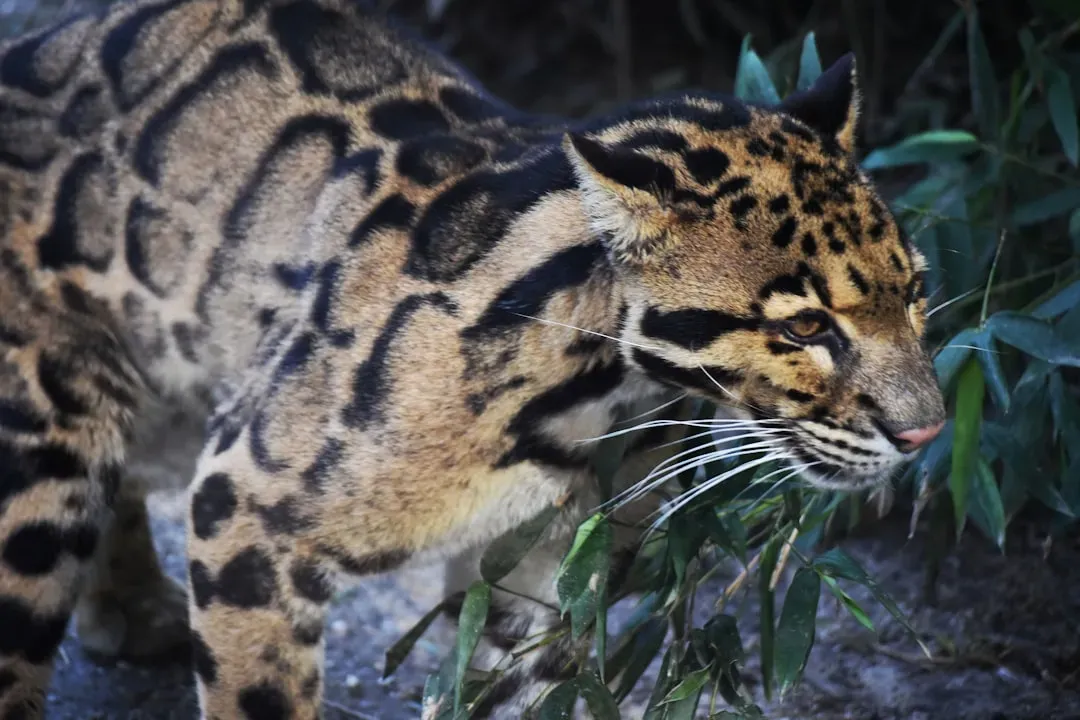
Here’s the thing that really gets me. Fewer than 10 clouded leopards in the wild have been radio-collared and studied; 90 percent of what is known about clouded leopards comes from research on captive populations. After all these years of wildlife research, we still know almost nothing about how these cats actually behave in their natural habitat. There have been very few live sightings. In fact, many forest guards and local villagers are unaware that such a cat even exists alongside the more well-known leopards and tigers.
Even after dedicating three years to conducting surveys in its habitat, we regretfully never physically saw this mysterious cat in its natural habitat. Instead, we were forced to rely only on motion-detecting camera traps to gain glimpses into the mysterious inner lives of clouded leopards. This is a researcher’s nightmare and a conservationist’s challenge. How do you protect something you can barely find? Recent studies in Manas National Park identified only 12 individual clouded leopards after years of intensive camera trapping, highlighting just how elusive these cats truly are.
Vanishing Faster Than We Can Count Them
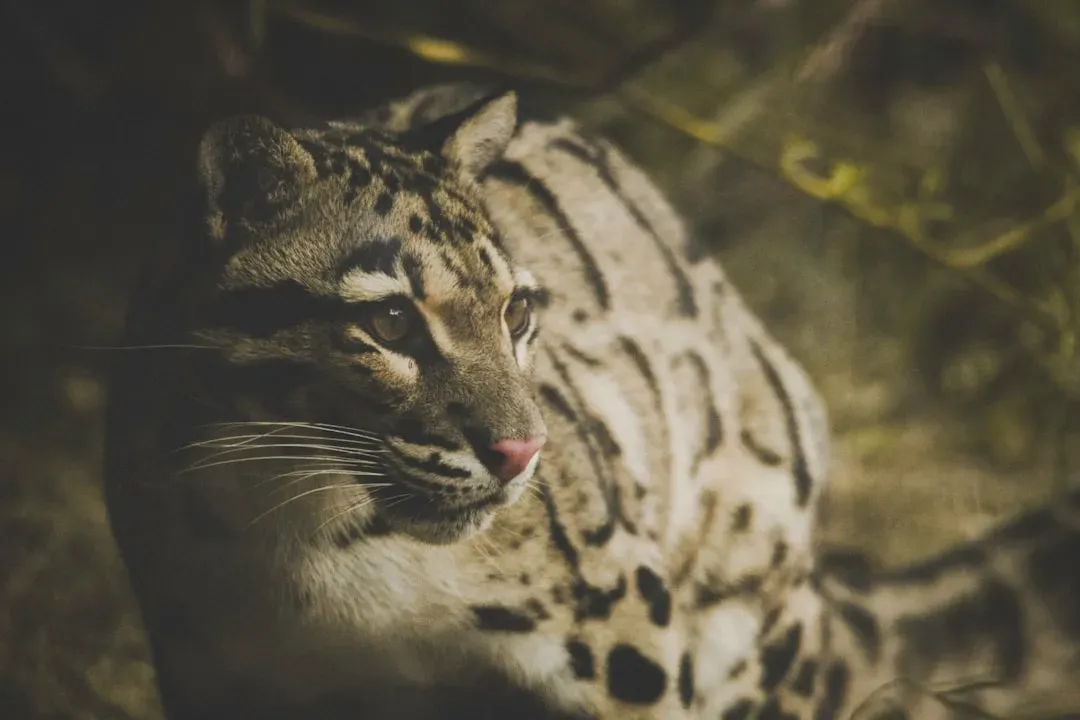
A new assessment of the mainland clouded leopard’s conservation status has estimated the global population to be between 3,700 and 5,580 mature individuals. Let that sink in. That’s potentially fewer clouded leopards than there are wild tigers across all of Asia. The clouded leopard population is believed to have declined by over 30% in the last 20 years.
Their forest habitat is experiencing the world’s fastest rate of deforestation. Clear cutting of forests for use as agricultural lands such as palm oil, is its primary threat, as the clouded leopard requires large tracts of forest for hunting. The math is brutal. The species natural habitat has been fragmented and decreasing at a rate of 10% per year since 1997. Meanwhile, Clouded leopard pelts are the most commonly seen pelts on the illegal market, driven by demand for traditional medicine and decorative purposes.
When Males Become Deadly Threats to Females
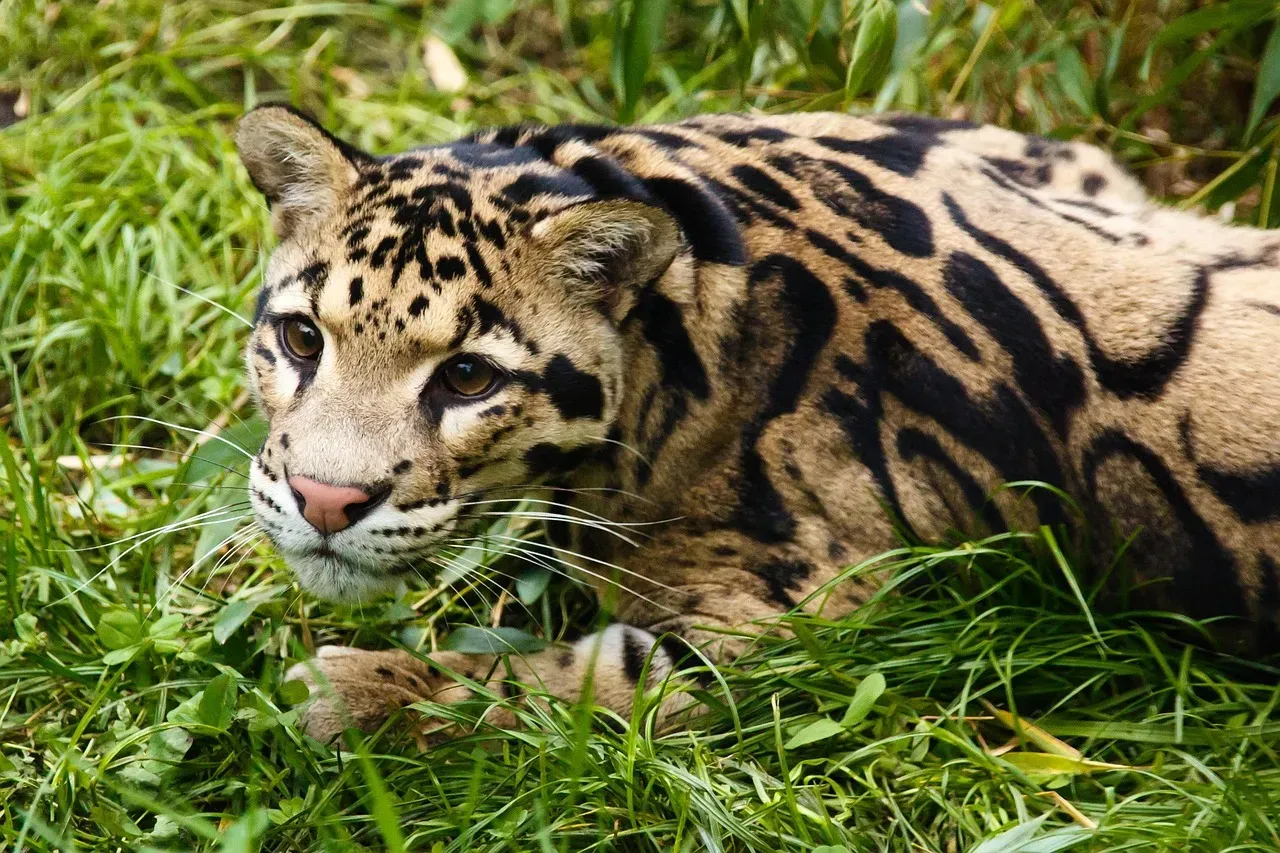
Since adult male cloudeds are generally twice the size of females, the chance of injury to the female cat in a breeding encounter in managed care is always a concern, as males often kill their potential mates during courtship. This isn’t some rare accident. It’s a genuine problem that has plagued captive breeding programs for decades. This lack of knowledge concerning wild mating behavior has made it extremely difficult to breed these animals in captivity. Arranged mating encounters at zoos often conclude with aggression between the two individuals, and the male often kills the female with a bite to the back of the neck.
The solution turned out to be surprisingly simple, though labor-intensive. It has been found that potential pairs that are introduced to each other at an early age have better breeding success. Zoos now raise male and female cubs together from just weeks old, allowing them to bond before reaching sexual maturity. It’s hard to say for sure, but this compatibility might be just as important in the wild, where we simply haven’t been able to observe their courtship behaviors.
A Future Written in Disappearing Ink
It has therefore been listed as Vulnerable on the IUCN Red List since 2008. The population is threatened by large-scale deforestation and commercial poaching for the wildlife trade. Conservation efforts are underway, from anti-poaching patrols to community education programs, but the clock is ticking. The biggest driver of population decline however is mortality due to illegal hunting. The clouded leopard is threatened through targeted illegal hunting for its decorative fur, and its teeth and bones for the traditional medicine market, and indiscriminate hunting snares. The increase in snaring across Cambodia and Lao PDR likely has been the biggest driver of population declines.
Today, the clouded leopard is locally extinct in Singapore, Taiwan, and possibly also in Hainan Island and Vietnam. Protected areas like Manas National Park in India and Tanjung Puting in Borneo offer hope, but no single reserve is large enough to sustain a viable population long-term. The cats need forest corridors connecting isolated patches, allowing genetic diversity to flow between fragmented populations. Without these connections, inbreeding becomes inevitable, weakening the species from within.
What You Can Do About a Cat You’ll Likely Never See
The clouded leopard’s survival depends on forests most of us will never visit and protections enforced in countries far from our own. Yet our choices matter. Palm oil plantations are swallowing their habitat at an alarming rate, and that palm oil ends up in roughly half the packaged products in your local supermarket. Looking for sustainable palm oil certifications is a start, though admittedly not a perfect solution.
Supporting organizations working on the ground in Southeast Asia makes a tangible difference. Camera trap programs, ranger patrols, and community conservation initiatives all need funding. Perhaps most importantly, simply knowing these cats exist and sharing their story helps. The clouded leopard has lived in obscurity for too long, a ghost cat slipping through the canopy while the world looks elsewhere. They deserve better than to vanish unnoticed.
These ancient predators with their saber-like teeth and gravity-defying acrobatics represent something irreplaceable. If we lose them, we lose not just a species but a living connection to the deep evolutionary past, a masterpiece of adaptation sculpted over millions of years. What do you think? Can we find the will to protect a creature most people will never see? Tell us in the comments.