

Have you ever stopped to wonder how your ancestors made it through impossibly harsh conditions with no modern conveniences whatsoever? Long before grocery stores, electricity, or even the simplest metal tools, prehistoric humans figured out how to not just survive but thrive in a world that would terrify most people today. They faced massive predators, brutal climate shifts, and food scarcity that could mean life or death.
What’s truly fascinating is just how clever these early humans were. They weren’t primitive brutes stumbling through existence. They were innovators, problem solvers, and masters of adaptation who developed strategies so effective that some are still relevant thousands of years later. So let’s dive into the remarkable world of prehistoric survival and discover the ingenious methods that kept our ancestors alive.
Stone Tools: The Foundation of Human Innovation

You might think stone tools sound incredibly basic, yet prehistoric humans were using deliberately modified and sharpened stone implements as early as around three million years ago. These weren’t just random rocks picked up off the ground. Your ancestors carefully selected rock types based on how easily the material could be flaked to the desired shape, creating sharp-edged fragments manufactured for various needs including hunting and food processing.
The earliest toolkit, known as Oldowan technology, consisted of hammerstones, stone cores, and sharp flakes. Let’s be real, it might not sound impressive at first glance. These tools were characterized by simple construction using core forms made from river pebbles or similar rocks that had been struck to create an edge and often a sharp tip. Manufacturing these tools required skill, planning, and a thorough understanding of stone fracture mechanics, suggesting an understanding of how different rocks behaved during breakage.
The Revolutionary Leap: From Simple Choppers to Handaxes

By roughly one and three-quarters million years ago, early humans began to strike really large flakes and then continue shaping them, resulting in a new kind of tool called a handaxe. This was a genuine game changer. Think of it like upgrading from a flip phone to a smartphone.
These handaxes were pear shaped, teardrop shaped, or rounded in outline, usually between twelve and twenty centimeters long and flaked over at least part of the surface of each side. This persistence suggests that these early humans had developed a successful survival strategy that worked across a wide range of ecological settings. Here’s the thing: they kept using these designs for over a million years because they worked incredibly well.
Fire Control: Humanity’s Most Transformative Discovery

The control of fire by early humans was a critical technology, providing a source of warmth and lighting, protection from predators especially at night, a way to create more advanced hunting tools, and a method for cooking food. Honestly, it’s hard to overstate just how important this was. Claims for the earliest definitive evidence of using fire range from roughly one and a half to two million years ago, with scholarly support for microscopic traces of wood ash use beginning around one million years ago.
As early as four hundred thousand years ago ancient hominins might have had the skills to conjure flame. Fire was even used in manufacturing tools for hunting and butchering, and hominids learned that starting bushfires to burn large areas could increase land fertility and clear terrain to make hunting easier. Fire was useful in hunting, as hunters with torches could drive a herd of animals over the edge of a cliff.
Smart Scavenging: An Overlooked Survival Strategy

New research suggests that scavenging animal carcasses wasn’t a desperate last resort, but a smart, reliable survival strategy that shaped human evolution. I know it sounds crazy, but this might have been more important than hunting for a long time. Carrion provided calorie-rich food with far less effort than hunting, especially during hard times, and humans were uniquely suited to take advantage of it.
Language and stone tools made it possible to coordinate group efforts, locate carcasses, and extract valuable resources such as meat, fat, and bone marrow. Scavenging offered clear benefits to early humans, as finding and exploiting animal carcasses required far less energy than hunting live prey and could provide critical nutrition during times of scarcity. The efficiency of this approach is remarkable when you consider the energy calculations involved.
Building Shelter: From Caves to Constructed Homes

Caves are the most famous example of Paleolithic shelters, yet your ancestors built much more than that. In Siberia, scientists uncovered a house or tent with a frame constructed of mammoth bones, where great tusks supported the roof while skulls and thighbones formed the walls, and several families could live inside with small hearths keeping people warm.
Around fifty thousand years ago in southern France at Terra Amata, hunter-gatherers built a long and narrow house with a foundation that was a ring of stones and vertical posts down the middle supporting roofs and walls of sticks and twigs probably covered with straw. Early humans chose locations that could be defended against predators and rivals and that were shielded from inclement weather, often found near rivers, lakes, and streams with low hilltops that could serve as refuges.
Hunting and Weapons: Precision Over Brute Force

Prehistoric humans figured out how to funnel game for easier kills. This shows incredible strategic thinking. Archaeological evidence suggests spears were deliberately fire-hardened, which allowed early humans the ability to modify their hunting tactics and use the spears as thrusting rather than throwing weapons.
The blades and points were designed for hunting, butchering, and cutting wood, representing a complete survival kit for a mobile hunter-gatherer lifestyle. The inclusion of worn and broken tools alongside functional pieces suggests these ancient hunters valued every scrap of workable stone, recycling materials whenever possible during resource-scarce periods. Nothing went to waste when survival depended on it.
Social Organization and Knowledge Transmission

The development of tool-making skills required cognitive abilities and social learning, leading to more complex social structures and foraging strategies. Community was everything for survival. Through music, dance and art, ancestors collected and transmitted vast amounts of information about the seasons, edible plants, animal migrations, weather patterns and more.
Scientists discovered that Neanderthals modified their survival strategies even without external influences such as environmental or climate changes. They were more similar to modern humans than previously assumed. The transport of raw materials and presence of exotic lithic resources at some sites indicate planning and executing complex foraging strategies and maintaining social networks over considerable distances. Your ancestors weren’t isolated wanderers – they were connected communities sharing knowledge and resources.
Conclusion
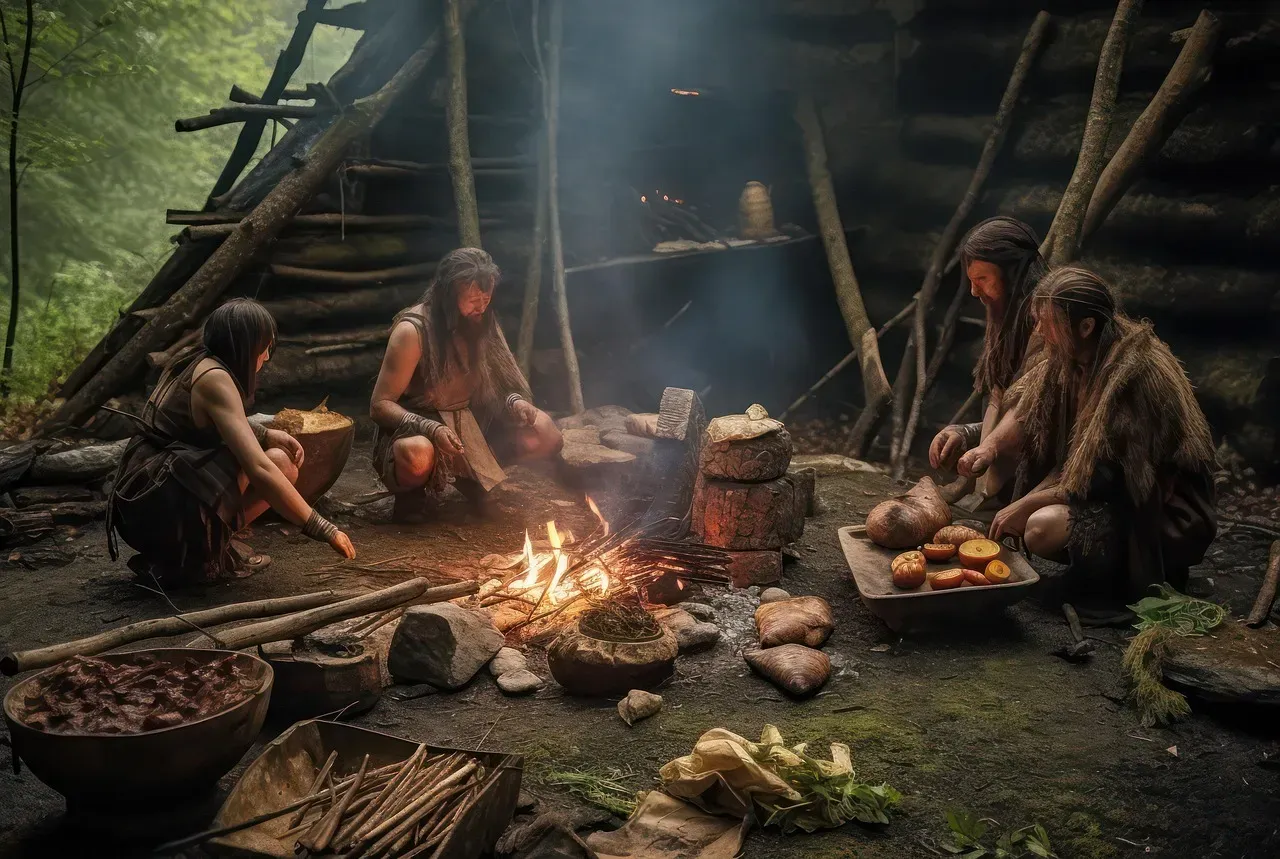
The truth about prehistoric humans is far more impressive than the stereotypical caveman image suggests. These were intelligent, adaptive people who solved complex problems with limited resources. They mastered fire, developed sophisticated tools, built effective shelters, and created social networks that allowed knowledge to spread across generations.
What truly stands out is their resourcefulness and innovation under pressure. They didn’t have instruction manuals or YouTube tutorials. Everything they knew came from observation, experimentation, and passing lessons down through generations. Their survival strategies weren’t just clever – they were essential stepping stones that eventually led to the development of modern civilization.
Next time you use a knife or light a fire, think about those distant ancestors who figured these things out from scratch. Pretty remarkable when you consider where we started, isn’t it? What do you think was their most ingenious innovation?