When most people think of dinosaurs, their minds drift to the usual suspects – the thundering T. rex, the three-horned Triceratops, the long-necked Brachiosaurus. These are the rock stars of the prehistoric world, forever immortalized on lunchboxes, cinema screens, and museum centerpieces. Honestly, they deserve the fame. But here is the thing that most people miss: the Mesozoic Era was bursting with thousands of creatures that never quite made it into popular imagination, yet played roles just as dramatic, just as evolutionary, and sometimes far stranger than anything Hollywood ever dreamed up.
These lesser-known dinosaurs, hidden in the shadows of their more celebrated counterparts, offer a unique glimpse into the nuanced and diverse tapestry of prehistoric ecosystems. While the colossal footsteps of the Tyrannosaurus rex echo through popular culture, there exists a captivating array of smaller, yet equally significant, creatures that once roamed our planet. So if you have ever wondered what else was out there, roaming the same fern-covered valleys and steaming swamps, you are in for a real treat. Let’s dive in.
Therizinosaurus: The Scythe-Clawed Puzzle That Baffled Scientists for Decades
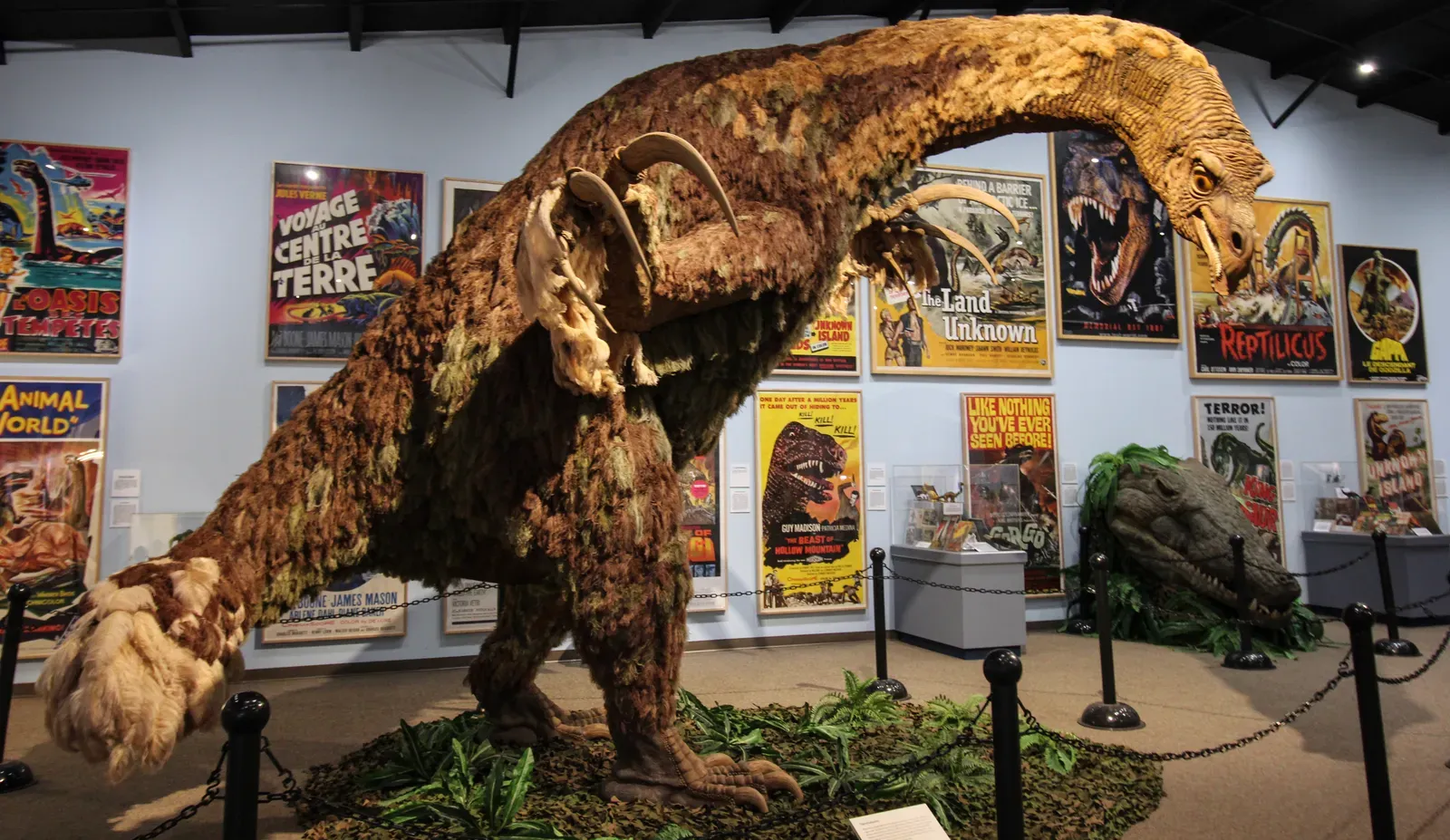
Picture this: you are a paleontologist in 1948, digging through the Gobi Desert in Mongolia, and you pull out a claw so impossibly massive that it looks like it belongs to a mythological creature. In 1948, a Mongolian field expedition unearthed the first Therizinosaurus fossils in the Gobi Desert. Paleontologist Evgeny Maleev later formally described it in 1954. Initially, based solely on its large claw bones, Maleev suggested it was a turtle-like reptile. This proved to be a misconception due to the fragmentary remains. You can imagine the confusion. A turtle. From claws that looked like garden scythes.
The most distinctive feature of Therizinosaurus was the presence of gigantic unguals on each of the three digits of its hands. These were common among therizinosaurs but particularly large and stiffened in Therizinosaurus, and they are considered as the longest known from any terrestrial animal. Despite those intimidating claws, to their surprise, this was no predator. Recent studies classified Therizinosaurus within the Therizinosauridae family, suggesting a primarily herbivorous diet despite being a theropod. This shift in understanding highlights the diverse evolutionary paths within Theropoda. Think of it as the prehistoric equivalent of a grizzly bear that only eats salad – terrifying to look at, completely misunderstood.
Deinocheirus: The Monster With Arms and No Face
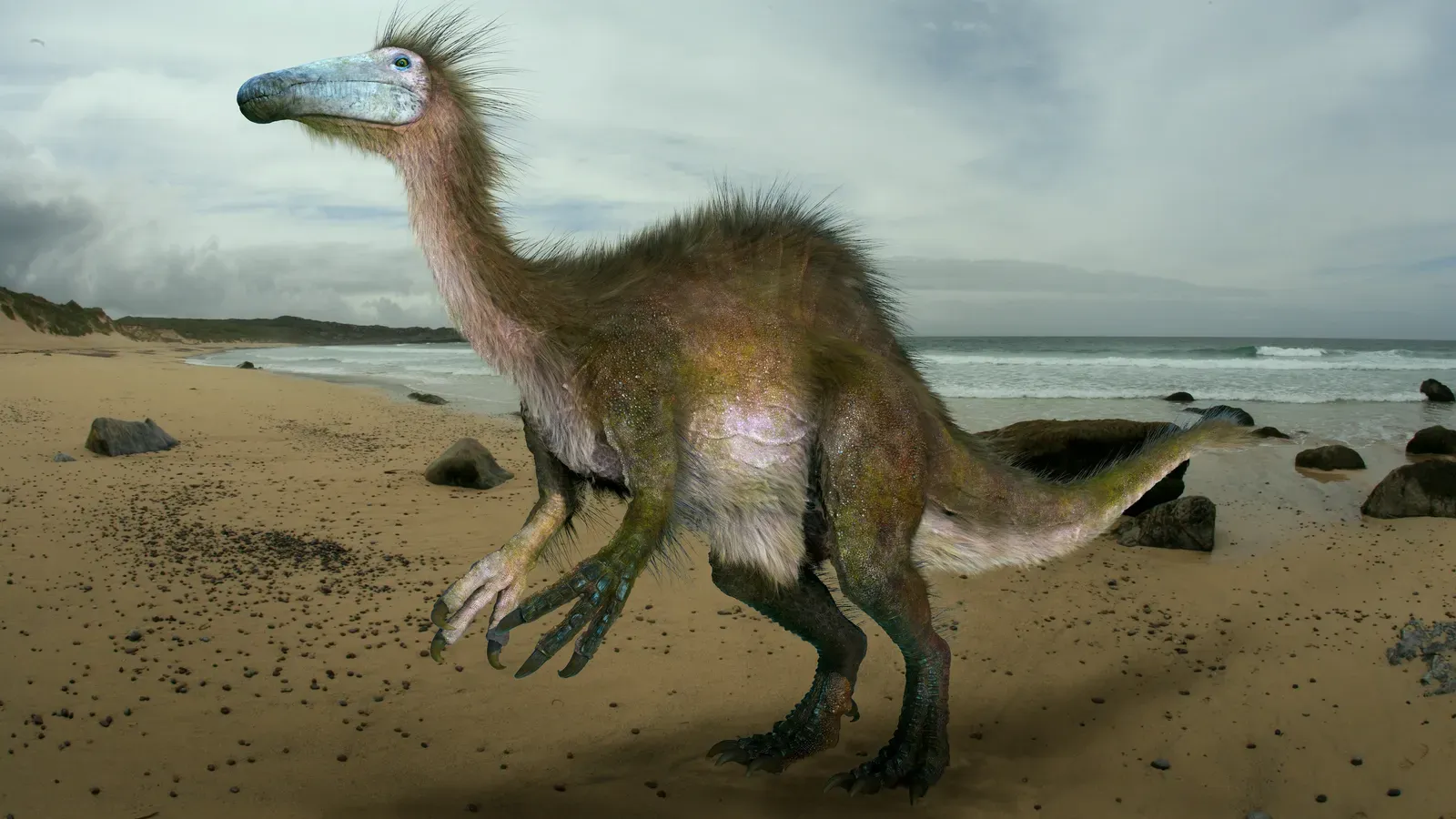
For decades, Deinocheirus was the most tantalizing mystery in all of paleontology. In 1965, a pair of large arms, shoulder girdles, and a few other bones of a new dinosaur were first discovered in the Nemegt Formation of Mongolia. In 1970, this specimen became the holotype of the only species within the genus, Deinocheirus mirificus; the genus name is Greek for “horrible hand”. No further remains were discovered for almost fifty years, and its nature remained a mystery. Two more complete specimens were described in 2014, which shed light on many aspects of the animal. Imagine sitting with only a pair of giant arms for half a century, trying to figure out what the rest of the creature looked like. That is basically what paleontologists had to do.
In the end, the bones revealed an animal far stranger than paleontologists ever expected – an enormous “ostrich mimic” dinosaur with a sail on its back and a shovel-like face. The full picture was absolutely wild. Known as the “terrible hand” due to its large, clawed forelimbs, Deinocheirus was an ornithomimosaur that roamed Mongolia during the Late Cretaceous period, around 70 million years ago. This dinosaur grew approximately 11 meters in length and exhibited a mix of features that have puzzled paleontologists. With a humped back similar to a camel’s and a duck-like beak, Deinocheirus was built for a specialized lifestyle. Initially thought to be a carnivore, further findings suggested it was omnivorous, feeding on plants and possibly fish.
Megalosaurus: The Dinosaur That Started It All
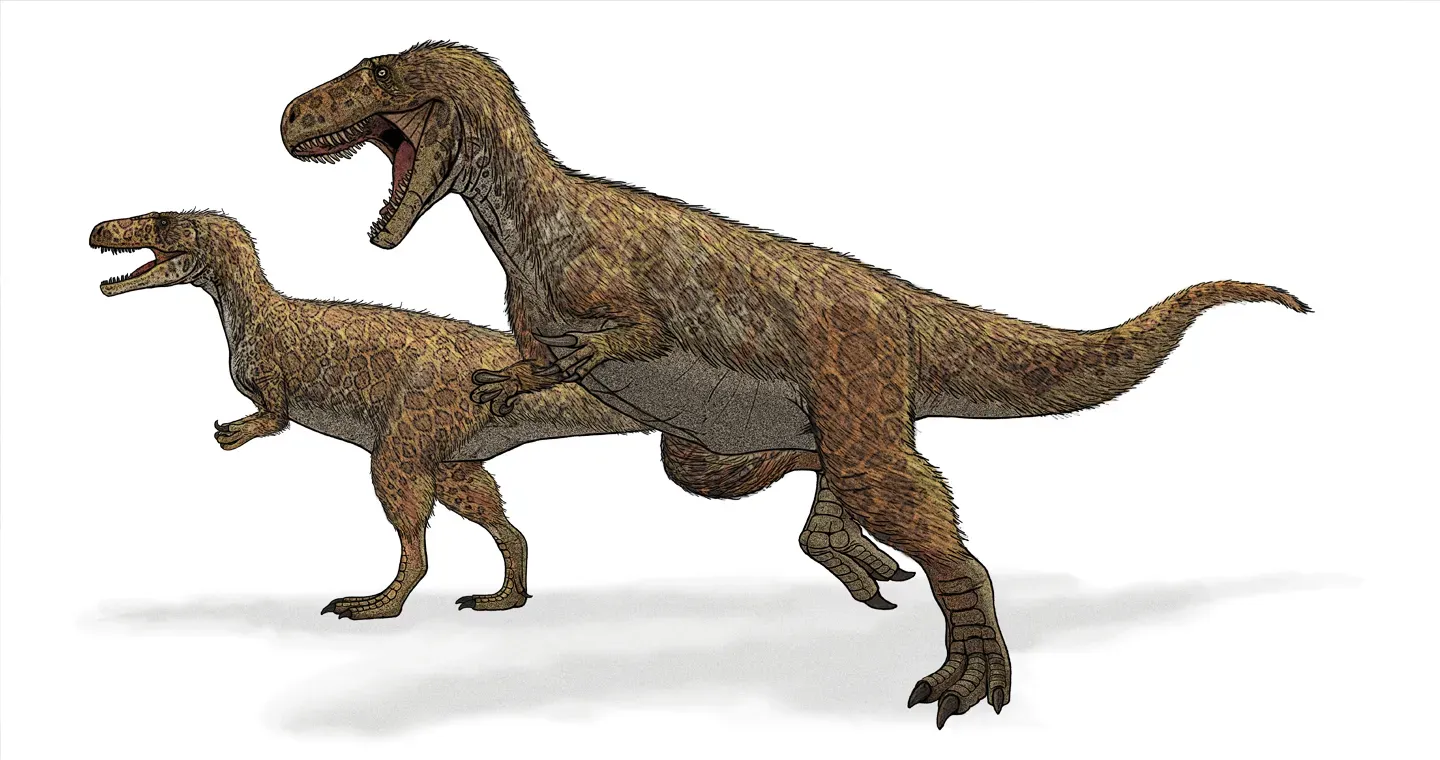
You may never have heard of Megalosaurus, but without it, the entire concept of “dinosaurs” might not exist. Megalosaurus was named in 1824 by William Buckland, becoming the first genus of dinosaur to be validly named (other than birds, not then recognized as dinosaurs). That is right – the very first. Before T. rex, before Triceratops, before all the glamour, there was Megalosaurus limping into scientific history from an English quarry. The earliest remains of Megalosaurus were described in the 17th century, and were initially interpreted as the remains of elephants or giants.
A carnivorous theropod discovered in southern England, Megalosaurus was much smaller than its North American cousin T. Rex. But it was still large compared to modern animals, about 20 feet long and 1.1 tons. It is a little like how the first automobile ever built barely resembles a modern car, yet everything that came after owes everything to that first invention. The first dinosaur fossil to be scientifically recognized was the Megalosaurus, discovered in England in 1824. That single discovery cracked open an entirely new chapter in humanity’s understanding of life on Earth. Not bad for a creature most kids have never heard of.
Albertosaurus: The Pack Hunter That Rewrote Predator Science
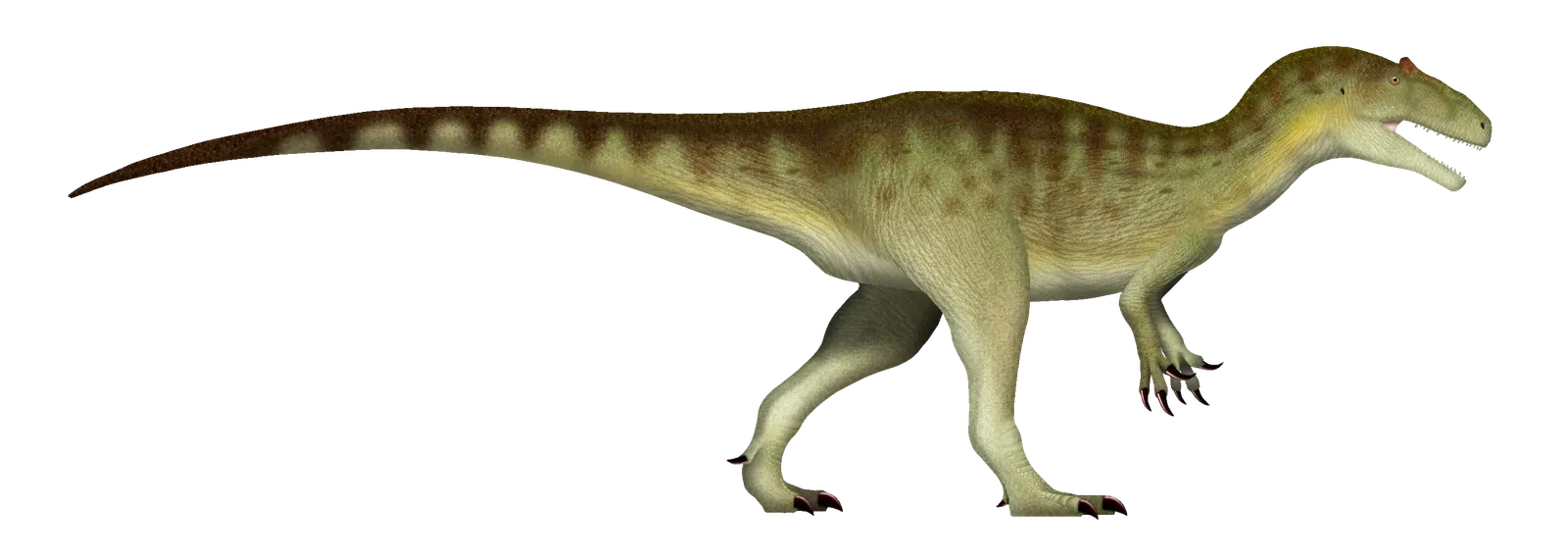
Albertosaurus is a genus of large tyrannosaurid theropod dinosaur that lived in northwestern North America during the early to middle Maastrichtian age of the Late Cretaceous period, about 71 million years ago. It is, in short, T. rex’s older, leaner cousin. While T. rex gets all the blockbuster roles, Albertosaurus did something arguably more astonishing. These dangerous carnivores likely fed on smaller, plant-eating dinosaurs and based on the fossil records, Albertosaurus appeared to have coordinated their approach to finding meals. Over 30 individual Albertosaurus have been discovered, making it one of the best-known and studied species, with 20 recovered from the same site. This suggests that Albertosaurus hunted in packs, making survival almost impossible for their prey.
Pack hunting among large theropods was not something scientists widely believed possible before this evidence surfaced. The large number of unique individuals found could be evidence of pack behavior, or the animals may have been brought together by a drought or flood. Either way, the bone bed threw a real wrench into old assumptions. When compared to its later cousin, Tyrannosaurus, Albertosaurus is lightly built and more streamlined. This suggests it mainly chased down fast prey such as hadrosaurs, rather than tackling tougher prey such as ceratopsians or ambushing its prey. Additionally, some paleontologists have speculated that Albertosaurus could run as fast as 30 mph. Speed, teamwork, and strategy – this was no mindless beast.
Maiasaura: The Good Mother Who Changed Everything We Knew About Dinosaur Parenting
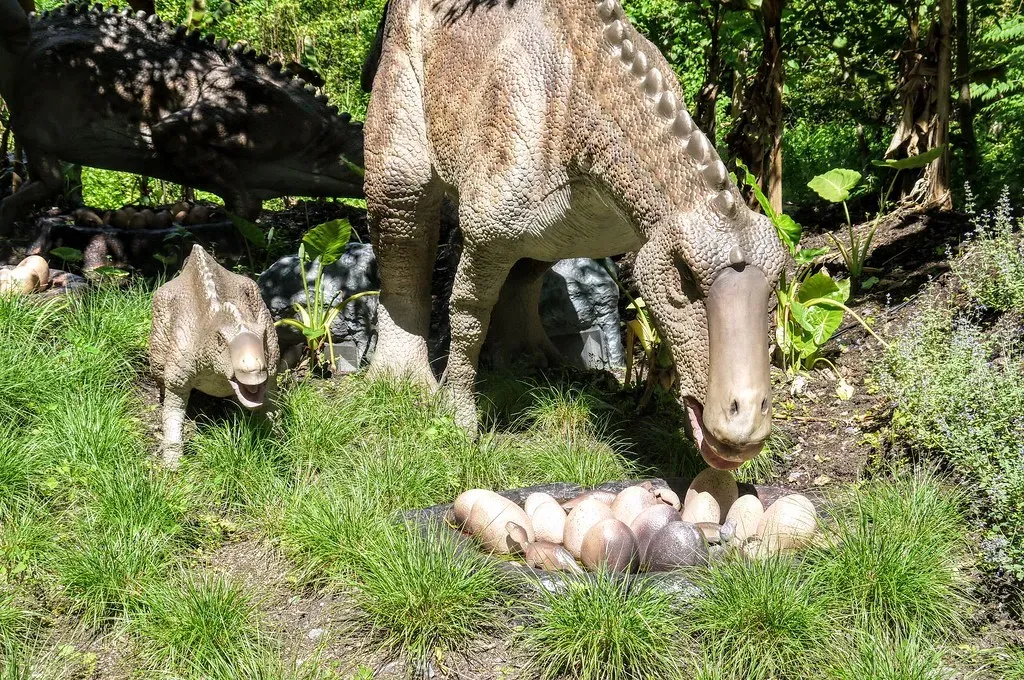
For a long time, the popular image of a dinosaur parent was essentially zero – lay the eggs, walk away, done. Maiasaura completely shattered that idea. A skull of Maiasaura was discovered by Laurie Trexler in 1979 and described by dinosaur paleontologists Jack Horner and Robert Makela as the holotype of a new species. They named the type species Maiasaura peeblesorum. The name itself is a tip-off: the generic name related to the Greek goddess Maia, the mother of Hermes.
The generic name refers to Marion Brandvold’s discovery in 1978 of a nest with remains of eggshells and babies too large to be hatchlings. These discoveries led to others, and the area became known as “Egg Mountain,” in rocks of the Two Medicine Formation near Choteau in western Montana. The fact that juveniles were found in the nest who were too big to be fresh hatchlings is the key detail – it means an adult was actively bringing food back and caring for the young. This provided evidence for the first time that some giant dinosaurs raised and fed their young in the nest, and would inform their name, Maiasaura, which comes from the Greek goddess Maia, the “Good Mother.” It also rubbed off on the area in which they were found, which became known as “Egg Mountain.” One species, one discovery, one paradigm shift.
Oryctodromeus: The Dinosaur That Actually Lived Underground
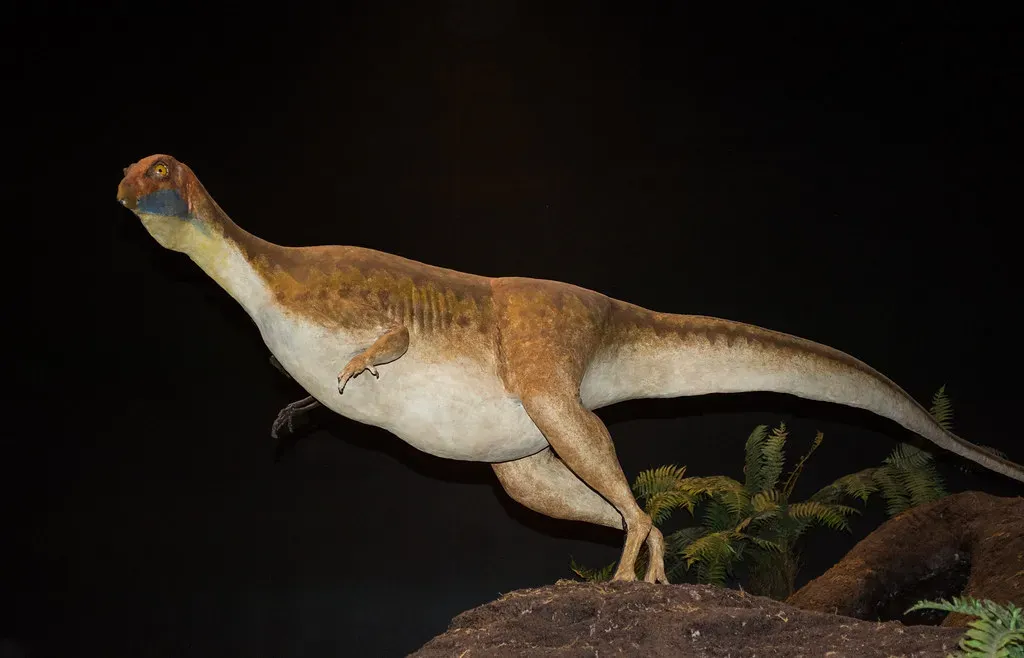
Here is one that genuinely surprises people. Most of us picture dinosaurs as open-land creatures – charging across plains, wading through swamps, stalking the forest edge. Nobody pictures them burrowing into the ground like a badger. Oryctodromeus was a small, agile dinosaur from the Late Cretaceous period, approximately 95 million years ago. Unearthed in Montana, this unique herbivorous dinosaur displayed an extraordinary adaptation for burrowing, a rare behavior among dinosaurs. It stood about 2.1 meters long and weighed around 45 kilograms, sporting a physique optimized for speed and digging.
The dinosaur’s skull structure and large eyes were ideal for a burrowing lifestyle, likely aiding in foraging within dim environments. Oryctodromeus’ discovery alongside juveniles in a burrow suggests it engaged in parental care, indicating a complex social structure potentially involving family groups. So not only was this creature burrowing, it was raising its young underground as well. Oryctodromeus, a small herbivorous dinosaur, was one of the few known dinosaurs that built burrows to protect its young. Think of it as the prehistoric prairie dog – small, clever, and completely redefining what a dinosaur could be.
Yi Qi: The Dinosaur That Tried to Be a Bat
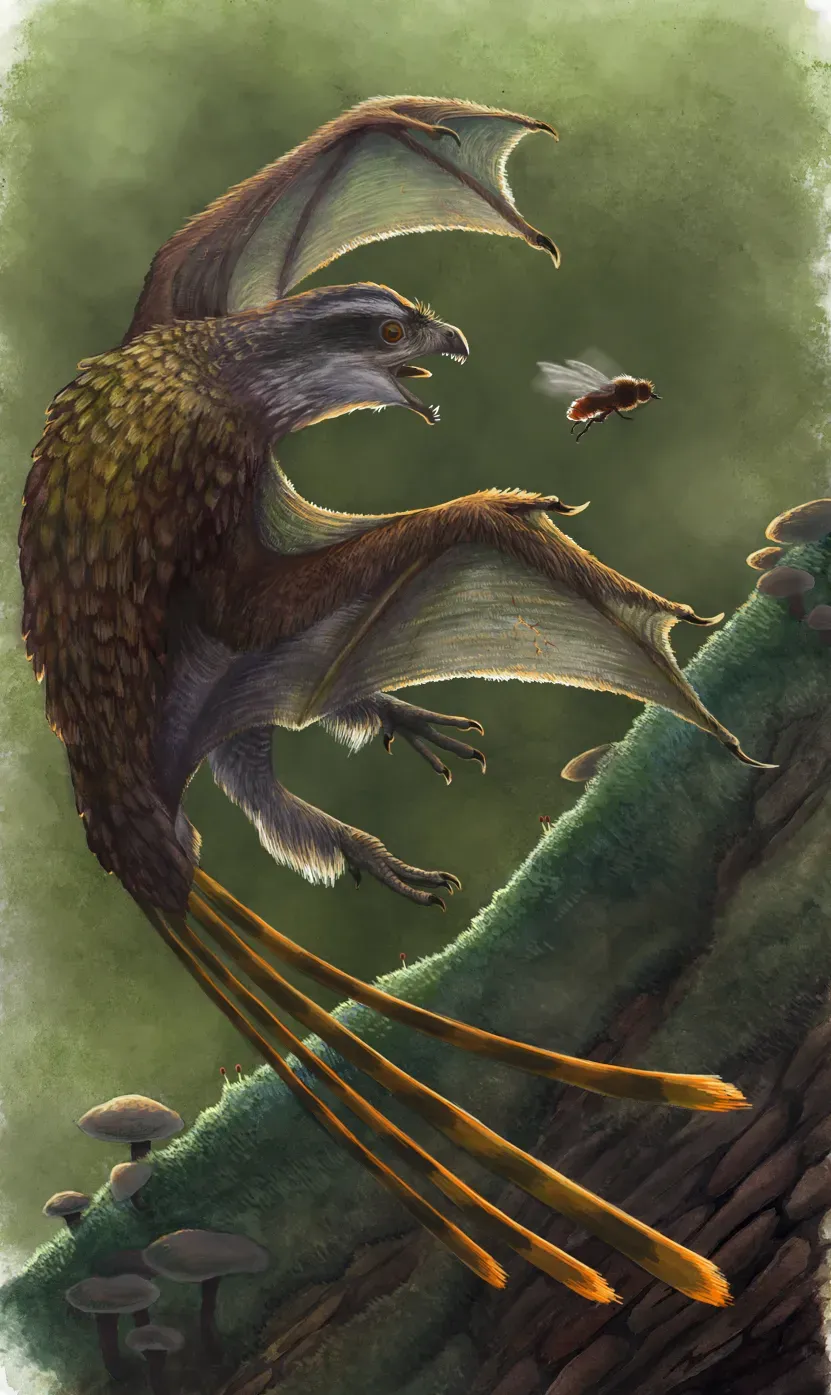
If you lined up every dinosaur ever discovered and asked which one looked the most like a science experiment gone gloriously wrong, Yi qi would probably win. The Yi qi, unearthed in China, had a bizarre membrane-wing structure, representing a rare glimpse into the evolution of flight in dinosaurs. I know it sounds crazy, but this small, sparrow-sized dinosaur essentially evolved its own version of bat wings, something no other dinosaur is known to have done. This remarkable dinosaur, resembling a cross between a bird and a bat, challenged preconceived notions about the evolution of flight in dinosaurs.
Yi qi’s existence tells us something profound: evolution does not follow a clean, straight line. It experiments wildly, throwing out radical designs to see what sticks. From the mysterious adaptations of the Yi qi to the peculiar anatomy of the Therizinosaurus, these unsung heroes of the Mesozoic era provide crucial pieces to the puzzle of Earth’s ancient past. The dinosaur-to-bird transition, long thought to be a single clear pathway, turns out to have been far messier and more experimental than anyone imagined. Yi qi is the living – well, formerly living – proof of that.
Gigantoraptor: The Bird-Dinosaur That Grew Way Too Big
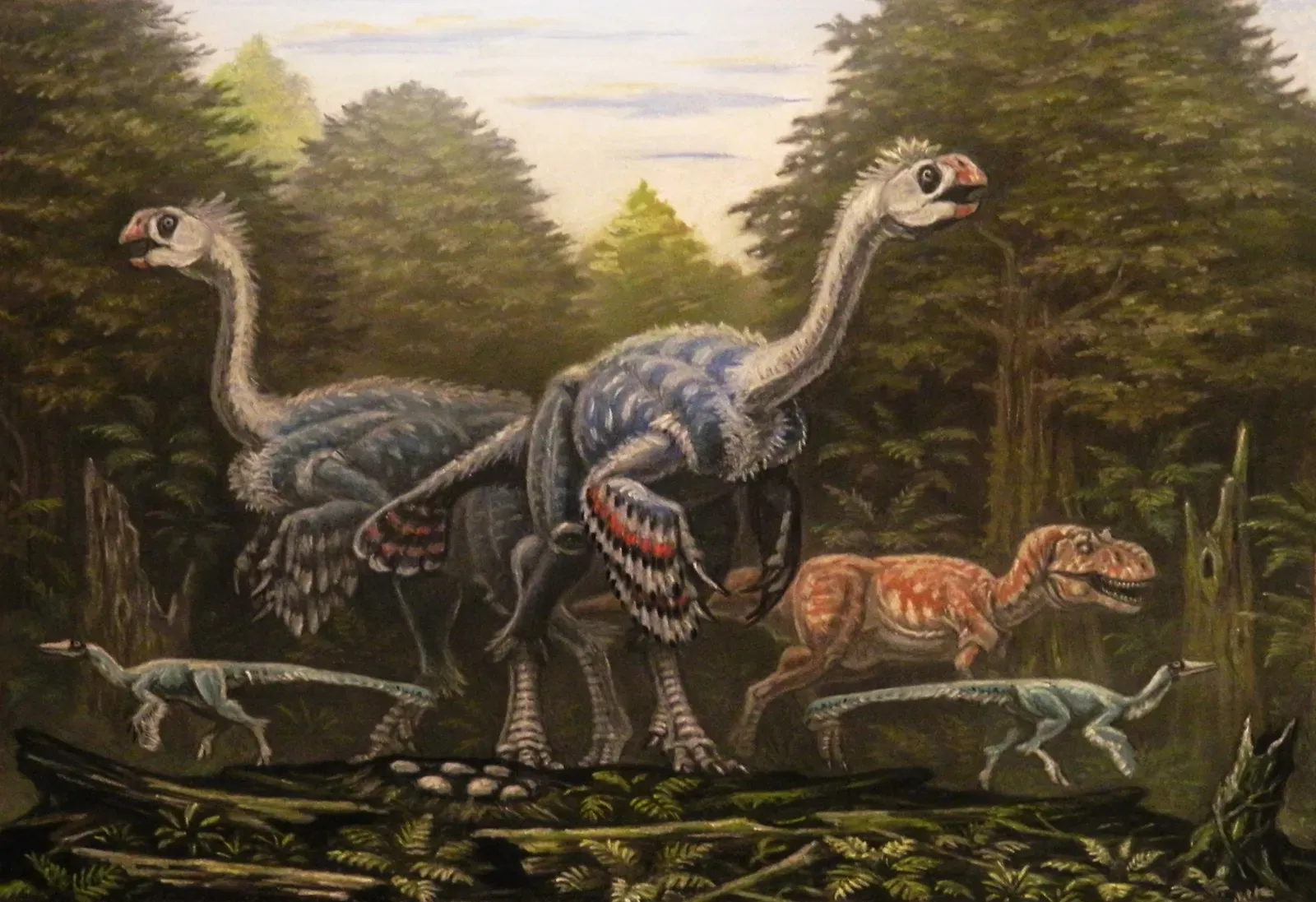
Most people know that oviraptorosaurs, the bird-like dinosaurs ancestral to modern avians, were generally compact creatures. So when Gigantoraptor showed up, it rather rudely ignored that expectation. Discovered in 2005 by the prolific paleontologist Xu Xing, Gigantoraptor resembled a huge flightless bird, with a beak-like mouth and possibly feathers. Most oviraptorosaurs – the ancient ancestors of birds – were small, the size of chickens or peacocks. But Gigantoraptor was massive, measuring some 26 feet in length.
It roamed the Gobi Desert some 70-80 million years ago, and had sharp claws that indicate it may have been omnivorous. The Gigantoraptor, a large theropod dinosaur, remains a puzzle due to its unusual combination of traits. It is a bit like finding a hummingbird the size of an elephant – the scale just does not compute. Along with Deinocheirus, the discoveries of Therizinosaurus and Gigantoraptor show that three groups of herbivorous theropods (ornithomimosaurs, therizinosaurs, and oviraptorosaurs) independently reached their maximum sizes in the late Cretaceous of Asia. Three completely separate lineages, all independently evolving into giants at roughly the same time. That is not a coincidence – that is evolution responding to its environment in ways that still astound researchers today.
Saltasaurus: The Armored Giant That Rewrote Sauropod Science
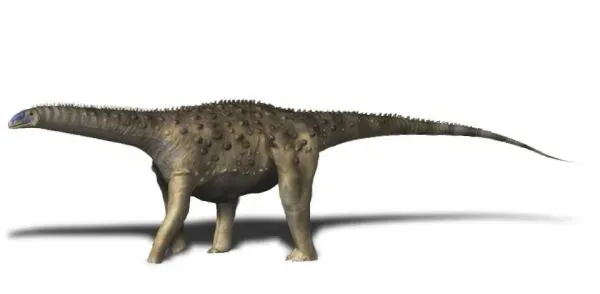
Sauropods, those enormous long-necked plant-eaters, were long assumed to rely on nothing but their sheer size for protection. Then Saltasaurus showed up and complicated everything. Saltasaurus was the first discovered sauropod that possessed armor; its plates were at first assumed to be from an ankylosaur. Its discovery made paleontologists rethink the variety of ways that sauropods could defend themselves. Before this find, the very idea of an armored sauropod seemed almost contradictory – these were slow-moving giants built for eating, not fighting.
Saltasaurus was small for a sauropod (long-necked dinosaur), but still reached a respectable length of nearly 30 feet long. It lived in the Late Cretaceous, around 70 million years ago, and had a rotund body covered in bony osteoderms. Those bony skin plates were not just decorative. They served as genuine defensive armor, layered across a creature that otherwise seemed defenseless against large predators. This is the kind of discovery that forces an entire field to pause, take a breath, and start asking new questions. It is hard to say for sure what else might be waiting out there in the rock, ready to overturn the next assumption entirely.
Conclusion: The Fossil Record Still Has Secrets to Tell You
You have now met nine dinosaurs that most textbooks barely mention, yet each one rewrote a chapter of Earth’s prehistoric story. They have been important to scientists studying evolution, extinction, and the history of life on earth, not to mention their role as ambassadors for science. From Therizinosaurus confusing everyone with claws the size of canoe paddles, to Maiasaura revealing that dinosaurs were tender parents, to Yi qi inventing its own version of bat wings – the story of prehistoric life is so much richer than the T. rex highlight reel.
Lesser-known dinosaur species often exhibit unique physical features, challenging our understanding of these ancient creatures. The deeper we dig, both literally and figuratively, the more we realize how little we once knew. Starting from the 1990s, major discoveries of exceptionally preserved fossils in deposits known as conservation Lagerstätten contributed to research on dinosaur soft tissues. Every new dig season, every overlooked bone bed, every forgotten museum drawer holds the potential for the next paradigm-shifting find. The prehistoric world is not done surprising us. So the next time someone mentions dinosaurs and starts with T. rex, you might want to ask: “Yes, but have you heard of Oryctodromeus?” What would you have guessed about a dinosaur that tucked its babies in underground?