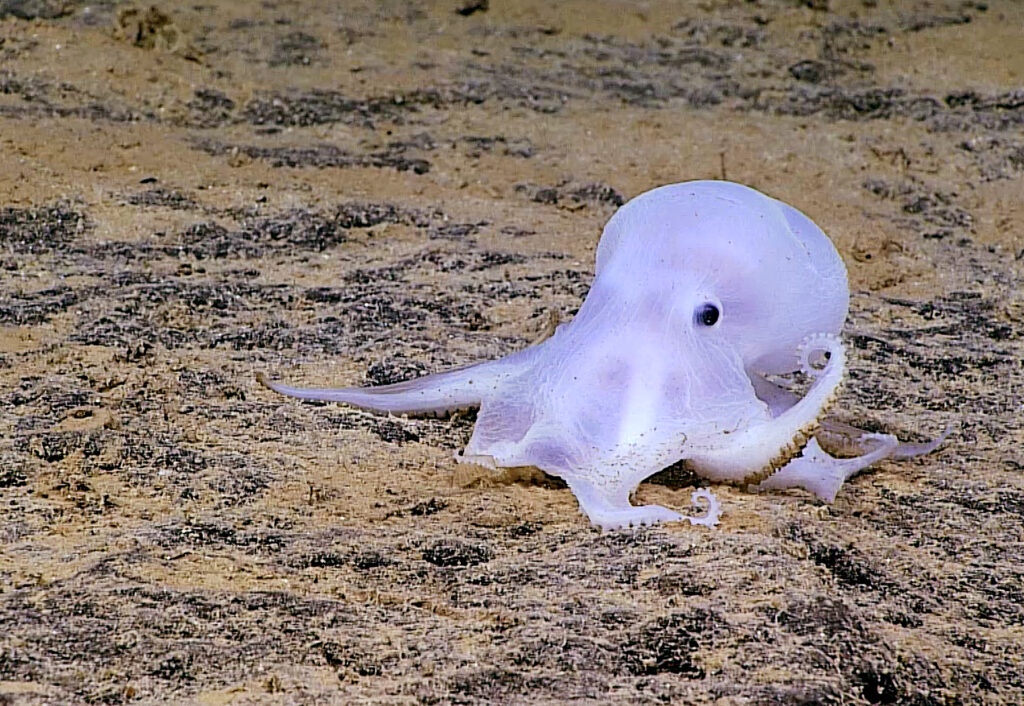
In the vast, lightless expanse of the Pacific Ocean’s Clarion-Clipperton Zone, a delicate translucent octopus known as Casper guards its eggs on ancient sponge stalks. This ghostly creature, discovered over a decade ago at depths exceeding 4,000 meters, depends on manganese nodules for its unique reproductive needs. A recent joint investigation by Mongabay and CNN exposed how Chinese research vessels prowled these waters, raising alarms for the octopus and broader deep-sea ecosystems.
Casper’s Fragile World Beneath the Waves
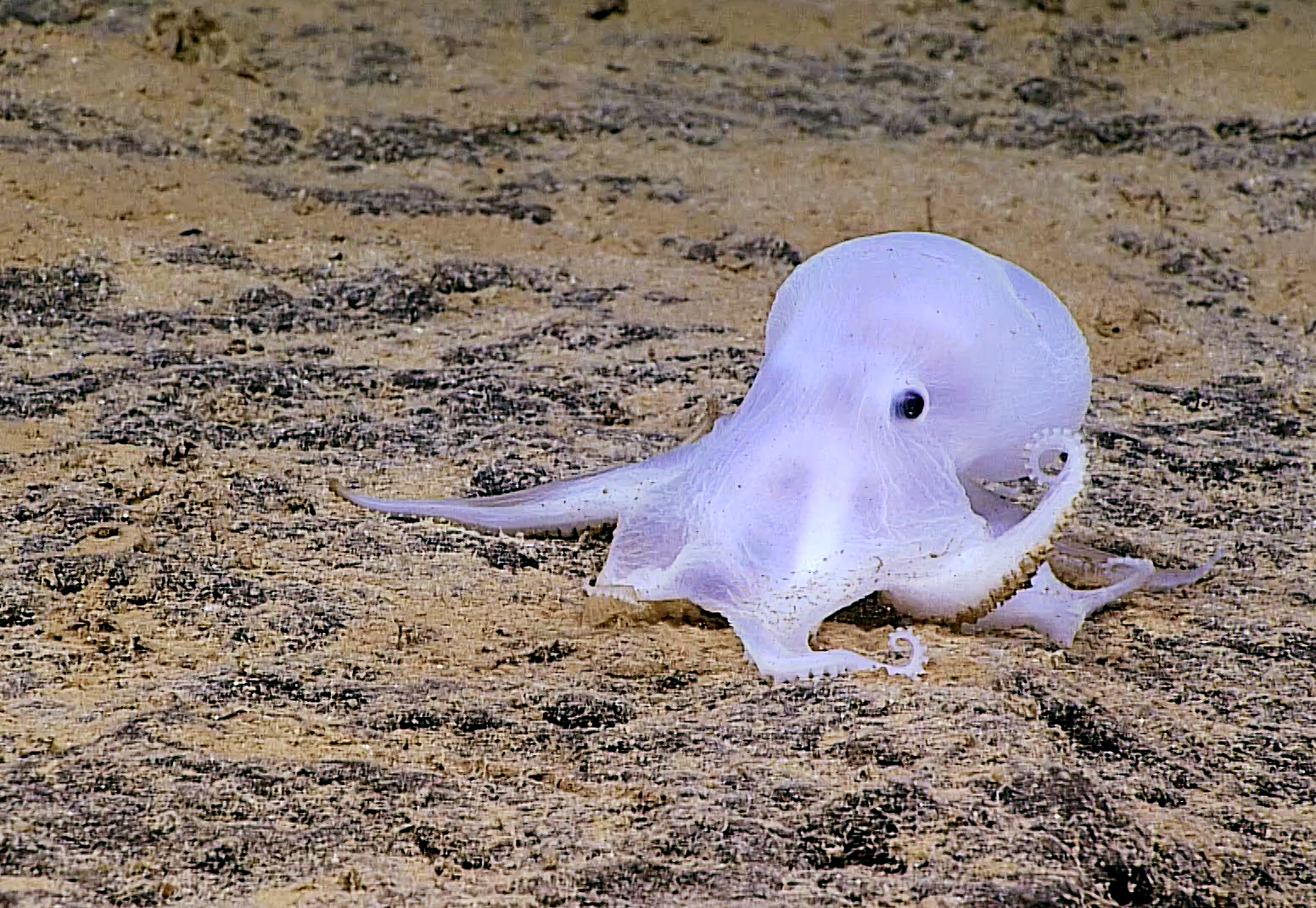
Casper’s Fragile World Beneath the Waves (Image Credits: Upload.wikimedia.org)
Researchers first encountered the Casper octopus during deep-sea expeditions near Hawaii. The creature lacks fins and ink sacs, adaptations suited to crushing pressures and perpetual darkness. Females attach eggs to dead sponge stalks anchored firmly to polymetallic nodules that form over millions of years.
These nodules, scattered across the seafloor, provide the only known substrate for the sponges essential to Casper’s brooding. Without them, eggs would drift exposed in currents, vulnerable to predators and sediment. The Clarion-Clipperton Zone spans an area comparable to the continental United States, harboring countless undiscovered species adapted to this extreme environment.
China’s Extensive Claims in the Abyss
China secured five exploration contracts from the International Seabed Authority, the most of any nation, spanning 225,000 square kilometers – three times the size of Ireland. State-owned firms like China Minmetals Corporation and the China Ocean Mineral Resources Research and Development Association hold these licenses in the zone.
These contracts target nodules rich in cobalt, nickel, copper, and manganese, critical for batteries and electronics. China also manages a 74,000-square-kilometer reserve area transferred to the ISA in 2019. Such dominance positions the country as the leading contender in what could become a trillion-dollar industry.
Probe Reveals Vessels’ Broader Agenda
A joint Mongabay-CNN investigation tracked eight Chinese research vessels from January 2021 to January 2026. The ships logged 814 days in or near Chinese-designated zones, covering 102,000 kilometers – more than twice the Earth’s circumference. Yet data showed they devoted only 6 percent of open-water time to these areas.
Instead, vessels like the Xiang Yang Hong 01 zigzagged over nodule fields before venturing into Russia’s exclusive economic zone and the Bering Sea. Others, including the Xiang Yang Hong 06, mapped vast seabeds west of Guam in lawnmower patterns, while the Hai Yang Di Zhi Liu Hao hovered near undersea cables in Palau’s waters. Raymond Powell, a retired U.S. Air Force colonel with SeaLight, observed: “They want to know what’s going on at the bottom of the sea, where U.S. submarines might go.”
- Xiang Yang Hong 03 surveyed a transpacific cable for 48 hours.
- Shen Hai Yi Hao probed foreign-licensed areas in the North Atlantic.
- Da Yang Hao traced lines along Taiwan’s east coast.
- Ke Xue cruised Alaska’s Aleutian Islands multiple times.
Imminent Dangers to Deep-Sea Life
Powerful multibeam echosounders on these vessels emit intense noise, known to disorient whales and disrupt cephalopods like Casper. Michael Jasny of the Natural Resources Defense Council noted that such systems “silence whales and even cause animals to strand.” Mining itself would strip nodules, uprooting sponges and abandoning octopus eggs.
Trials in the zone demonstrated a 37 percent drop in animal abundance, with no full biodiversity recovery after 44 years. Sediment plumes from extraction could smother nearby vents and trenches, while noise pollution alters communication in the silent depths. Nearly 90 percent of species here remain unknown to science, amplifying the risk of irreversible loss.
| Vessel Activity | Time in Mining Zones | Strategic Surveys |
|---|---|---|
| 8 vessels total | 814 days (6% of time) | Bering Sea, Guam, Taiwan |
| Distance traveled | 102,000 km | Near cables, EEZs |
International Pushback Grows
Forty nations have called for a moratorium on deep-sea mining until regulations ensure protection. The United States, not an ISA member, fast-tracked licenses like one to Lockheed Martin for 232,000 square kilometers in the zone. Tensions escalated in the Cook Islands, where China’s 2025 research pact drew U.S. countermeasures.
Experts warn that commercial extraction looms without finalized ISA rules. China maintains its operations prioritize environmental protection under ISA oversight.
Key Takeaways
- Manganese nodules, vital for Casper’s eggs, regenerate over millions of years.
- Vessel echosounders already harm marine mammals and invertebrates.
- Mining tests show lasting biodiversity collapse in affected areas.
The quiet urgency of the deep sea demands caution amid the minerals rush. Casper’s fate underscores the need to balance resource needs with unseen biodiversity. What measures would you prioritize to safeguard these depths? Tell us in the comments.