Araripe Basin, Brazil – Paleontologists uncovered a remarkable find within a long-forgotten museum specimen: the remains of a previously unknown pterosaur species preserved in 110-million-year-old fossilized vomit. The discovery, detailed in a recent Scientific Reports study, marks the first time scientists have named an extinct species from such an unusual source. This regurgitalite, or fossilized regurgitate, also contained fish bones, offering a snapshot of ancient predator-prey interactions in the Early Cretaceous.
Researchers identified the pterosaur while reexamining collections from the Romualdo Formation in Northeast Brazil’s Araripe Basin. The specimen had lingered unidentified for decades, mistaken for fish fossils amid the region’s abundant marine remains.
A Surprising Museum Rediscovery
A Surprising Museum Rediscovery (Image Credits: Reddit)
William Bruno de S. Almeida, a scientific initiation student at the Federal University of Rio Grande do Norte, spotted the anomaly during routine cataloging at the Museu Câmara Cascudo. Under the supervision of paleontologist Aline M. Ghilardi, the team recognized the concretion’s distinct taphonomic features: densely packed, semi-articulated bones showing partial digestion.
The fossil split into matching halves revealed jaw fragments from two pterosaur individuals alongside four fish, likely Tharrhias species. Aligned head-first, the remains suggested a predator swallowed prey whole to avoid choking, much like modern fish-eating birds. One half now resides at the Plácido Cidade Nuvens Museum to honor the specimen’s origins.
Inside the Regurgitalite: Pterosaur and Fish Remains
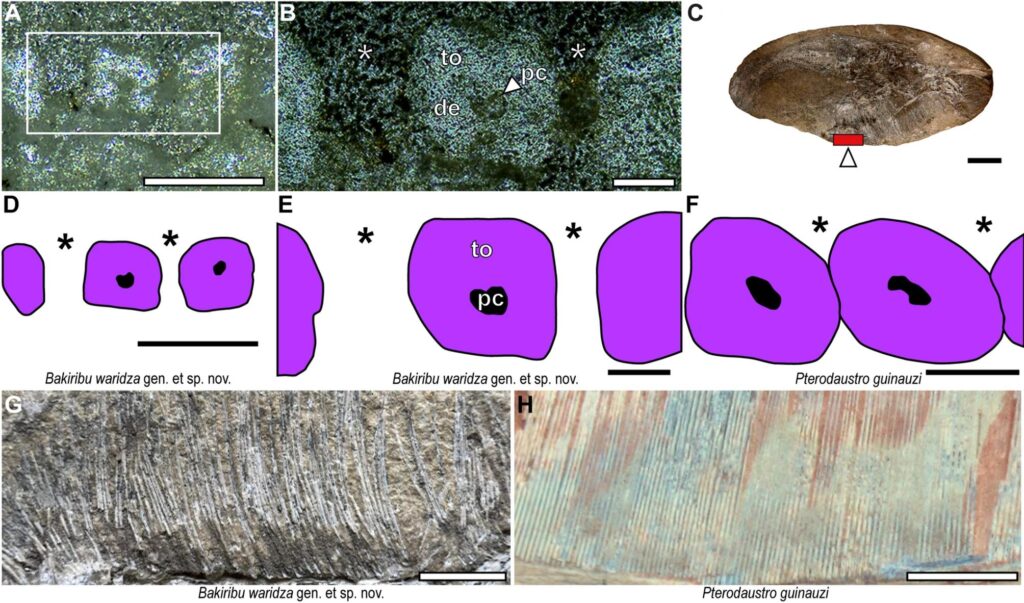
Paleohistological analysis confirmed the matrix as a wackestone concretion, with no compression from overlying sediments. Pterosaur bones included partial rostra, dentaries, a metatarsal, and a pedal phalanx, all jumbled yet preserving fine details like tooth pulp cavities. The fish cluster indicated a later meal regurgitated atop the pterosaurs.
This arrangement supported the regurgitalite interpretation over coprolite, as bones lacked abrasion and aligned subparallel. Lead researcher Rubi Vargas Pêgas noted the rarity: the Araripe Basin had yielded nearly 30 pterosaur types, none filter-feeders until now.
Features of Bakiribu waridza
The new species, Bakiribu waridza—”comb mouth” in the Indigenous Kariri language—belonged to the Ctenochasmatidae family. Its skull measured about 9-12 centimeters, comparable to a modern seagull. Elongated jaws bore densely packed, slender teeth with high density (17.6 per centimeter) and counts up to 568 total.
- Teeth: Elongated over 60 times their width, subquadrangular, acrodont-like on both jaws.
- Feeding: Brush-like dentition for filter-feeding on small crustaceans and plankton.
- Size: Small-bodied, wingspan likely modest for agile flight over coastal waters.
- Phylogeny: Sister to Pterodaustro guinazui, bridging Ctenochasma and later forms.
These traits positioned it evolutionarily between European ancestors and Argentine descendants, filling a Gondwanan gap.
Tropical Twist on Filter-Feeding Evolution
Prior ctenochasmatids appeared in temperate Europe, East Asia, and southern South America. Bakiribu waridza represented the first from tropical latitudes, challenging assumptions about their distribution. Its intermediate tooth features bridged evolutionary stages in filter-feeding adaptations.
Pêgas highlighted the surprise: “It was very unexpected, because fossils from the Araripe region have been studied for decades and almost 30 types of pterosaurs had already been found, none of them filter feeders.” The coastal Araripe setting suggested these flyers skimmed lagoons or rivers for prey.
Clues to the Predator
A spinosaurid dinosaur, such as Irritator challengeri, likely consumed the pterosaurs. Known from the formation, these crocodile-jawed piscivores matched the evidence: a prior fossil showed a spinosaur tooth in pterosaur neck vertebrae. Overloaded with indigestible skulls, the predator expelled the mass.
Ghilardi observed, “Today’s fish-eating birds swallow animals whole by the head to avoid choking on fins. Whoever ate the Bakiribu and the fish probably did so in the same way.” This event preserved a rare trophic link in the Romualdo paleoecosystem.
Key Takeaways
- First extinct species named from a regurgitalite, revolutionizing fossil sourcing.
- Earliest tropical filter-feeder, expanding ctenochasmatid range.
- Insights into Early Cretaceous food webs via preserved digestion traces.
This discovery underscores the value of museum collections and ethical repatriation practices. It enriches understanding of pterosaur diversity in ancient Gondwana. What do you think about finds from such unconventional fossils? Tell us in the comments.