Grand Canyon – A vast erosional surface known as the Great Unconformity slices through Earth’s rock record, where Cambrian sedimentary layers sit directly atop much older Precambrian basement rocks. This gap represents up to a billion years of missing strata, first observed by geologist John Wesley Powell in 1869. Fossils from the Cambrian Explosion, marking the abrupt debut of complex animals, often rest along this boundary, fueling enduring questions about geological and biological history.
A Global Scar in the Rock Record
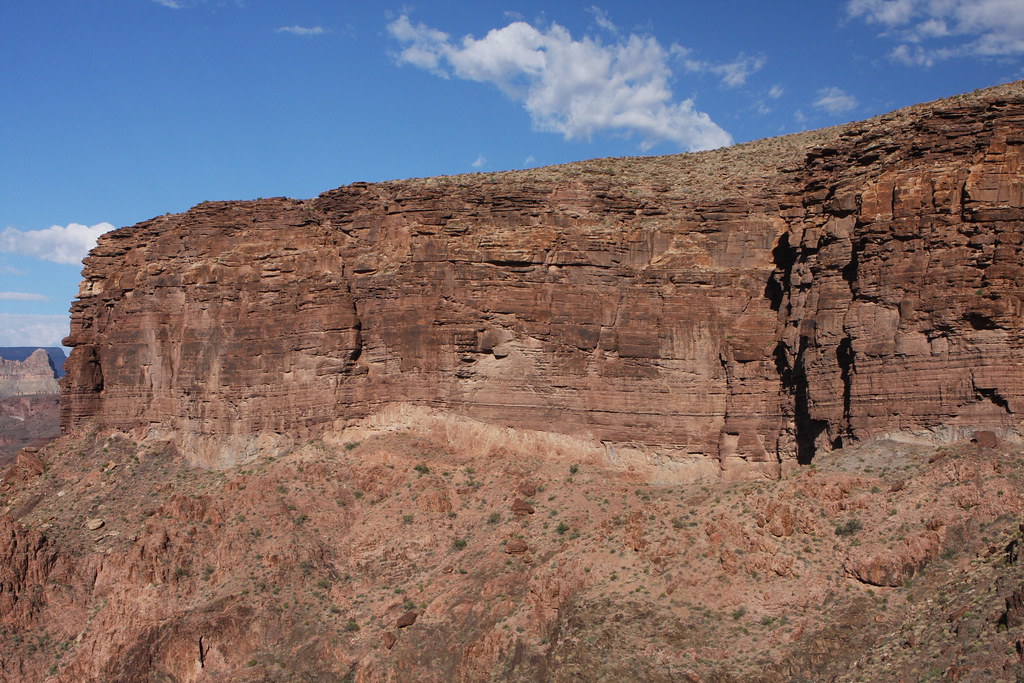
A Global Scar in the Rock Record (Image Credits: Flickr)
Geologists define the Great Unconformity as a widespread boundary where younger Phanerozoic sediments overlie eroded Precambrian rocks, with enormous volumes of material stripped away over vast areas. In the Grand Canyon, the Cambrian Tapeats Sandstone conformably overlays Vishnu Schist and granite gneiss, erasing hundreds of millions of years in between. Similar features appear across North America, from the Rocky Mountains to the Canadian Shield, and extend to other continents like Australia and South Africa.
This unconformity demanded intense, prolonged erosion to exhume deep crustal rocks and planarize landscapes on a continental scale. Estimates suggest miles of rock vanished in places, carving near-flat surfaces that defied easy explanation. Continental glaciers, while powerful, rarely produce such uniform planes, challenging early hypotheses.
- Grand Canyon, Arizona: Tapeats Sandstone on Vishnu Basement Rocks.
- Frenchman Mountain, Nevada: Similar Cambrian-Precambrian contact.
- Northern China: Exposed sites revealing thermochronologic histories.
- Rocky Mountains and Canadian Shield: Linked to Laurentia exposures.
Sudden Diversity: Fossils of the Cambrian Explosion
Just above the Great Unconformity in many locales, rocks preserve the Cambrian Explosion’s hallmark fossils – trilobites, brachiopods, and early arthropods that represent nearly all major animal phyla. This event unfolded around 539 million years ago, over 13 to 25 million years, transitioning Earth from sparse, soft-bodied Ediacaran life to a menagerie of shelled, mobile creatures. Trace fossils like burrows and trails signal complex behaviors absent earlier.
Prior strata below the unconformity yield mostly microfossils or simple multicellular forms, lacking the hard parts that dominate Cambrian assemblages. The sharp contrast puzzled scientists: why did biomineralized skeletons – calcium phosphate bones, carbonate shells, silica spicules – emerge so abruptly atop this eroded plane? Preservation biases partly explain the record, yet the diversification’s pace remains striking.
Erosion as Catalyst for Life’s Leap
Researchers long suspected the Great Unconformity’s formation flooded oceans with weathered ions, spurring evolutionary innovation. A 2012 study analyzed over 20,000 North American samples, revealing early Cambrian surges in carbonates and glauconite – minerals tied to chemical weathering of exposed basement rocks. This influx of phosphorus, calcium, and silica disrupted seawater chemistry, pressuring organisms toward biomineralization to manage ion loads.
Shallow seas transgressed cratons during this phase, accelerating erosion and nutrient release. Trilobites and other fauna acquired shells simultaneously, suggesting an environmental trigger rather than pure chance. Such conditions aligned perfectly with the unconformity’s end, positioning Cambrian strata as direct responders to the gap’s aftermath.
Recent Studies Reshape the Timeline
A March 2026 Proceedings of the National Academy of Sciences paper upended snowball Earth ideas, using thermochronology across northern China sites. Led by Rong-Ruo Zhan, the team traced cooling histories via multiple methods, pinpointing major denudation to the late Paleoproterozoic – 1.6 to 2.5 billion years ago. Erosion peaked during supercontinent Columbia’s assembly, predating Cryogenian glaciations by hundreds of millions of years.
“Mechanisms driving most of the GUn denudation date from the late Paleoproterozoic, much earlier than the Cambrian Explosion of life,” the authors concluded. This timeline weakens direct causal links to Cambrian events, as primary erosion preceded them vastly. Secondary contributions from Rodinia breakup or Snowball Earth phases may have polished the surface, but Columbia emerges as the dominant force. Debates persist, with no consensus yet unifying global patterns.
Key Takeaways
- The Great Unconformity erased up to a billion years through prolonged erosion, visible globally.
- Cambrian Explosion fossils cap this surface, hinting at environmental triggers like nutrient floods.
- New 2026 evidence points to ancient supercontinent Columbia as the main culprit, complicating life-evolution ties.
The Great Unconformity endures as geology’s grand puzzle, bridging vanished epochs to life’s diversification. While recent findings push erosion origins deeper into time, they underscore erosion’s role in reshaping oceans and opportunities for evolution. Future fieldwork promises sharper timelines. What explanation resonates most with you? Tell us in the comments.