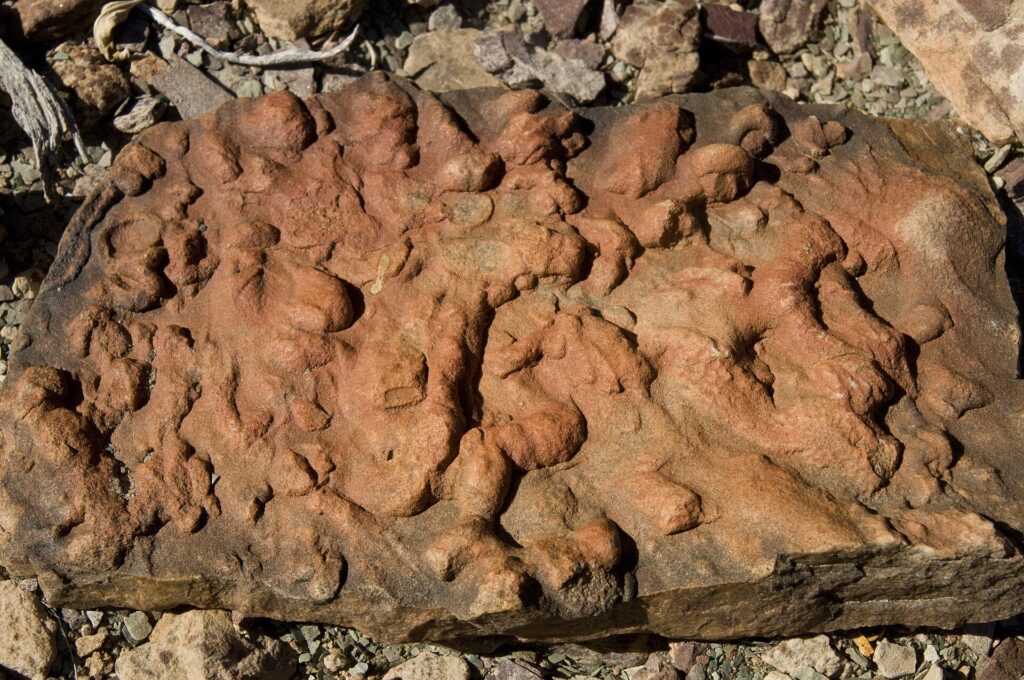
Grand Canyon, Arizona – A 2023 expedition along the Colorado River yielded fist-sized shale rocks that concealed thousands of tiny fossils from 507 to 502 million years ago. These remains from the Bright Angel Formation captured soft-bodied creatures in a shallow sea where the iconic canyon now stands. Researchers processed the samples through a laborious acid-dissolution technique, revealing an ecosystem of advanced feeders rarely preserved in the region.
Serendipitous Breakthrough in Ancient Shales
Serendipitous Breakthrough in Ancient Shales (Image Credits: Wikimedia)
Paleontologist Giovanni Mussini of the University of Cambridge led the team during the field trip. They targeted fine-grained mudrocks known for potential soft-tissue preservation. Back in the lab, the rocks dissolved in hydrofluoric acid, and sieves captured over 1,500 mesofossils.
The process proved arduous with no assured results. Yet two samples from the central Grand Canyon delivered articulated fragments of priapulids, crustaceans, and mollusks. These finds marked the first substantial soft-bodied Cambrian fossils from the area, complementing prior trilobite discoveries.
Mussini noted the site’s oversight amid the canyon’s scenic allure. High-power microscopes unveiled intricate details like teeth and setae, linking fragments to specific animal groups.
Spotlight on the Spiky-Toothed Predator
A standout discovery emerged as Kraytdraco spectatus, a new priapulid worm species dubbed after a Star Wars creature for its fierce dentition. This cactus worm, or penis worm, featured a retractable pharynx lined with hundreds of branching teeth in gradients from robust scrapers to delicate filters.
The worm measured up to 10 centimeters, with pharyngeal tracts preserving V-shaped sclerites, spinose prongs, and filamentous denticles up to eight orders deep. It likely swept seafloor debris into its extensible mouth. Such complexity signaled cutting-edge feeding tech for the era.
Co-author James Hagadorn of the Denver Museum of Nature and Science described some specimens as resembling fuzzy caterpillars, complete with preserved hairs and fibers.
Diverse Feeders in a Bustling Seafloor Community
Mollusks resembled modern aplacophorans, equipped with radulae of shovel- and peg-shaped teeth showing wear from scraping algae or bacteria. Chains of these boot-like denticles, up to 450 micrometers long, formed efficient grazing tools.
Crustaceans, likely branchiopods akin to brine shrimp, boasted molars with scaly surfaces, sternal triangles fringed with setae, and comb-like filter plates. Tiny plankton particles clung near their grinding grooves, evidencing suspension feeding.
- Priapulids: Microphagous worms with filament-bearing teeth for versatile predation.
- Mollusks: Substrate scrapers using imbricated radular teeth.
- Crustaceans: Filterers with molar teeth, setal arrays, and food grooves.
- Microbes: Algal acritarchs and cyanobacterial mats as basal food sources.
Burrows and scratches across the formation confirmed high activity levels, with diverse ichnofossils like Palaeophycus and Teichichnus indicating dense populations.
The Ideal Habitat Driving Escalation
The ancient sea sat at 40 to 50 meters deep, a Goldilocks depth balancing sunlight for photosynthesis, oxygen influx, and shelter from waves. Nutrient-rich waters supported intense bioturbation, unlike oxygen-poor sites like Burgess Shale.
Mussini explained that abundance enabled risky innovations. “Animals needed to keep ahead of the competition through complex, costly innovations, but the environment allowed them to do that,” he stated. This shelf setting fostered derived traits, pushing generalists to margins.
External experts like Susannah Porter of UC Santa Barbara highlighted the contrast to harsh preservation sites. The Grand Canyon offered a view of thriving, not stressed, evolution.
Reshaping Views of Cambrian Dynamics
The Science Advances paper from July 2025 detailed how resource-rich shelves accelerated functional diversity. Priapulids converged on modern microphages, while crustacean and molluscan tools echoed today’s.
These fossils pieced together a full ecosystem when paired with traces. Mussini remarked, “These rare fossils give us a fuller picture of what life was like during the Cambrian period.”
Key Takeaways
- Grand Canyon hosted soft-bodied innovators in an oxygen-rich shelf sea.
- New worm species Kraytdraco spectatus boasts unprecedented dental complexity.
- Findings underscore evolutionary arms races in habitable zones over marginal ones.
This trove underscores untapped potential in familiar landscapes. It refines models of the Cambrian explosion, showing how optimal conditions propelled animal modernity. What do you think about these ancient innovators? Tell us in the comments.