Lehringen, Germany – A re-examination of bones discovered in 1948 has provided definitive proof that Neanderthals hunted and butchered straight-tusked elephants at this Eemian lakeside site 125,000 years ago. Cut marks on the animal’s ribs and vertebrae reveal that the hunters gained early access to the fresh carcass, opening its chest to harvest organs and meat. The site also yielded traces of processing on other large animals, underscoring the versatility of Neanderthal subsistence during a warm interglacial period at the northern limits of their range. These findings challenge past skepticism and highlight sophisticated group hunting tactics.
A Thrusting Spear Ignites a Century of Debate
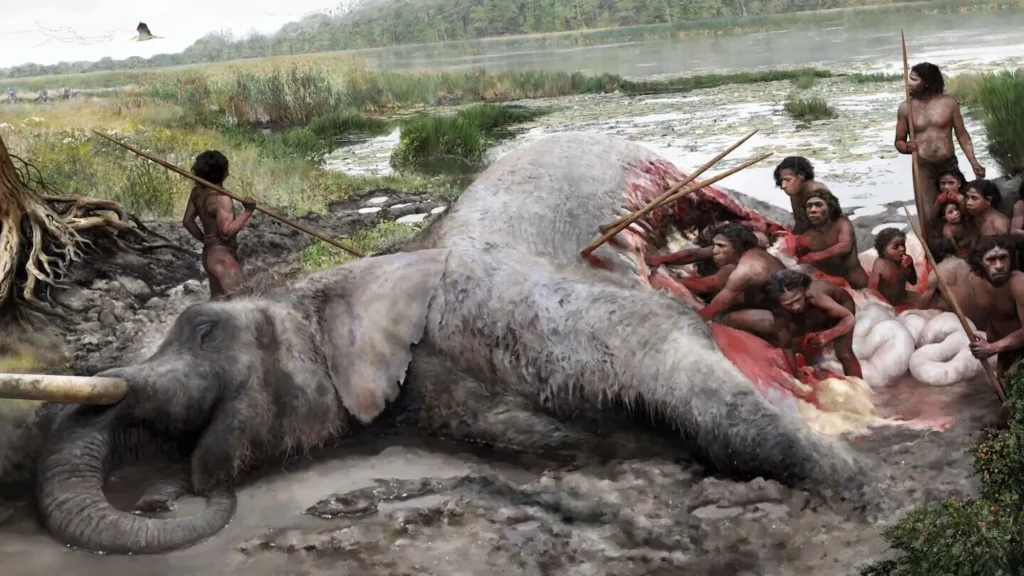
A Thrusting Spear Ignites a Century of Debate (Image Credits: Facebook)
In 1948, amateur excavators led by local school principal Alexander Rosenbrock uncovered a partial straight-tusked elephant skeleton amid marl deposits from a former lake. Workers in a fertilizer mine had already disturbed the site, removing half the bones before the team intervened. Amid the ribs lay fragments of a 2.38-meter yew-wood thrusting spear, the only complete Palaeolithic weapon of its kind known at the time.
The discovery sparked immediate controversy. Some hailed it as direct evidence of Neanderthal big-game hunting, while others dismissed the spear’s position as coincidental. Stored in cardboard boxes due to equipment shortages, the remains languished in an attic for decades, their potential overlooked amid incomplete documentation and legal disputes over ownership. Recent efforts by researchers finally brought advanced tools to bear on the assemblage.
Cut Marks Seal the Hunt’s Success
Microscopic analysis exposed clear butchery traces on seven elephant ribs and vertebrae, including V-shaped incisions for filleting and internal marks from evisceration. These modifications occurred on a carcass in prime condition, with limited carnivore damage suggesting Neanderthals intervened soon after death. The 30-year-old male elephant stood over 3.5 meters at the shoulder and offered roughly 3,500 kilograms of meat, fat, and organs—enough to sustain a large group for weeks.
Flint flakes found near the skull bore use-wear consistent with defleshing, linking the tools directly to the processing. The spear’s placement between ribs further implies it played a lethal role, likely in a coordinated ambush of the solitary bull. No marrow fracturing appeared on the elephant’s long bones, but the focus on high-value thorax contents aligned with efficient exploitation.
Diverse Prey Sustained Repeated Visits
Neanderthals did not limit themselves to megafauna. Traces of butchery marred bones from at least three aurochs, including cut marks on mandibles and vertebrae for meat removal. A brown bear femur showed impact fractures for marrow access, while beaver remains displayed incisions for skinning and muscle harvesting.
The full assemblage included around 2,000 bones from 16 species, such as fish, birds, and turtles, though only select large mammals bore anthropogenic marks. Cervids like giant Irish elk and red deer showed carnivore gnawing but no human intervention. Stratified remains across peat and marl layers indicated multiple occupations, drawn by the resource-rich lakeshore.
- Straight-tusked elephant (*Palaeoloxodon antiquus*): Defleshed and eviscerated.
- Aurochs (*Bos primigenius*): Meat extraction on multiple individuals.
- Brown bear (*Ursus arctos*): Marrow and filleting.
- Beaver (*Castor fiber*): Skin, meat, and disarticulation.
- Other taxa: Fish (*Silurus glanis*, *Esox lucius*), turtles (*Emys orbicularis*), wolves, rhinos (no butchery evidence).
Opportunistic Strategies in a Warming World
The lakeside setting attracted watering animals during the Eemian, enabling broad-spectrum foraging. Neanderthals prioritized fat-rich resources like organs, marrow, and beaver fur, adapting to interglacial abundance. Ivo Verheijen, lead author from the Lower Saxony State Office for Heritage, noted, “Neanderthals in Lehringen repeatedly spent a long period of time at the lake and pursued diverse hunting strategies. Large quantities of meat were important to them of course, but they needed bone marrow and fur as well.”
Professor Thomas Terberger of the University of Göttingen added, “The finds… provide a crucial building block for an up-to-date understanding of Neanderthals, who were already hunting strategically with the same level of skill as anatomically modern humans were 125,000 years ago.” Group coordination proved essential for tackling dangerous prey like bears and elephants, mirroring modern hunter-gatherer tactics.
Lehringen stands as the strongest evidence yet of Neanderthal prowess against Ice Age giants, blending wooden weapons, flint tools, and communal effort. This northern outpost reveals adaptable survivors thriving amid climatic shifts.
Key Takeaways
- Cut marks on elephant ribs confirm on-site butchery and primary carcass access by Neanderthals.
- Exploitation spanned elephants, aurochs, bears, and beavers, highlighting opportunistic diets.
- Repeated lakeside visits underscore strategic resource use during the Eemian interglacial.
What do you think of these revelations about Neanderthal hunting? Share your thoughts in the comments.