Researchers in South Korea unearthed a partial skeleton in 2023 that revealed a previously unknown dinosaur species, marking the nation’s first such discovery since 2011. The find on Aphae Island, part of the southwestern coast, dates to the mid-Cretaceous period around 100 million years ago and includes rare skull fragments alongside other bones. This breakthrough not only expands knowledge of early ornithischian dinosaurs but also highlights advanced imaging techniques that unlocked hidden details within the rock.
A Tiny Skeleton Packed with Surprises
A Tiny Skeleton Packed with Surprises (Image Credits: Wikimedia)
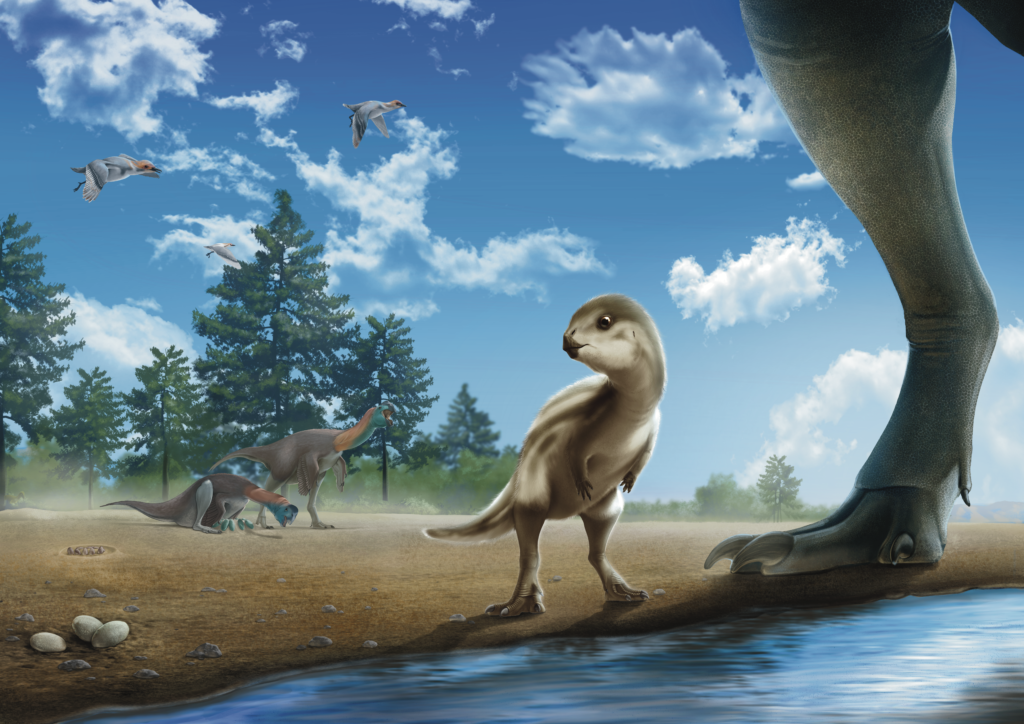
The fossil, cataloged as holotype KDRC-SA-V001, belonged to a juvenile dinosaur roughly the size of a turkey and weighing about 8.3 kilograms. Histological analysis confirmed the individual was around two years old and still undergoing rapid growth, as evidenced by its bowed femur and unfused cranial elements.
Initial excavation exposed leg bones and vertebrae, but the true extent emerged through micro-CT scans conducted at the University of Texas at Austin. These scans disclosed skull portions – the first such material from a named Korean dinosaur – along with forelimb elements and a cluster of 40 to 50 gastroliths totaling 30.7 grams. The gastroliths, subrounded pebbles swallowed to aid digestion, hinted at a diet broader than pure herbivory.
Advanced Technology Unlocks Ancient Secrets
Paleontologists Jongyun Jung and Hyemin Jo spotted the specimen during fieldwork in the Ilseongsan Formation, a fluvial to lacustrine deposit on Aphae Island in Shinan County. Traditional preparation risked damaging delicate structures embedded in hard rock, so the team turned to non-invasive X-ray micro-computed tomography.
Jung recalled the moment: “When we first found the specimen, we saw some leg bones preserved and some vertebrae. We didn’t expect skull parts and so many more bones. There was a fair amount of excitement when we saw what was hidden inside the block.” Co-author Julia Clarke noted the preservation: “A little cluster of stomach stones, with two leg bones sticking out, indicates that the animal was not fully pulled apart before it hit the fossil record.” This approach allowed digital reconstruction and precise comparisons to global specimens.
Doolysaurus huhmini: A Name Rooted in Culture and Science
The genus Doolysaurus draws from “Dooly the Little Dinosaur,” a cherished South Korean cartoon character known across generations for its mischievous, green juvenile form with distinctive hair tufts. Lead researcher Jongyun Jung explained, “Dooly is one of the very famous, iconic dinosaur characters in Korea. Every generation in Korea knows this character… our specimen is also a juvenile or ‘baby,’ so it’s perfect for our dinosaur species name to honor Dooly.”
The species name huhmini pays tribute to Professor Min Huh, founder of the Korean Dinosaur Research Center at Chonnam National University and a pioneer in preserving the country’s paleontological heritage. This dual homage reflects the blend of popular culture and rigorous scholarship in the March 2026 description published in Fossil Record.
Classifying a Bipedal Survivor from Cretaceous Wetlands
Doolysaurus huhmini belongs to Thescelosauridae, a family of small, bipedal neornithischians previously documented in East Asia and North America. Phylogenetic analyses positioned it as a basal member of Thescelosaurinae, following relatives like Changmiania and preceding North American forms such as Parksosaurus.
- Skull fragments: First diagnostic cranial material from a Korean dinosaur species.
- Vertebral column: Indicates a compact body structure.
- Hind limbs: Support bipedal locomotion, with juvenile bowing.
- Forelimb elements: Suggest limited use compared to legs.
- Gastroliths: Imply grinding of plants, insects, and small prey in a gizzard-like stomach.
Clarke described its potential look: “I think it would have been pretty cute. It might have looked a bit like a little lamb,” possibly with fuzzy filaments akin to some ornithischian relatives. The Ilseongsan Formation’s ecosystem featured turtles, crocodyliforms, fish, and other dinosaurs, painting a picture of diverse Cretaceous lowlands.
Reviving Korea’s Dinosaur Legacy
Prior to Doolysaurus, Korea boasted abundant trace fossils like tracks and nests but few skeletal remains, with only two partial postcrania from the Late Cretaceous. Jung emphasized, “The dinosaur skeletal fossil record in Korea has long been limited in both abundance and completeness.” This discovery signals untapped potential at sites like Aphae Island, where unique preservation favors bones over traces.
The collaboration between Chonnam National University, the Korean Dinosaur Research Center, and UT Austin demonstrates how international expertise accelerates progress. Future excavations may uncover adults twice the juvenile’s size and further diversify the record.
Key Takeaways
- First new Korean dinosaur species in 15 years, with unprecedented skull preservation.
- Evidence of omnivory via gastroliths, broadening dietary views for thescelosaurids.
- CT scanning revolutionizes study of encased fossils, promising more revelations.
Doolysaurus huhmini bridges a juvenile cartoon icon with a real ancient juvenile, enriching both cultural affection and scientific understanding of Cretaceous Asia. As Korean paleontology gains momentum, this find invites speculation on hidden biodiversity in familiar landscapes. What do you think about this charming prehistoric discovery? Tell us in the comments.