Think about standing at the edge of your ancestors’ world, a world without maps or borders, where survival required something far more valuable than strength alone. Your distant relatives didn’t simply wander the Earth – they conquered it through adaptability and innovation. The story of how early humans spread across every corner of our planet reads like the ultimate adventure, but it’s also one of humanity’s most perplexing chapters.
What drove our ancestors to leave their African homeland and venture into the unknown? How did they survive frozen tundras, scorching deserts, and endless ocean crossings without modern technology? The answers reveal something profound about what it means to be human. As you’ll see, this journey fundamentally shaped who you are today – because every person alive can trace their lineage back to these pioneering travelers. Let’s dive in.
Origins in Africa: Where the Journey Began
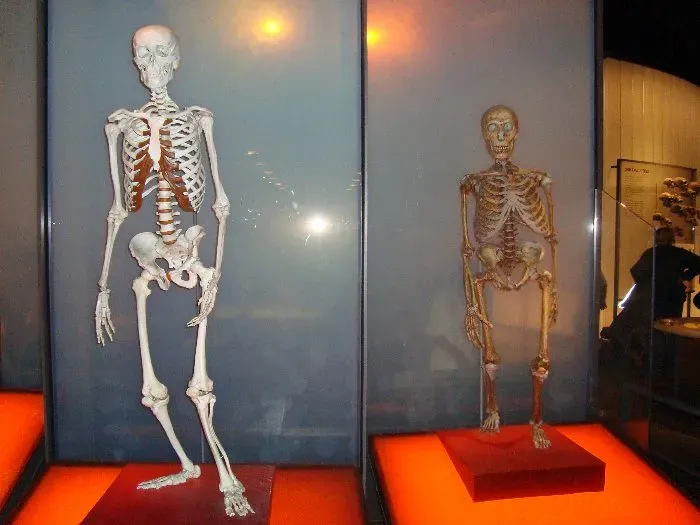
Your species, Homo sapiens, first evolved in Africa more than 300,000 years ago, and for a long time, you remained exclusively African. Fragments of 300,000-year-old skulls, jaws, teeth and other fossils found at Jebel Irhoud in Morocco are the oldest Homo sapiens remains yet found. Let’s be real here – your ancestors weren’t alone.
Homo erectus and Homo heidelbergensis had already travelled beyond Africa to explore parts of Eurasia, and sister species like the Neanderthal and Denisovan would traipse around there way before we did. Yet there was something special about Homo sapiens. Species of early Homo were more flexible in their dietary choices than other species, and their flexible diet was aided by stone tool-assisted foraging that allowed your ancestors to exploit a range of resources. This adaptability would become your superpower.
Climate as Catalyst: Why They Left
Why some Homo sapiens left Africa in the first place is uncertain, but it’s believed that changes in the climate offer the best explanation. The hominin fossil record and the environmental record show that hominins evolved during an environmentally variable time, with higher variability occurring as changes in seasonality produced large-scale environmental fluctuations.
Here’s the thing: your ancestors weren’t necessarily seeking adventure. It may have been that the climate temporarily became slightly warmer and wetter in western Asia, or parts of northern Africa might have grown more arid, pushing these populations out of the continent – they were simply following their food. Human traits evolved over time because they enabled human ancestors to adjust to environmental uncertainty and change. I think that’s remarkable – survival came down to flexibility rather than brute strength.
Routes Out of Africa: Pathways to the Unknown
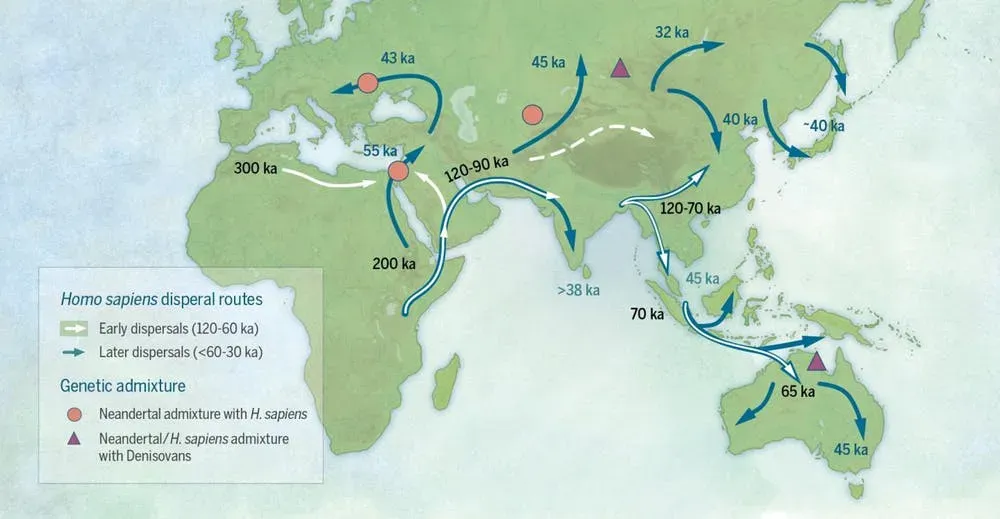
A small group from a population in East Africa, numbering possibly fewer than 1,000 individuals, crossed the Red Sea strait at Bab-el-Mandeb to what is now Yemen, after around 75,000 years ago. One likely route for early human migration out of Africa was through the Sinai and Arabian Peninsulas, where Homo sapiens could have migrated on foot without having to attempt a sea crossing.
An international team of scientists found early human migrants left Africa for Eurasia, across the Sinai peninsula and on through Jordan, over 80-thousand years ago. There was a “well-watered corridor” which funnelled hunter-gatherers through The Levant towards western Asia and northern Arabia via Jordan, supporting previous research suggesting this green, overland route was favoured by travelling Homo sapiens. Multiple paths existed, though. Some coastal routes allowed your ancestors to follow familiar marine resources.
Adapting to Diverse Environments: The Ultimate Survival Test
Later species, especially H. sapiens, settled in more extreme habitats including deserts and tundra. Among the hominins studied, only H. sapiens was able to successfully adapt to mosaic landscapes, and this adaptability to changing climate regimes evolved through consistent occupation of mosaic landscapes as they dispersed throughout the globe. What does this mean for you? Your ancestors became masters at reading landscapes.
When humans started to spread to different parts of the world about 100,000 years ago, they encountered a variety of different climatic conditions and evolved new physical adaptations more suitable to those new climates. Early humans developed more sophisticated stone tools and weapons, expanded trade networks, and even evidenced the growth of symbolic communication. Honestly, it’s hard to say for sure how quickly these changes happened, yet the evidence points to rapid innovation.
Social Networks and Innovation: Strength in Numbers

Modern humans, Homo sapiens, had specialized tools to extract a variety of dietary resources, had broad social networks as shown by the exchange of goods over a long distance, and used symbols as a means of communicating and storing information. These weren’t just bands of wandering hunters – they were connected communities.
Combining three kinds of advance could have led directly to bursts of innovation, and at the point where new ideas balance out with lost ones, the number of ideas a population can support increases dramatically with population size. Neanderthals had roughly a third the population of other early humans, and migration was always out of Africa – modern humans migrating from Africa might have brought with them a more advanced repertoire of technologies.
Conquering the Coldest Frontiers: Ice Age Survival

Your Homo sapiens ancestors had migrated from the warm African heartland into northern European and Eurasian latitudes severely impacted by sinking temperatures, yet armed with big, creative brains and sophisticated tools, these early modern humans not only survived but thrived. Around 30,000 years ago came the most important invention in human history: the needle, which enabled humans to make tight-fitting clothing tailored to the individual.
Through music, dance and art, your ancestors collected and transmitted vast amounts of information about the seasons, edible plants, animal migrations, weather patterns – and when wildlife biologists look at cave paintings of reindeer and bison, they can tell you what time of year it was painted just from the appearance of the animals’ hides, showing how incredibly these people knew their environment. Think about that level of environmental mastery.
Global Domination: Reaching Every Corner
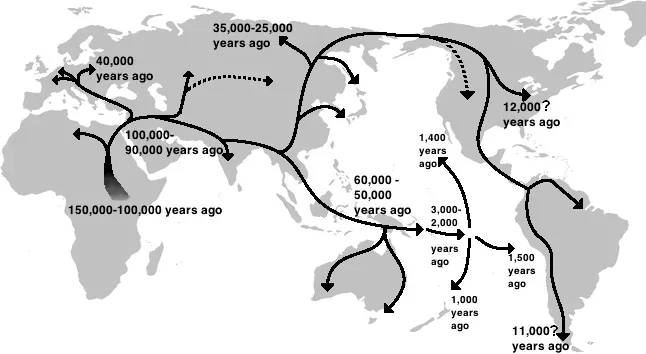
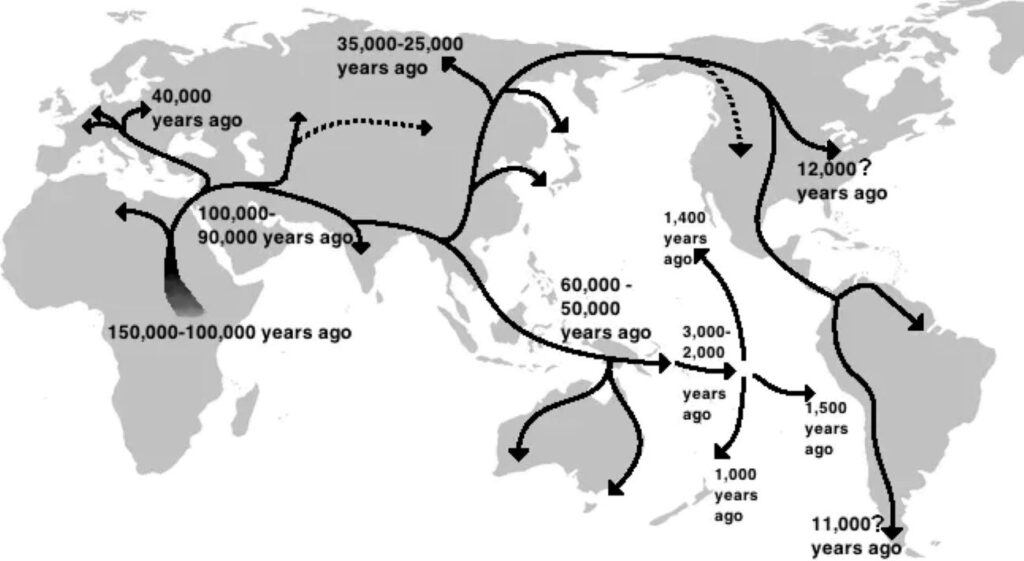
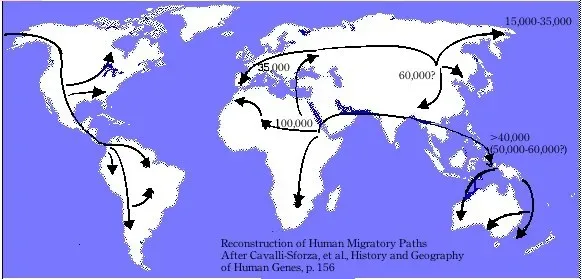
Modern humans spread across Europe about 40,000 years ago. From their beginnings in Africa, modern humans went first to Asia between 80,000 and 60,000 years ago, and by 45,000 years ago, or possibly earlier, they had settled Indonesia, Papua New Guinea and Australia. After the Last Glacial Maximum, North Eurasian populations migrated to the Americas about 20,000 years ago.
Approximately 45 to 60 thousand years ago, a very rapid population expansion occurred outside of Africa, and spread in all directions across the Eurasian continents, eventually populating the entire world. Humans reached the Americas through the Bering Land Bridge by around 15,000 years ago, and after this, there were some last strongholds that remained human-free for a long time still, such as Hawaii – reached by boat around 100 CE – and New Zealand, which held out until around 1000 CE. Your species had finally conquered the globe.
The great migration wasn’t a single journey – it was thousands of journeys across hundreds of thousands of years. What truly sets you apart from other species isn’t superior strength or speed. It’s adaptability. Your ancestors survived by being flexible, innovative, and connected. They transformed landscapes, developed technologies, and created cultures that could weather any storm.
Every challenge they faced made them – and ultimately you – more resilient. The next time you adapt to a difficult situation or learn something new, remember that this ability is woven into your DNA, a gift passed down through countless generations of survivors who refused to give up. What would they think about how you’re using their legacy today?