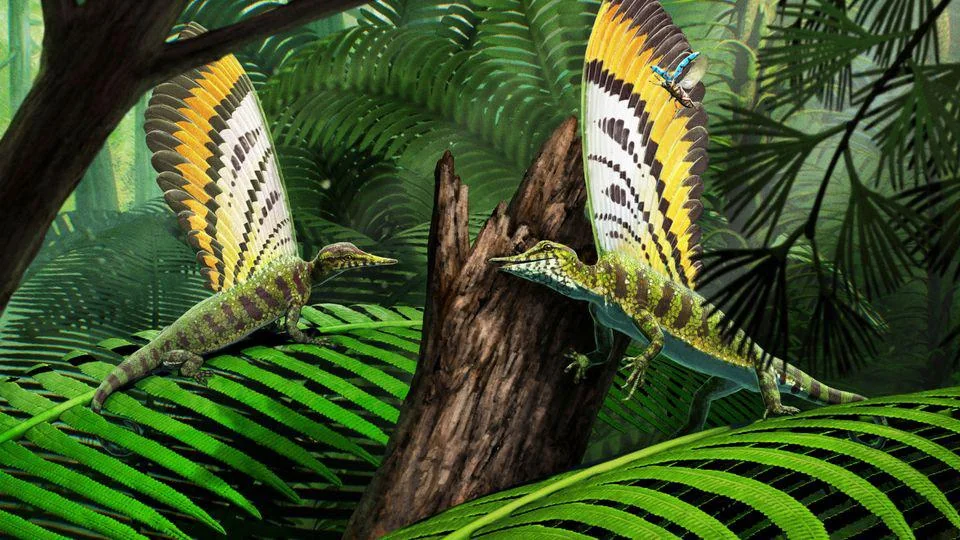
Alsace, France – A humble fossil gathered from local quarries in the 1930s has emerged as a pivotal clue in reptile evolution. Paleontologists recently identified Mirasaura grauvogeli, a small tree-dwelling reptile from 247 million years ago, sporting a striking dorsal crest of feather-like skin structures. This Middle Triassic find, preserved in the Grès à Voltzia Formation, predates dinosaurs and reveals that complex integumentary appendages arose earlier and more diversely than previously thought.
A Forgotten Collection Yields a Surprise
A Forgotten Collection Yields a Surprise (Image Credits: Reddit)
Fossil enthusiast Louis Grauvogel prospected sandstone quarries in the Vosges Mountains during the 1930s. He amassed specimens from the early Anisian stage of the Middle Triassic, including intriguing reptile remains. His collection, later donated to the State Museum of Natural History in Stuttgart, sat largely unstudied until 2019.
Researchers there noticed unusual structures on the fossils. Advanced preparation revealed a tiny skull beneath what appeared to be leafy imprints. Synchrotron X-ray tomography at the European Synchrotron Radiation Facility enabled a full 3D reconstruction, confirming a new species. Lead author Stephan Spiekman spent months processing the scans of the millimeter-scale specimen.
The team published their findings in Nature on July 23, 2025. Co-authors included reptile expert Rainer Schoch and Hans-Dieter Sues, who noted the reptile’s place among early post-extinction innovators.
Unpacking the Anatomy of Mirasaura
Mirasaura grauvogeli measured mere centimeters long, fitting in a human palm. Its skull featured an elongate, tapering snout with edentulous anterior jaws, dome-like roof bones, and forward-facing orbits suited for arboreal life. The body formed a barrel-shaped trunk with a slight anterior hump, supported by 24 dorsal vertebrae and a deep tail.
Curved pedal unguals and a prehensile tail suggested climbing habits, extracting insects from bark crevices. The standout feature ran along the back: a serial crest of 16 to 20 densely overlapping appendages. Each measured up to 51 millimeters high, narrowing proximally before expanding into bilateral laminae separated by a medial ridge.
- Appendages lacked branching barbs, unlike bird feathers.
- Rugae or folds covered surfaces, hinting at flexibility.
- Melanosomes in preserved films showed rod-to-ovoid shapes akin to feathers, not scales or hair.
- Scanning electron microscopy confirmed carbon-rich films rich in iron and other elements.
Phylogenetic analysis placed it within Drepanosauromorpha, a Triassic clade basal to modern reptiles.
Feather-Like, Yet Distinct
The crest evoked feathers at first glance, with its contour and overlapping arrangement. Yet detailed imaging showed no rachis derived from barbs or follicular origins. Appendages formed solid sheets, evolving independently as display structures for mating or deterrence.
Similar sails appeared in the enigmatic Longisquama, another drepanosauromorph. Convergent evolution explained the mimicry, tapping shared genetic toolkits from amniote ancestors. Spiekman observed, “The fact that we have discovered such complex skin appendages in such an ancient group of reptiles sheds a new light on their evolution.”
| Feature | Mirasaura Crest | Bird Feathers |
|---|---|---|
| Structure | Unbranched laminae with medial ridge | Rachis with branching barbs |
| Melanosomes | Rod-ovoid, feather-like shapes | Varied, including similar forms |
| Homology | Independent origin | Avemetatarsalian-specific |
| Function | Likely display | Display, insulation, flight |
This table highlights structural parallels without genetic ties.
Rewriting Reptile Origins
Mirasaura thrived in lush, conifer-fringed river deltas shortly after the Permian-Triassic extinction. Its appendages pushed back evidence of integumentary complexity by millions of years. Previously, such traits linked to warm-blooded dinosaurs and mammals; now, cold-blooded basal reptiles joined the roster.
Rainer Schoch remarked, “Mirasaura grauvogeli shows us how surprising evolution can be and what potential it holds.” The find extended Drepanosauromorpha’s range and blurred lines between scaly reptiles and feathered avians. Genetic studies suggest corneous beta-proteins enabled this since the Carboniferous.
Arboreal niches fostered innovation, as seen in grasping limbs and specialized dentition. Hans-Dieter Sues added, “Drepanosaurs have many ecological adaptations… The dorsal crest… adds to the range of remarkable adaptations.”
Key Takeaways
- Complex skin structures evolved independently in non-dinosaurian reptiles 247 million years ago.
- Mirasaura’s crest demonstrates convergent evolution with feathers for display purposes.
- Modern imaging unlocked details from 1930s fossils, highlighting technology’s role in paleontology.
This Triassic marvel underscores evolution’s creativity in the recovery after mass extinction. Forests teemed with experimental forms, many lost to time. What innovations might future scans reveal? Share your thoughts in the comments.