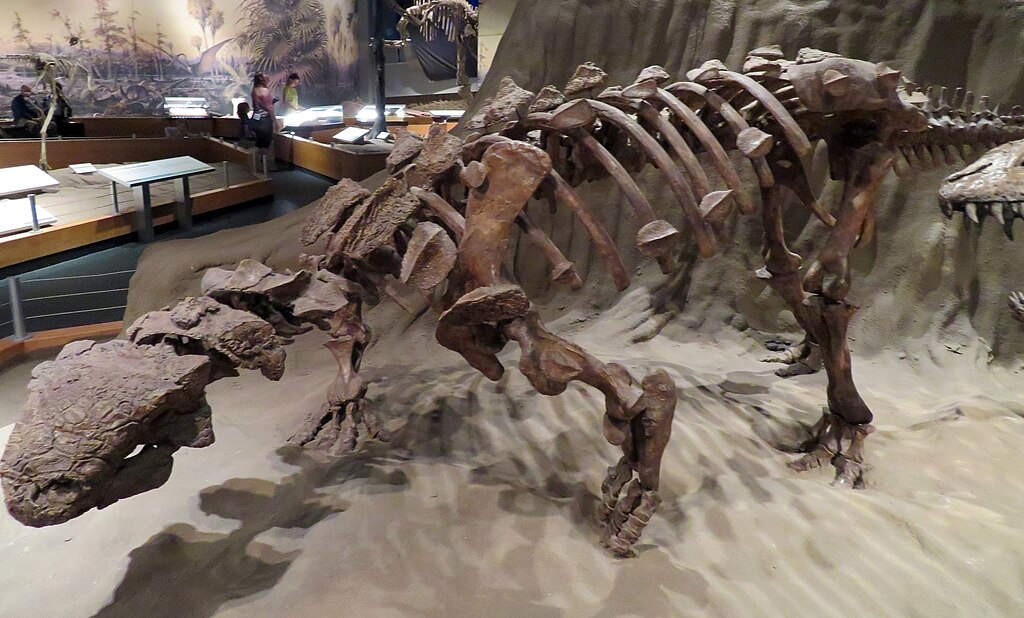
Imagine walking through an ancient mudflat seventy-five to seventy-six million years ago and witnessing something extraordinary – different species of dinosaurs traveling together like a prehistoric convoy. The discovery provides the first evidence of mixed-species herding behavior in dinosaurs, similar to how modern wildebeest and zebra travel together on the African plains. This isn’t science fiction or Hollywood fantasy anymore; it’s real evidence captured in stone, revolutionizing our understanding of how these magnificent creatures lived their social lives.
Mixed-Species Herds: A Revolutionary Discovery

Paleontologists say they have discovered the 75-76-million-year-old footprints of a ceratopsian dinosaur-dominated herd in Dinosaur Provincial Park in Alberta, Canada. This groundbreaking find represents something unprecedented in dinosaur research. The trackways show at least five ceratopsians – horned dinosaurs like Triceratops – walking alongside an ankylosaur, creating what researchers describe as the first documented evidence of mixed-species herding in dinosaurs.
While there, they discovered a set of at least 20 full and partial dinosaur footprints preserved in a roughly 312-square-foot section of sediment. But unlike past finds, the tracks didn’t all belong to one type of dinosaur. The footprints tell a fascinating story of cooperation across species boundaries. In a patch of land roughly the size of two parking spaces, the team was able to excavate over a dozen fossilized footprints. Unlike other dinosaur track sites where footprints often overlap, these tracks were evenly spaced and showed no signs of crowding. Based on their size, shape, and direction, the researchers concluded they were likely made by a mixed-species group of at least five dinosaurs walking together.
The Predator-Prey Drama Frozen in Time

Perhaps the most chilling aspect of this discovery involves two large tyrannosaurs whose tracks were found perpendicular to the herd. But it was the discovery of two additional footprint sets perpendicular to the herd that potentially provide the best context to the Cretaceous era snapshot. Not far away, a duo of large tyrannosaurs appear to have been stalking the other dinosaurs. The positioning suggests these apex predators might have been coordinating their approach, similar to how modern lions work together to hunt herds of zebra and wildebeest.
“The tyrannosaur tracks give the sense that they were really eyeing up the herd, which is a pretty chilling thought, but we don’t know for certain whether they actually crossed paths.” The trackway creates a snapshot of prehistoric tension – herbivorous dinosaurs moving together for protection while massive carnivores potentially stalked them from the periphery. The researchers were also surprised to find the tracks of two large tyrannosaurs walking side-by-side and perpendicular to the herd, raising the prospect that the multispecies herding may have been a defense strategy against common apex predators.
Ancient Highways Across Continents

Dinosaur footprints don’t just reveal local behavior – they expose continental-scale movement patterns. More than 260 footprints were discovered in Brazil and in Cameroon, showing where land-dwelling dinosaurs were last able to freely cross between South America and Africa millions of years ago before the two continents split apart. These matching trackways demonstrate that dinosaurs used predictable migration routes across vast distances, creating what scientists call “dinosaur highways.”
The Brazilian and Cameroonian footprints are nearly identical, despite now being separated by roughly 3,700 miles of ocean. “In terms of their shapes, they are almost identical.” The footprints, impressed into mud and silt along ancient rivers and lakes, were found more than 3,700 miles, or 6,000 kilometers, away from each other. “The dinosaurs made the tracks 120 million years ago on a single supercontinent known as Gondwana – which broke off from the larger landmass of Pangea,” revealing how these creatures navigated their changing world.
Britain’s Massive Dinosaur Highway System

In a stunning find, researchers from the Universities of Oxford and Birmingham have uncovered a huge expanse of quarry floor filled with hundreds of different dinosaur footprints, creating multiple enormous trackways. Dating back to the Middle Jurassic Period (around 166 million years ago), the trackways form part of a huge ‘dinosaur highway’ The British discovery represents one of the most extensive trackway systems ever found in the UK.
They form five extensive trackways, with the longest stretching for more than 150 metres. Four of the trackways were made by a species of gigantic, long-necked, herbivorous sauropod. The researchers believe the most likely candidate is Cetiosaurus, which was an 18-metre-long cousin of the more famous Diplodocus. The fifth trackway belonged to Megalosaurus, a ferocious carnivore. One area of the site shows the carnivore and herbivore tracks crossing over, suggesting the predator followed up on the steps of the sauropod.
Age-Segregated Communities

Early dinosaur societies were far more complex than previously imagined. Researchers from MIT, Argentina, and South Africa say Mussaurus patagonicus may have lived in herds some as early as 193 million years ago – 40 million years earlier than other records of dinosaur herding. In a paper appearing today in Scientific Reports, researchers from MIT, Argentina, and South Africa detail their discovery of an exceptionally preserved group of early dinosaurs that shows signs of complex herd behavior as early as 193 million years ago
The Mussaurus discovery reveals sophisticated social organization. When the researchers unearthed the remains, they noticed that the younger specimens were grouped together while the adults were in pairs or alone. This suggests that the animal gathered in age-oriented groups, a habit of many larger animals today. The results point to herd-like behavior among the dinosaurs, where the adults likely foraged for food and collectively helped raise the younger ones, which grouped together in schools. This pattern mirrors modern elephant herds, where juveniles stay together under adult supervision.
Modern Trackway Technology Reveals Hidden Secrets

Twenty-first century technology is revolutionizing how we interpret ancient footprints. Together, they painstakingly uncovered around 200 footprints and built detailed 3D models of the site using aerial drone photography – documenting the footprints in unprecedented detail for future research. These advanced techniques allow paleontologists to extract information that would have been impossible to gather just decades ago.
The preservation of these latest fossils is so detailed that researchers can see how the mud was deformed as the dinosaurs trod across the soft ground. The scientists have taken more than 20,000 images of the footprints. This will allow them to find out more about the lives of these reptiles, such as how they walked, how fast they were travelling, how large they were and whether they were alone or in a group. The level of detail preserved in these ancient mudflats provides snapshots of behavior that skeletal remains simply cannot offer.
Colonial Nesting Grounds

Dinosaur footprints often lead to even more remarkable discoveries – massive nesting colonies. Sites like “Egg Mountain” in Montana have revealed hundreds of Maiasaura nests in close proximity, strongly suggesting colonial nesting behavior similar to modern seabirds. These nests contain evidence that parents provided care to their young, including worn teeth in adult specimens consistent with gathering food for nestlings.
The nesting sites show remarkable organization and planning. The arrangement of nests in these colonies often shows regular spacing, suggesting territorial boundaries within a larger social structure. Particularly compelling are the massive sauropod nesting grounds in Argentina, where hundreds of titanosaur nests have been discovered in distinct layers, indicating that the same locations were used repeatedly over generations. This site fidelity and colonial nesting strongly suggest complex social interactions and possibly coordinated breeding seasons among dinosaur populations.
Trackways Reveal Speed and Movement Patterns

Footprints preserve the physics of dinosaur locomotion in ways bones cannot. Dinosaur tracks are fossilized behavior. Each footstep represents an actual moment in the dinosaur’s life, affected by how it was moving. And while paleontologists have found trackways made by running dinosaurs before, this year paleontologists described a trackway made by a dinosaur that was flapping as it ran.
Detailed in the Proceedings of the National Academy of Sciences, the Cretaceous trackway was made by a two-toed dinosaur like Microraptor. The spacing between the tracks indicates the dinosaur was moving at high speed, but it seemed to be moving even faster than expected if the dinosaur was just propelling itself with its legs alone. The little raptor was likely flapping as it kicked with its feet, even though experts aren’t sure if the dinosaur was trying to take off, land, run up an incline or something else. These discoveries challenge traditional views of dinosaur locomotion and behavior.
Mass Migration Evidence

Some trackway sites suggest movements on an almost unimaginable scale. Some dinosaur trackways record hundreds, perhaps even thousands, of animals, possibly indicating mass migrations. The existence of so many trackways suggests the presence of great populations of sauropods, prosauropods, ornithopods, and probably most other kinds of dinosaurs. These massive movements would have fundamentally shaped ancient ecosystems.
The majority must have been herbivores, and many of them were huge, weighing several tons or more. The impact of such large herds on the plant life of the time must have been great, suggesting constant migration in search of food. The most impressive evidence comes from a site in Bolivia, where over 5,000 footprints representing at least 300 individual sauropods demonstrate coordinated movement. Crucially, these trackways often show different-sized footprints intermingled, suggesting family groups with adults and juveniles traveling together.
Seasonal Migration Patterns

Recent technological advances in studying dinosaur teeth have revealed evidence for seasonal behavior. Sauropod tooth scratches reveal that some dinosaurs migrated seasonally, others ate a wide variety of plants, and climate strongly shaped their diets. Tanzania’s sand-blasted vegetation left Sauropod tooth scratches reveal that some dinosaurs migrated seasonally, others ate a wide variety of plants, and climate strongly shaped their diets.
The combination of trackway evidence and dental analysis paints a picture of dinosaurs as highly mobile creatures that responded dynamically to environmental changes. Some species appear to have followed predictable seasonal routes, much like modern migratory animals. The trackways provide the roadmap, while the dental evidence reveals the ecological pressures driving these massive movements across prehistoric landscapes.
Scientific Skepticism and Ongoing Debates

Not all paleontologists agree with the mixed-species herding interpretation. Anthony Romilio, a paleontologist at the University of Queensland in Australia, says that although some dinosaurs likely did form mixed-species herds, he disagrees with how the authors interpreted the footprints. “As researchers, we’re naturally drawn to the possibilities these fossils offer – but that excitement can sometimes lead to interpretive overreach,” Romilio says. In his view, the ceratopsian and ankylosaurid tracks look similar in shape, and he thinks they are more likely to be poorly preserved footprints of large-bodied hadrosaurs.
Christian Meyer, a paleontologist from the University of Basel in Switzerland, is also skeptical, and calls the findings “speculative.” “I find that the preservation of the tracks, including their taxonomic assignment, is on weak feet, as there are no complete trackways preserved that show also the walking” These debates highlight how challenging it can be to interpret ancient evidence and underscore the importance of continued research and peer review in paleontology.
Conclusion: Walking in Ancient Footsteps

Fossilized dinosaur footprints have opened an unprecedented window into the social lives of these magnificent creatures. From mixed-species herds traveling together for protection to massive migration highways spanning continents, the evidence reveals dinosaurs as complex, social animals whose behavior paralleled many modern species. “It was incredibly exciting to be walking in the footsteps of dinosaurs 76 million years after they laid them down. Using the new search images for these footprints, we have been able to discover several more tracksites within the varied terrain of the park, which I am sure will tell us even more about how these fascinating creatures interacted with each other and behaved in their natural environment.”
The story written in stone continues to unfold as technology advances and new discoveries emerge. Each trackway site adds another chapter to our understanding of dinosaur society, revealing that these ancient giants lived rich, complex social lives that shaped their survival strategies and evolutionary success. What other secrets remain buried in the mud, waiting for the next generation of paleontologists to uncover? The footprints suggest we’ve only begun to scratch the surface of dinosaur social complexity.
未定種.jpg)