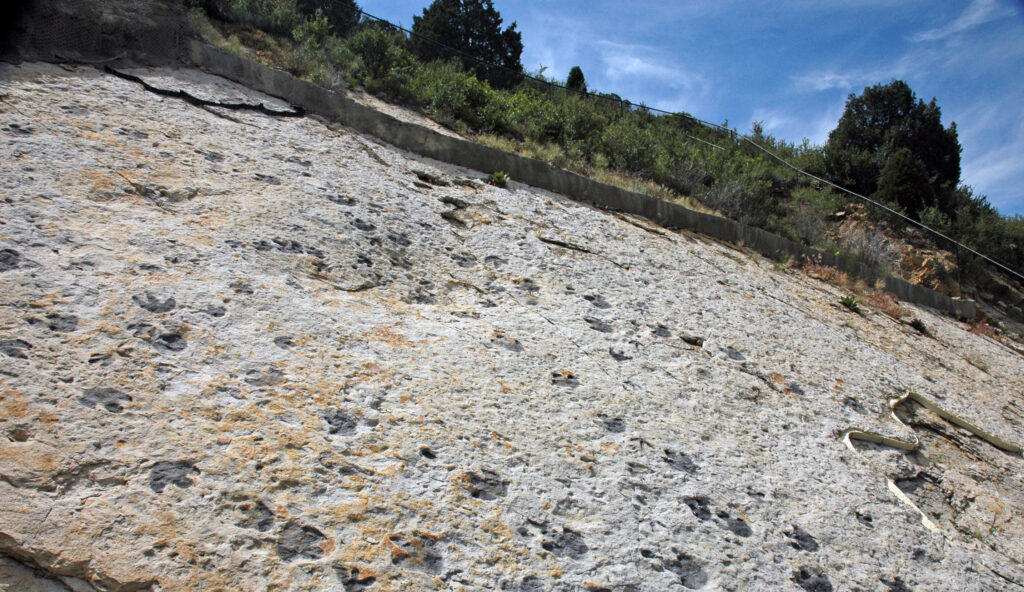
There is something quietly staggering about standing next to a rock and realizing a living creature left its mark there over 100 million years ago. Not a bone, not a tooth. A footstep. A single frozen moment from a world that no longer exists. Honestly, the idea that geology itself acted as a kind of time capsule, preserving these fleeting impressions against all odds, feels almost too extraordinary to believe.
For a track made tens of millions of years ago to survive until the present, several very specific steps had to occur. The sediment a dinosaur walked through needed to be just the right texture, not too soft and not too hard. Prints in very wet soil would collapse on themselves, while walking in hard soil simply didn’t make much of an impression. It’s a precise geological recipe, and the fact that it worked at all is remarkable. Let’s dive into five of the most breathtaking sites where nature got that recipe exactly right.
Cal Orcko, Bolivia: The Limestone Wall That Defied Gravity
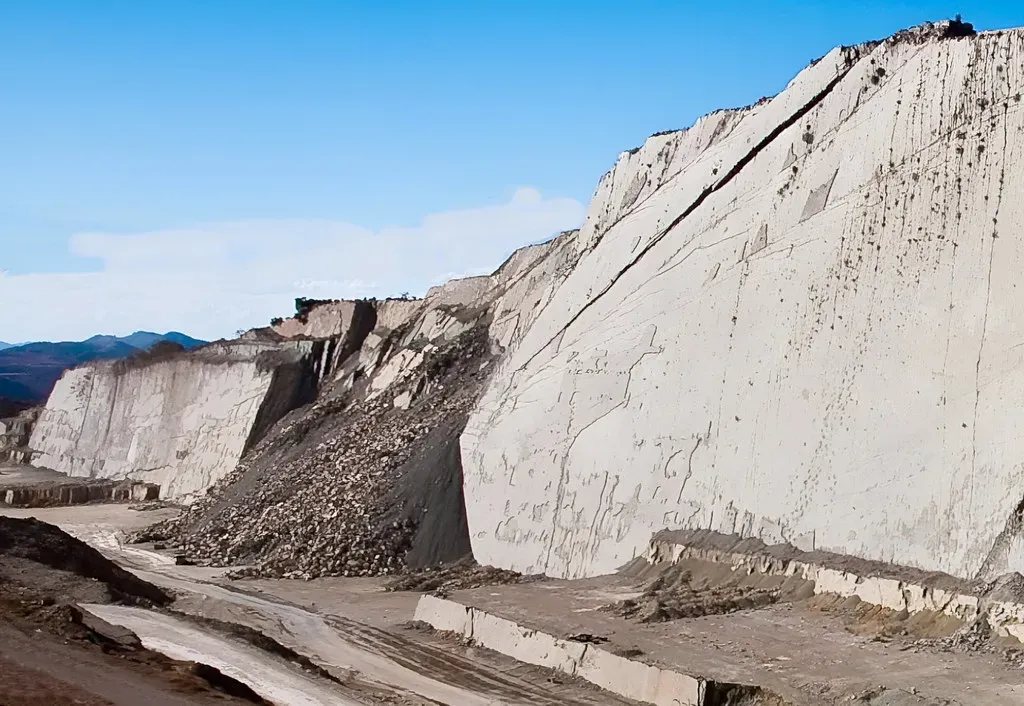
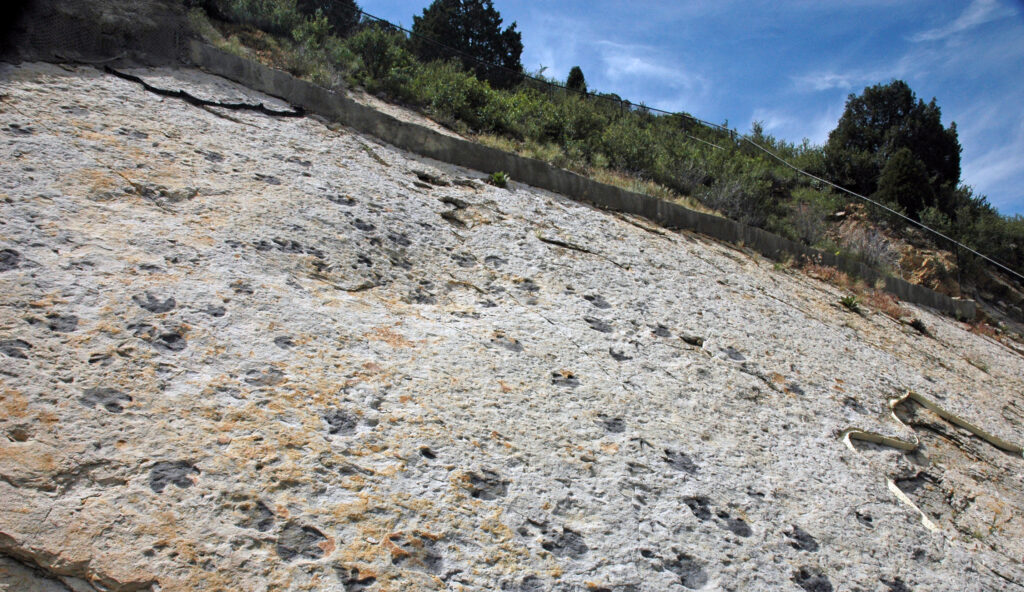
Picture this: you’re looking at a towering cliff face, nearly 300 feet high and over a mile long, and it’s absolutely covered in dinosaur footprints. Every track appears to run straight up the wall, as if entire herds of dinosaurs once walked vertically. I know it sounds crazy, but the explanation is even wilder than the visual.
Originally, the area at Cal Orcko was a flat shoreline of a lake that attracted both herbivorous and carnivorous dinosaurs. The soft, humid ground caused their feet to sink, leaving deep impressions. Alternating wet and dry weather patterns then preserved these footprints by creating protective sediment layers. Tectonic movements eventually tilted the flat ground, creating the nearly vertical 300-foot-high limestone wall you can see today.
Detailed mapping conducted from 1998 to 2015 documented over 12,000 individual tracks across 465 trackways, confirming its status as the world’s largest dinosaur tracksite. Think about that for a second. Over twelve thousand individual steps, all frozen in stone. These tracks date back approximately 68 million years, placing them in the late Cretaceous period, just before the mass extinction event that wiped out the dinosaurs. Among the most remarkable finds is a trail belonging to a juvenile Tyrannosaurus Rex, nicknamed “Johnny Walker,” whose continuous 347-meter-long trail represents the longest dinosaur walk ever found.
Dinosaur Valley State Park, Texas: When an Ancient Sea Became a River
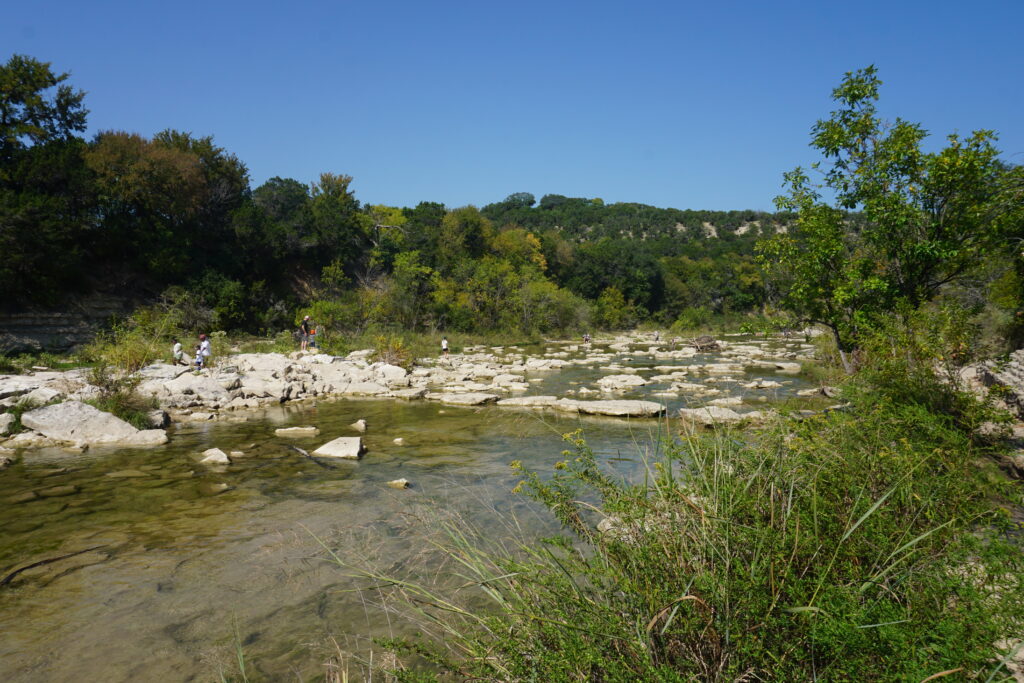
If you’ve never waded into the Paluxy River and felt ancient limestone under your bare feet while staring at something that once belonged to a creature the size of a bus, you are genuinely missing out. The Glen Rose area of Texas is one of the most geologically fascinating places on the continent, and it all comes down to what that land used to be.
About 120 million years ago, soft, muddy lime sediment was deposited in bays and lagoons on the west shore of a shallow sea. Groups of dinosaurs walked here across the soft mud while it was still wet. Fine clayey and silt sediments washed in from land areas to the north and west and quickly buried the tracks. Beaches or lime sand bars were then formed as more marine conditions slowly returned, and lime sediments were quickly cemented to form moderately hard limestone.
In 1938, Roland T. Bird, assistant to Barnum Brown of the American Museum of Natural History in New York, discovered a dozen sauropod and four theropod or carnosaur trackways all following the same general direction. These were the first sauropod footprints ever scientifically documented, and were later designated a National Natural Landmark in 1969. Rear footprints of the sauropods are as much as 3 feet in diameter and 18 inches deep. The sheer scale of these animals, encoded permanently into rock, is genuinely hard to process. The Paluxy River itself now acts as a dual agent: it constantly uncovers new tracks while simultaneously threatening to erode the ones already exposed.
The High Atlas Mountains, Morocco: A Flood Plain Frozen in Jurassic Time
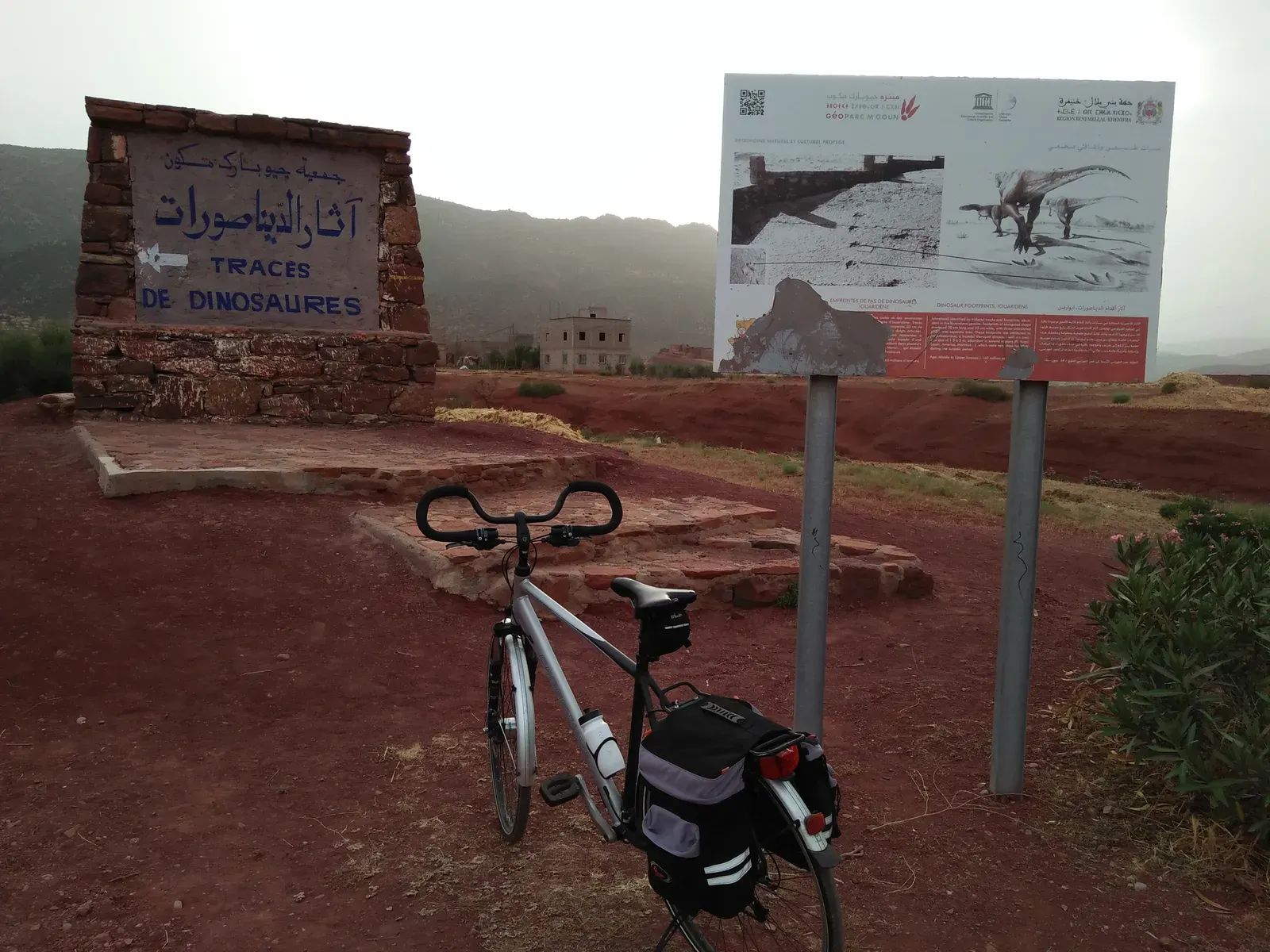
You might not immediately associate North Africa with dinosaur highways, but here’s the thing: the High Atlas Mountains of Morocco hold one of the most geologically perfect preservation environments ever discovered. The secret lies in what that landscape was doing roughly 150 million years ago.
Scientists found track sites in the Imilchil-Outerbat region of Morocco, located in the heart of the nation’s central High Atlas mountains. The sites lie within the Isli geological formation, which is between 167 and 145 million years old, a period that falls squarely within the Jurassic Period. In the case of the track sites in the High Atlas mountains, alternating deposits of flood-plain mud and river sands created an “ideal setting” for the preservation and fossilization of tracks. It’s like nature laid down a perfectly timed sandwich of sediment, pressing the footprints safely between geological layers like flowers in a book.
Among the tracks researchers documented were those made by theropod, sauropod, and ornithopod dinosaurs, some of the major groups in the entire dinosaur family tree. The first track site described in the latest study extends for almost 200 feet and contains six sauropod trackways, one ornithopod trackway, and 11 theropod trackways. What makes the Moroccan sites particularly exciting is how they reveal an entire ancient ecosystem in motion. You’re not just looking at a footprint. You’re reading a story of predators and prey moving through a lush, river-fed floodplain that no longer exists in any recognizable form.
The Connecticut River Valley, USA: Sandstone That Remembered Everything
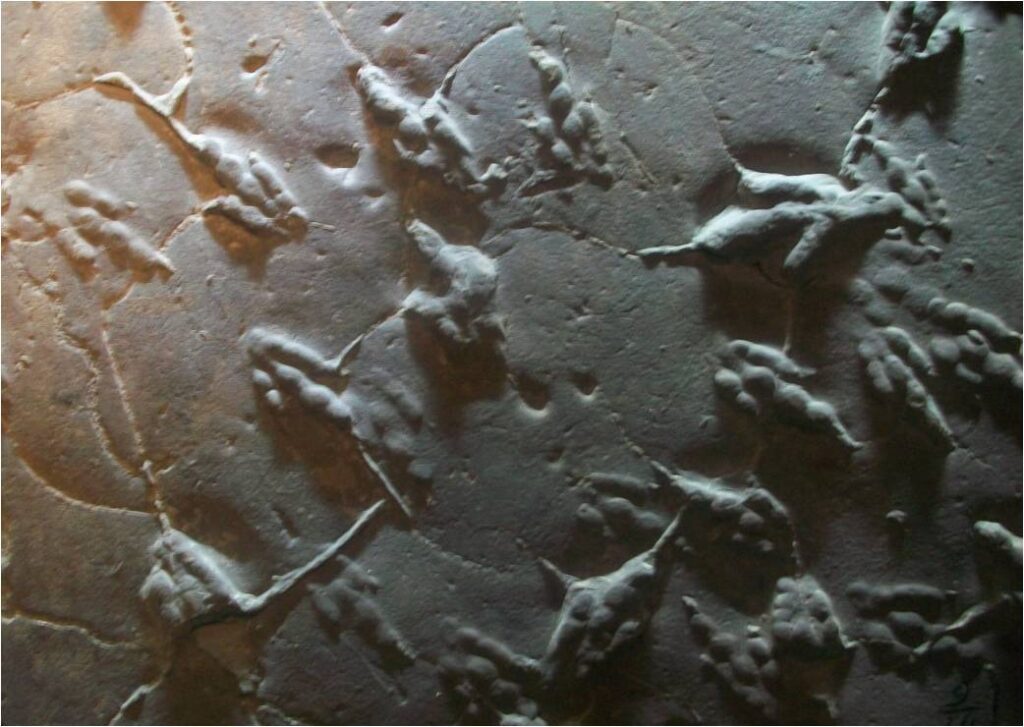
Most people think of New England as the land of autumn leaves and colonial history. Few people realize it’s also home to one of the most historically significant dinosaur footprint sites in the entire world. The Connecticut River Valley holds tracks that quite literally changed how science understood dinosaurs.
The dinosaur tracks at the Holyoke, Massachusetts site were among the first to be scientifically described in 1836, and are still visible to visitors today. Hundreds of tracks, made by as many as four distinct types of two-legged dinosaur, are present in the sandstone outcrops. Ichnology, the formal study of dinosaur tracks, actually began here in 1836 when Amherst College geology professor Edward Hitchcock found tracks from what he thought were “gregarious” birds in a quarry. He was wrong about the birds, but he was right about one thing: something extraordinary had happened in that rock.
Millions of years ago, dinosaurs left their tracks in sediment. Typically, the soil was wet, part of a shoreline, a mudflat or even the bottom of a shallow sea. As the area dried, the tracks hardened. Eventually, another layer of sediment filled the prints, protecting them from erosion or damage. The sandstone of the Connecticut Valley captured all of this with extraordinary fidelity. Besides the clearly formed dinosaur tracks, visitors can also see imprints left by prehistoric plants, invertebrate trace fossils, and delicate ripple marks of an ancient pool preserved in stone near the river’s west bank. It’s essentially a complete prehistoric snapshot.
Gondwana’s Rift Basins: When Two Continents Preserved the Same Footprints
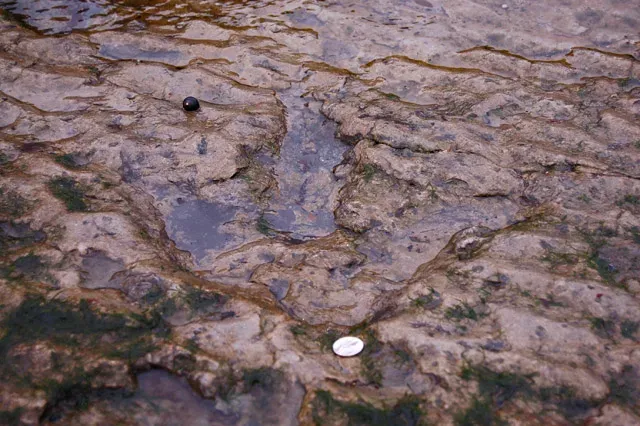
Here’s a geological story so astonishing it almost sounds like science fiction. There are dinosaur footprints in Brazil, and there are dinosaur footprints in Cameroon. They were made by the same animals, walking across the same ground. The fact that they are now separated by an entire ocean is what makes this one of the most mind-bending preservation stories in the entire fossil record.
More than 260 footprints were discovered in Brazil and in Cameroon, showing where land-dwelling dinosaurs were last able to freely cross between South America and Africa millions of years ago, before the two continents split apart. Dinosaurs made the tracks 120 million years ago on a single supercontinent known as Gondwana, which had broken off from the larger landmass of Pangea. The preservation mechanism here was the geological structure of the rift basins themselves.
Half-graben basins, which are geologic structures formed during rifting as the Earth’s crust pulls apart and faults form, are found in both areas and contain ancient river and lake sediments. Along with dinosaur tracks, these sediments contain fossil pollen that indicates an age of 120 million years. Africa and South America started to split around 140 million years ago, causing gashes in the Earth’s crust called rifts to open up along pre-existing weaknesses. As the tectonic plates beneath South America and Africa moved apart, magma from Earth’s mantle rose to the surface, creating new oceanic crust as the continents moved away from each other. The footprints were safely locked inside their respective basin sediments long before the ocean ever formed between them. It’s a reminder that geology operates on a scale so vast that it makes human history feel like a brief footnote.
Conclusion: When the Earth Becomes a Time Capsule
What all five of these extraordinary sites have in common is a chain of geological coincidences so precise they border on the miraculous. The right mud at the right moment. The right sediment arriving at exactly the right time. Tectonic forces that buried and then revealed, preserved and then displayed, what would otherwise have been lost forever.
The preservation of dinosaur footprints follows a series of geological steps that occur over thousands to millions of years. These steps involve the initial formation of the footprint, its burial by sediment, lithification into rock, and eventual exposure due to erosion. Every single site explored here required every single one of those steps to go right. The vast majority of footprints that were ever made simply vanished. The ones that survived did so because the Earth, in its slow and indifferent way, happened to act as a perfect archive.
These aren’t just rocks with impressions in them. They are windows into living moments, snapshots of breath and weight and movement from creatures that ruled this planet for well over 150 million years. The next time you feel a pebble under your shoe, consider this: somewhere in the world, something similar happened to a dinosaur, and the planet decided to remember it. What a thought to sit with.
What do you think is more astonishing: the creatures themselves, or the geological miracle that made sure we could ever know they existed? Share your thoughts in the comments.