You might imagine would be some dusty Victorian institution filled with modest displays of bone fragments. The reality surprises most visitors who discover that this pioneering venture didn’t even have walls or a roof. Instead, it sprawled across landscaped grounds in southeast London, where life-sized concrete dinosaurs still stand today, weathering the elements just as they have for over 170 years.
Natural history artist Benjamin Waterhouse Hawkins unveiled his dinosaur sculptures in 1854. These were the world’s first full-scale reconstructions of dinosaurs and represent the first three species discovered. What began as an ambitious outdoor exhibition in Crystal Palace Park has evolved into something far more complex than its creator could have imagined. These aren’t just historical curiosities gathering moss by a lake. They represent the beginning of how humanity first tried to bring extinct creatures back to life, literally carving our earliest understanding of dinosaurs into stone and iron.
The Ambitious Vision Behind Crystal Palace Park
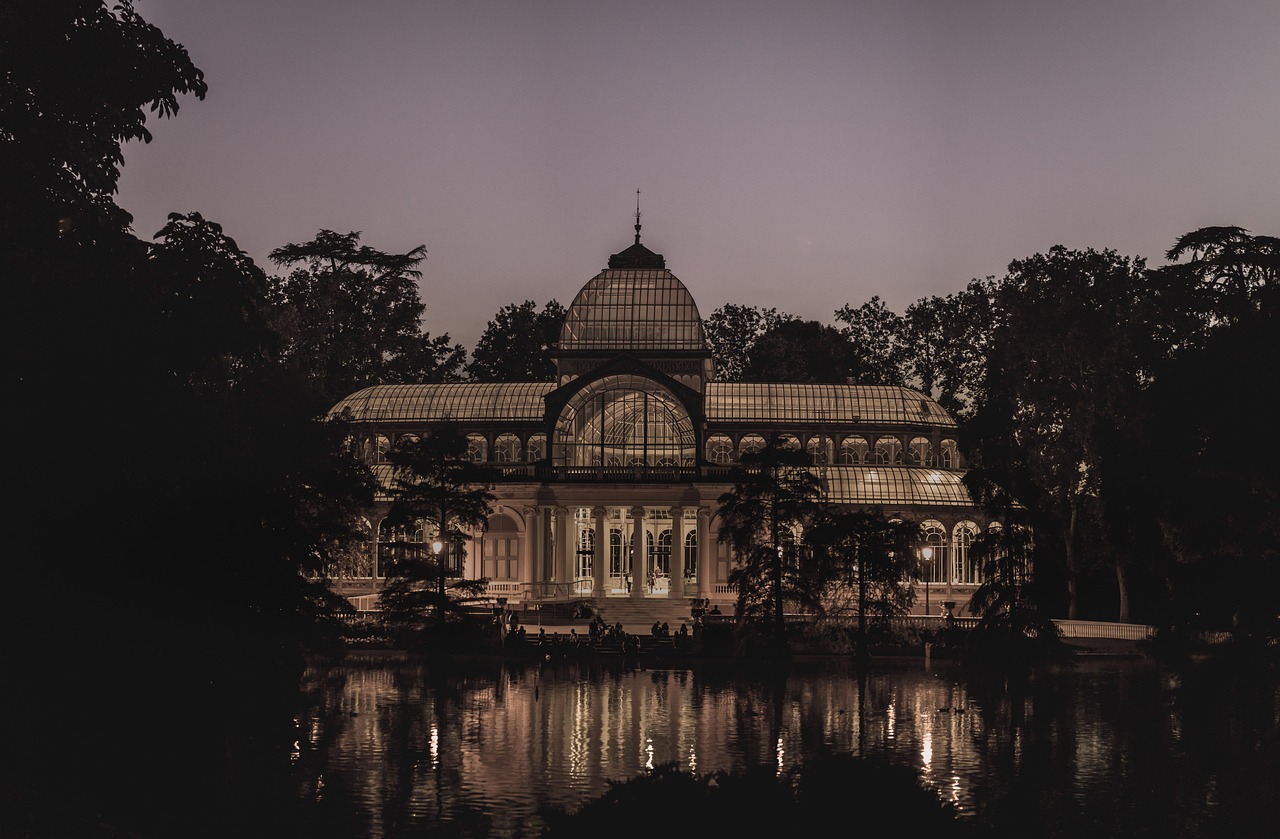
Following the closure of the Great Exhibition in October 1851, Joseph Paxton’s Crystal Palace was bought and moved to Penge Place atop Sydenham Hill, South London, by the newly formed Crystal Palace Company. As part of this renovation, Benjamin Waterhouse Hawkins was commissioned to build the first-ever life-sized models of extinct animals. Think about the audacity of that moment. Scientists had barely begun to understand what these creatures might have looked like, yet here was Hawkins accepting the challenge to create full-scale models.
Outside the palace, Queen Victoria’s husband, Prince Albert, commissioned an outdoor museum with sculptures of animals from Earth’s past. The exhibits, he felt, would have great civic value in educating the public. Albert was especially keen to include a newly named order of “fearfully great lizards,” the dinosaurs. The project was nothing short of revolutionary for its time.
The Famous New Year’s Eve Dinner Inside a Dinosaur

The models were highly anticipated by the public, so playing to the hype and to further publicise the project, Hawkins suggested holding a dinner party inside one of the dinosaurs in order to maximise press coverage. He invited 21 high-profile distinguished guests (all men), including scientists, Crystal Palace investors and newspaper editors, to enjoy an eight-course feast on New Year’s Eve 1853 inside the mould of the Iguanodon model. Picture that scene for a moment: Victorian gentlemen in formal wear climbing into the hollow belly of a concrete dinosaur.
As the ‘brains’ of the project, Richard Owen was sat at the head of the table within the skull of the Iguanodon. Hawkins was in the centre, as later he delivered a short presentation about the sculptures. During the model’s construction, 20 scientists dragged a table inside its hollow interior to ring in New Year’s Eve 1853. They dined on imitation pterodactyl wings and sang a song penned just for the occasion: The jolly old beast Is not deceased. There’s life in him again. ROAR!
What You’ll Find on the Islands Today
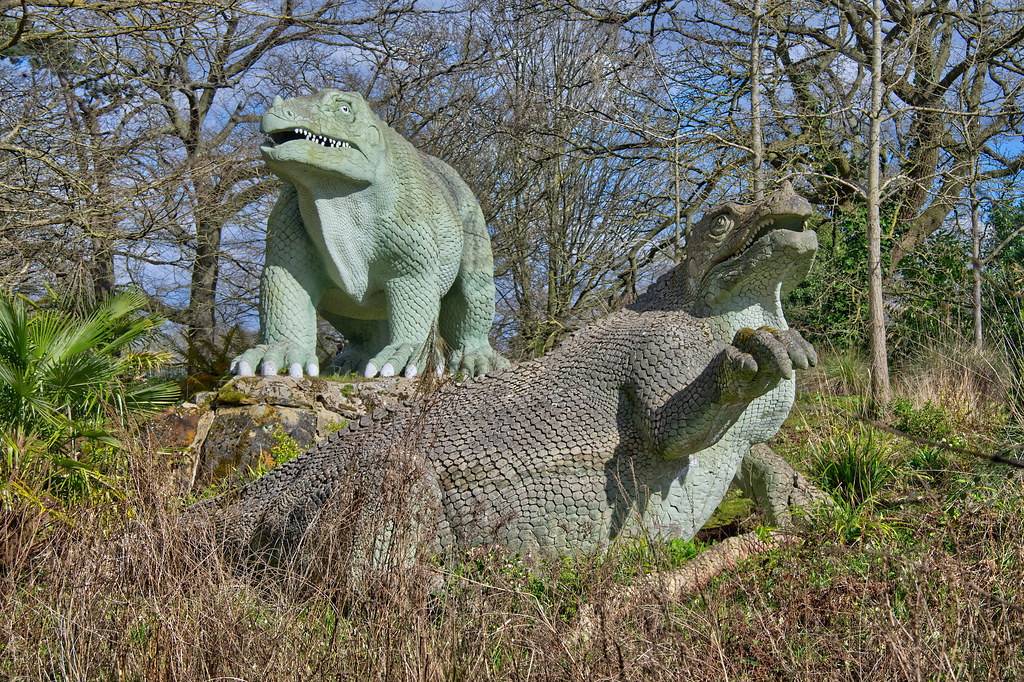
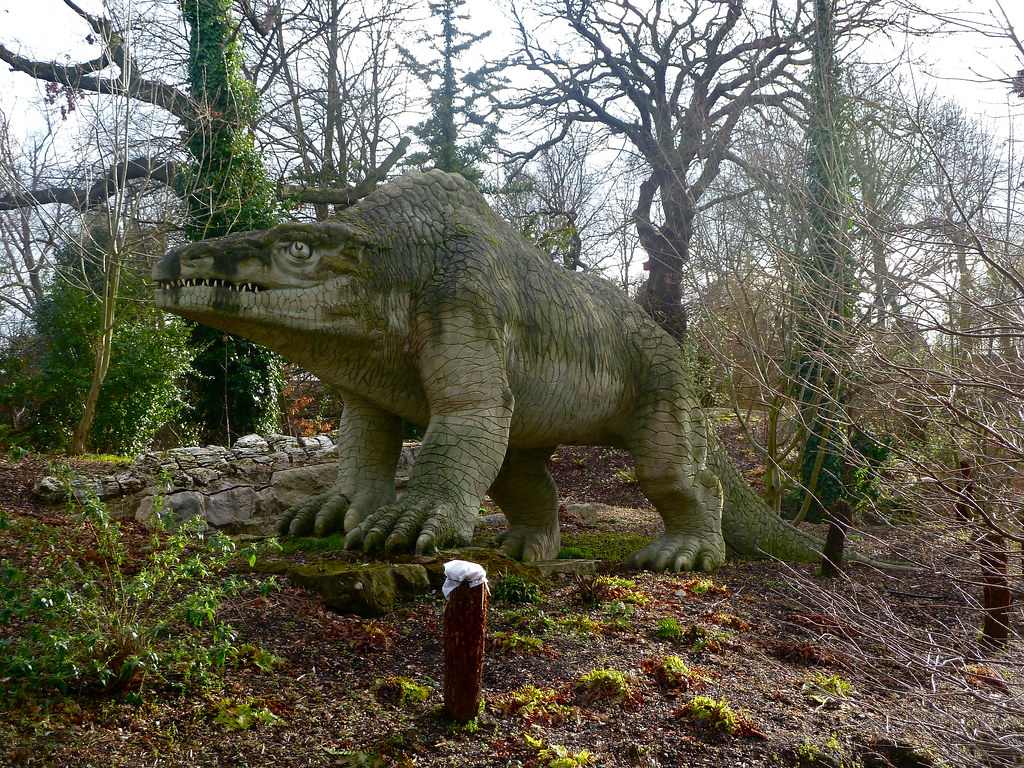
The best-known of Benjamin Waterhouse Hawkins’s numerous sculptures in Crystal Palace, southeast London, are the four dinosaurs: one each of Megalosaurus and Hylaeosaurus, and two Iguanodons. These aren’t replicas or modern reconstructions. You’re looking at the actual sculptures that Victorian families marveled at when the park opened in 1854.
The Crystal Palace Dinosaurs are joined by a number of other prehistoric animal sculptures designed by Waterhouse Hawkins. These include the giant ground sloth Megatherium, the Irish elk Megaloceros, as well as a number of other reptiles including Ichthyosaurs, Mosasaurus and pterosaurs. Walking through the park today feels like stepping into a Victorian fever dream of prehistoric life, where creatures from different geological periods inhabit the same artificial islands.
The Scientific Accuracy Problem
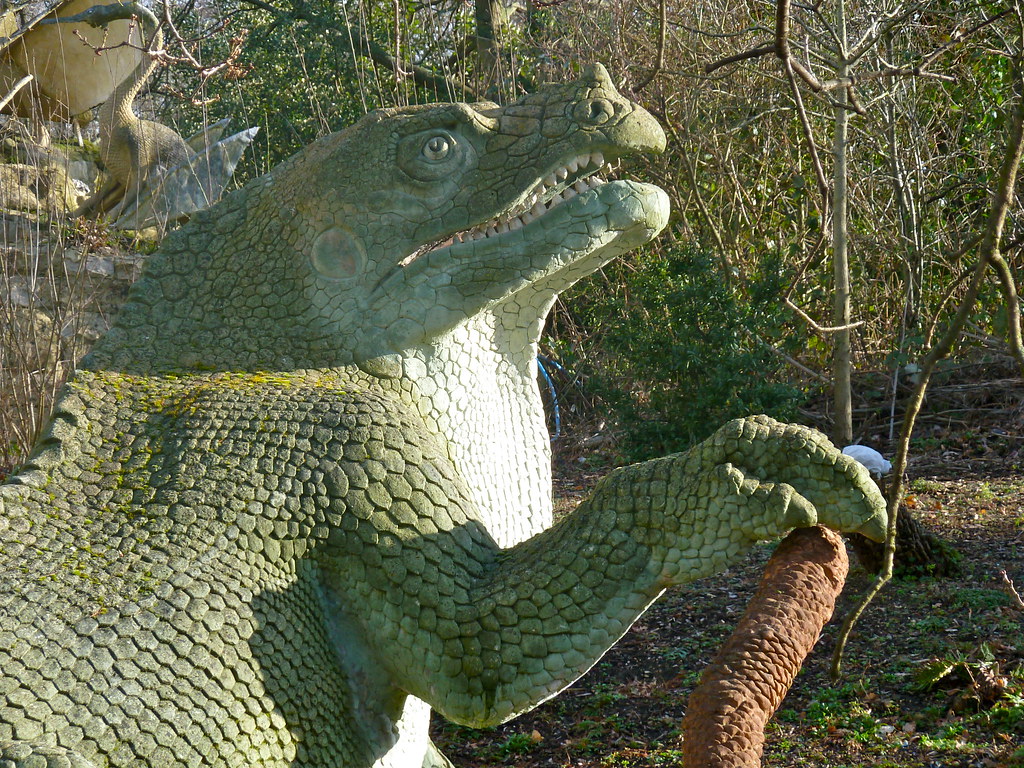
Dinosaurs were still a relatively new discovery in the mid-1800s. There were very few fossils to study and limited knowledge of what these prehistoric reptiles might have been like in life. But just how much did Benjamin Waterhouse Hawkins and his scientific advisors get right and wrong about these prehistoric reptiles? The answer reveals the courage and limitations of Victorian paleontology.
Susie says, ‘I think really what they did was take things that they knew, like crocodiles and lizards, and blow them up to be the size of the bones. ‘Big things today tend to be four-legged and relatively bulky. A gracile two-legged thing was completely beyond anybody’s understanding of what a reptile could be.’ This explains why the Crystal Palace dinosaurs look more like enormous lizards than the dynamic creatures we know them to be today.
The Construction Process and Materials
With such a gargantuan task, the sculptures were meticulously designed, planned and executed. Waterhouse Hawkins began the sculptures with sketches, before creating scale models in clay, which might have been used to plan the layout. The sculptures were then constructed from bricks, tiles, cement and iron in a dedicated workshop on-site in the Crystal Palace grounds. The technical achievement was remarkable for the 1850s.
In May of 1854, Hawkins gave a paper to the Society of Arts in which he described the conceptual problems of restoring a creature for which the evidence is piecemeal, as well as the technical problems of casting a replica that contains, as he put it, 640 bushels of artificial stone. Each sculpture was essentially a piece of Victorian engineering disguised as natural history.
How They Influenced Future Museums
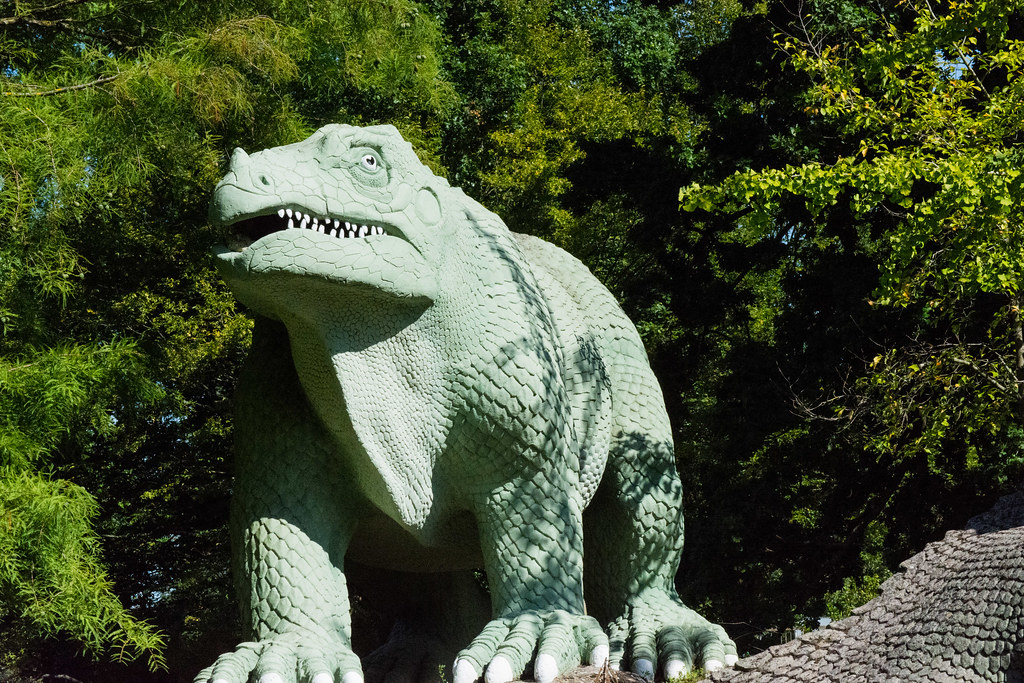
The most impressive aspect of the sculptures was their size. One iguanodon stretched 30 feet long. But the dinosaurs were the exhibition’s star attraction. When the park opened, it attracted large crowds who came to see the dinosaur sculptures. The public response was so overwhelming that it set the template for how museums would display dinosaurs for generations.
The Hawkins restorations essentially determined how dinosaurs would be depicted and viewed for the succeeding twenty-five years, as succeeding items in our exhibition demonstrate. Every dinosaur exhibit that followed owed a debt to what Hawkins created in Crystal Palace Park. His work proved that the public had an enormous appetite for prehistoric life presented in dramatic, accessible ways.
Modern Conservation Efforts
Michel lives near the park with her partner, Jon Todd, a paleontologist and senior curator at the Natural History Museum. In 2013, she co-founded the Friends of Crystal Palace Dinosaurs, a charity dedicated to preserving and promoting the sculptures. Since then, the couple and a group of like-minded scientists and enthusiasts have pushed Bromley Council, the local authority in charge of the park, to take better care of the dinosaurs.
They are now cautiously optimistic: A £5 million (around $6.3 million) project to spruce up the area is supposed to see all of the dinosaurs restored to their former glory over the coming years. A specially appointed trust is already set to take over daily management of the park in September. After decades of neglect, these pioneering sculptures are finally getting the attention they deserve as monuments to scientific history.
Educational Value in the Modern Era
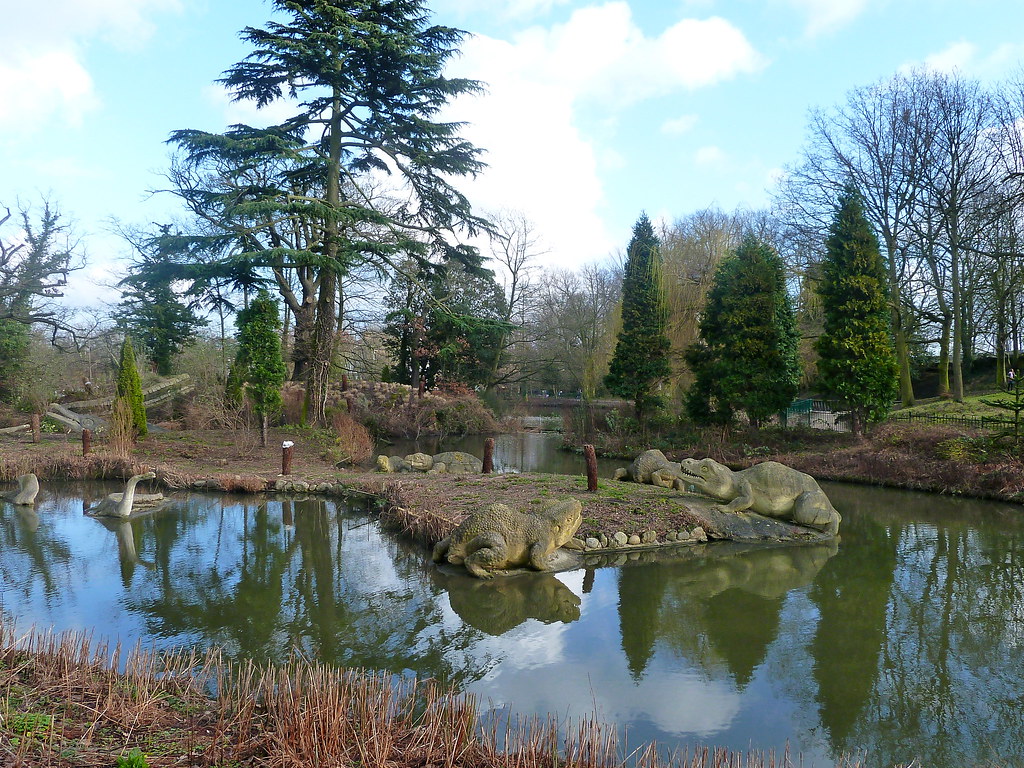
The Crystal Palace Dinosaurs might look comically incorrect, but they hold an important place in the history of palaeontology and at the time of construction were as accurate as was possible based on the scientific data available. They serve as a fascinating lesson in how scientific understanding evolves, showing us not just what Victorians got wrong, but how they courageously attempted to visualize the unknown.
Manias and other experts also point out that Hawkins’ work in Crystal Palace Park marked a giant leap for paleontology: He not only dispelled the notion, perpetuated by early paleoart, of prehistoric animals as semi-mythological creatures, but his meticulous recreations also often landed close enough to the truth. The result, then, was both ahead of its time and, within just a few years of completion, hopelessly outdated – which served as a cautionary tale for others in the field and meant that few similar projects were attempted in the decades to follow.
Visiting Crystal Palace Park Today
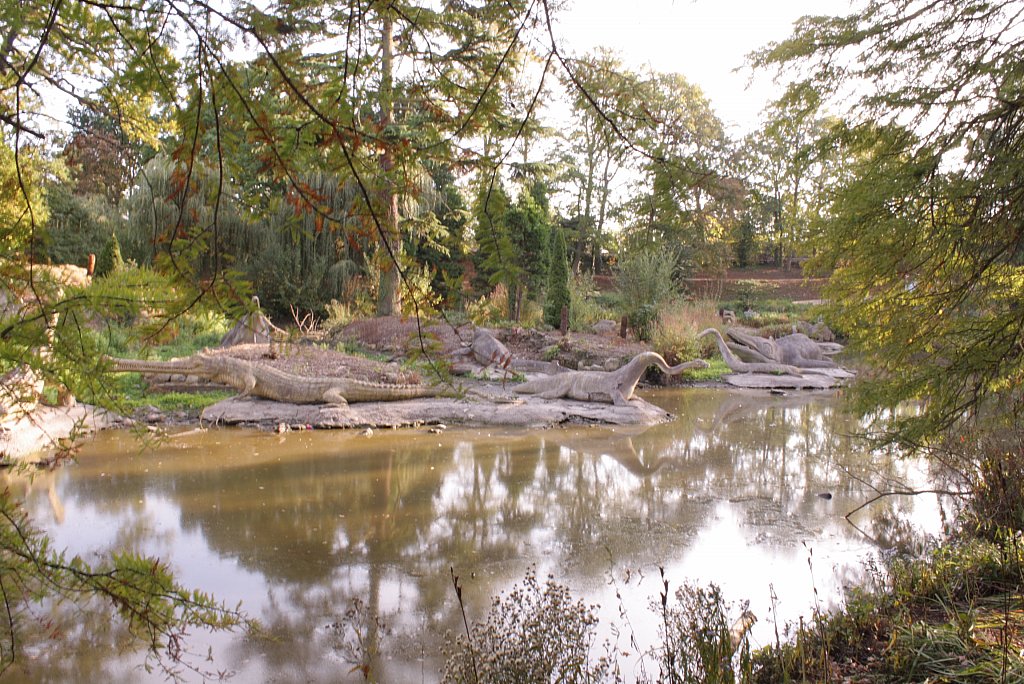
When you visit today, you’ll find the dinosaurs weathered but still imposing, standing on their artificial islands surrounded by Victorian landscaping. After over 150 years exposed to the elements, the sculptures deteriorated, and major conservation work has been carried out to try to restore the dinosaurs to their former glory. In May 2007, the Crystal Palace Dinosaurs were awarded Grade I listed status owing to their importance.
The areas around the sculptures in the park are currently being planted with vegetation that reflects the eras when these animals lived. This attention to geological accuracy shows how the park continues to evolve as both historical monument and educational resource. You can still see visitors wading closer to examine the sculptures, just as Victorian families did over a century ago, though hopefully without stealing any concrete teeth as some early visitors apparently did.
The world’s first dinosaur museum wasn’t really a museum at all, but rather a bold experiment in bringing science to the masses through art and imagination. Today, Crystal Palace Park stands as a remarkable time capsule, preserving not just Victorian sculptures but the moment when humanity first tried to resurrect the deep past. These weathered concrete giants remind us that every scientific breakthrough begins with someone brave enough to take their best guess and commit it to stone. What do you think would surprise Hawkins most about what we know about dinosaurs today? Share your thoughts in the comments.