Researchers recently delved into the oversized skull of Triceratops, the iconic horned dinosaur from the Late Cretaceous. Advanced CT scans revealed a nasal cavity far more intricate than earlier models suggested. This complex internal architecture likely supported enhanced sensory capabilities and critical physiological functions for these massive herbivores.
A Startling Internal Labyrinth
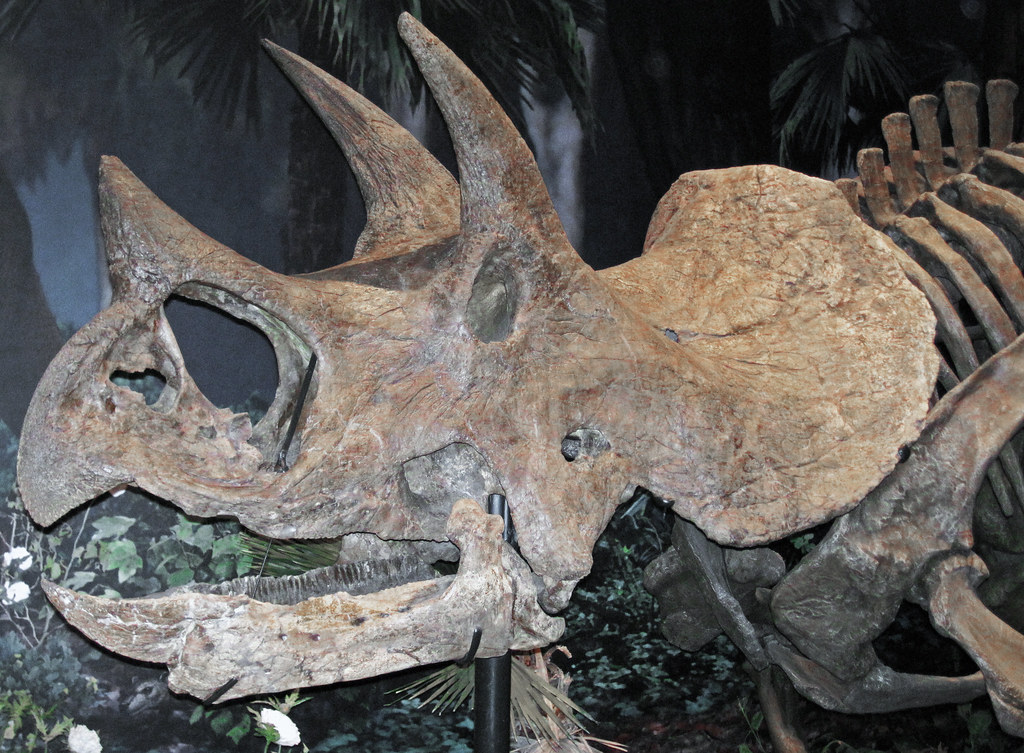
A Startling Internal Labyrinth (Image Credits: Flickr)
Triceratops skulls allocated an extraordinary portion of their volume to nasal passages, dwarfing those in most other reptiles. Scientists long puzzled over this feature, but new evidence points to a densely packed array of soft tissues within. The discovery challenges prior assumptions, painting a picture of a snout engineered for multifaceted survival needs.
Lead researcher Seishiro Tada noted the puzzle-like assembly of 3D-printed skull fragments that sparked insights. “Triceratops had unusual ‘wiring’ in their noses,” he explained. In typical reptiles, nerves and vessels access nostrils via jaw and nasal routes. However, Triceratops skull geometry rerouted these primarily through the nasal branch.
This adaptation emerged alongside the dinosaur’s hypertrophied naris, a trait unique among reptiles. Such rearrangements ensured robust supply to the expanded region, hinting at evolutionary pressures tied to the creature’s formidable head size.
Methods That Brought the Past to Life
The team examined multiple Triceratops specimens, including high-resolution micro-CT scans of an isolated premaxilla. Slice thickness reached just 100 micrometers, allowing precise 3D segmentation in specialized software. Comparisons drew from the Extant Phylogenetic Bracket, analyzing snouts of birds, crocodiles, and other living reptiles.
These tools mapped hidden grooves, foramina, and ridges – osteological clues to vanished soft tissues. Researchers cross-referenced features across ceratopsid subfamilies, from chasmosaurines like Triceratops to centrosaurines. The approach yielded the first detailed hypothesis for ceratopsid rostral anatomy.
Publication in The Anatomical Record marked a milestone on February 7, 2026. Co-authors from institutions like the University of Tokyo and Fukui Prefectural Dinosaur Museum contributed expertise in paleontology and imaging.
Key Structures in the Nasal Vault
The reconstructed nasal cavity brimmed with specialized features. Neurovascular bundles followed dedicated canals, with the ophthalmic nerve branch dominating innervation. A nasal gland occupied a recess on the nasal bone’s inner surface, its duct tracing alongside vessels.
Most strikingly, evidence emerged for respiratory turbinates – delicate, scroll-like scrolls absent in most dinosaurs. Ridges on nasal bones served as attachment sites, mirroring those in birds. These structures maximized surface area for air processing.
- Unique narial nerves: Lateral nasal nerve supplied rostral regions, supplanting typical maxillary input.
- Vascular networks: Arteries paralleled nerves, supporting dense tissue.
- Nasolacrimal duct: Routed medially, draining tears into the nasal chamber.
- Premaxillary chambers: Housed auxiliary pathways for airflow and conduits.
- Osteological correlates: Sulci, foramina, and flanges guided tissue positions.
This inventory underscored a system optimized for efficiency in a cavernous space.
Functions Beyond Basic Olfaction
The nasal setup extended far past smell detection. Respiratory turbinates likely conditioned inhaled air, conserving moisture and facilitating heat exchange. Well-vascularized walls cooled blood en route to the brain and eyes, countering thermal buildup in the oversized cranium.
“Horned dinosaurs probably used their noses not just for smelling but also to help control temperature and moisture,” the study inferred. This thermoregulatory role proved vital for ceratopsids roaming warm Late Cretaceous landscapes. Enhanced sensory innervation sharpened environmental awareness amid herd life and predator threats.
| Feature | Triceratops/Ceratopsids | Typical Reptiles |
|---|---|---|
| Narial Wiring | Nasal branch dominant | Jaw and nasal routes |
| Turbinates | Present (inferred) | Rarely ossified |
| Primary Function | Thermo/moisture + sensory | Olfaction mainly |
Such capabilities aligned with partial endothermy, bridging reptilian and avian traits.
Evolutionary Echoes in Horned Dinosaurs
Ceratopsid innovations traced to a shared ancestor, post-protoceratopsids. Narial expansion drove neural adaptations, evident in thicker endocast nerve traces. Turbinates appeared selectively, robust in centrosaurines but subtler in chasmosaurines.
These traits bolstered survival for giants like Triceratops, weighing tons and sporting elaborate headgear. The study fills gaps in dinosaur head evolution, inviting scrutiny of frills and beaks next.
Key Takeaways
- Triceratops nasal cavity featured unique wiring and respiratory turbinates for advanced functions.
- Structures aided thermoregulation, vital for large-skulled herbivores.
- First comprehensive soft-tissue model reshapes ceratopsian physiology views.
This revelation reframes Triceratops not merely as a horned behemoth, but as a physiologically sophisticated survivor. What other secrets hide in prehistoric skulls? Share your thoughts in the comments.