The Cambrian Period, spanning roughly 539 to 487 million years ago, marked a transformative era when complex animals burst onto the scene in Earth’s oceans. Scientists recently unveiled a groundbreaking geological tool – a “rock clock” – that delivers unprecedented precision in dating key events from this time. This innovation stems from detailed analysis of ancient sediments and promises to align fossil discoveries from distant continents more accurately than ever before.
Unlocking Secrets in Swedish Shale
Unlocking Secrets in Swedish Shale (Image Credits: Reddit)
Researchers zeroed in on the Alum Shale Formation in southern Sweden, part of the ancient Baltica continent. They examined the Albjära-1 drill core, which captured continuous layers of seafloor sediments accumulated over millions of years. These rocks preserved not only fossil remnants but also subtle chemical signatures of past ocean conditions.
The team applied high-resolution geochemical techniques to track variations in carbon isotopes and elements. By identifying repeating patterns tied to Earth’s orbital wobbles, they constructed a timeline independent of traditional dating challenges in sedimentary rocks. This cyclostratigraphy approach turned thick rock sequences into a finely tuned chronological record.
The Drumian Carbon Isotope Excursion Comes into Focus
For the first time, scientists pinned down the exact timing and duration of the Drumian Carbon Isotope Excursion, or DICE – a major global perturbation in the ocean carbon cycle during the middle Cambrian. This event featured a sharp dip in carbon isotope values, signaling widespread environmental stress.
Anchored by a precise U-Pb age, the new timescale integrated biostratigraphy with orbital cycles. Obliquity and eccentricity variations emerged as key drivers, pulsing climate rhythms that influenced sea levels and dust delivery to oceans. Such details revealed how greenhouse conditions amplified these astronomical influences over 500 million years ago.
Orbital Forcing and Cambrian Climate Dynamics
Earth’s orbital parameters – precession, obliquity, and eccentricity – left detectable imprints in the shale layers. Short-term obliquity cycles modulated high-latitude climates, while longer eccentricity rhythms shaped broader patterns.
- Cyclostratigraphy detected these cycles at millimeter resolution in the core.
- Elemental proxies showed fluctuations in sea-level and terrestrial inputs.
- Carbon isotope shifts aligned perfectly with orbital predictions.
- Dust flux variations hinted at continental weathering responses.
- The full DICE profile emerged without gaps, unlike fragmented records elsewhere.
This synchronization highlighted the sensitivity of early Paleozoic oceans to celestial mechanics. In a hothouse world without ice caps, even minor orbital tweaks triggered notable environmental swings.
Revolutionizing Fossil Correlations Worldwide
Prior efforts to match Cambrian fossils across sites relied heavily on shared species, often leading to mismatches. The rock clock now offers a chemical and cyclical anchor for global alignment.
Fossil-rich layers from Sweden can now sync with sequences in Utah or other basins. This precision clarifies whether climate disruptions preceded biological turnovers or vice versa. Researchers anticipate tighter constraints on evolutionary bursts during the Cambrian radiation.
Biostratigraphic refinements further bolster the framework, positioning the Albjära-1 core as a reference standard. Improved timescales will aid studies of extinction pulses and ecosystem recoveries in this foundational period.
Broader Insights into a Greenhouse Earth
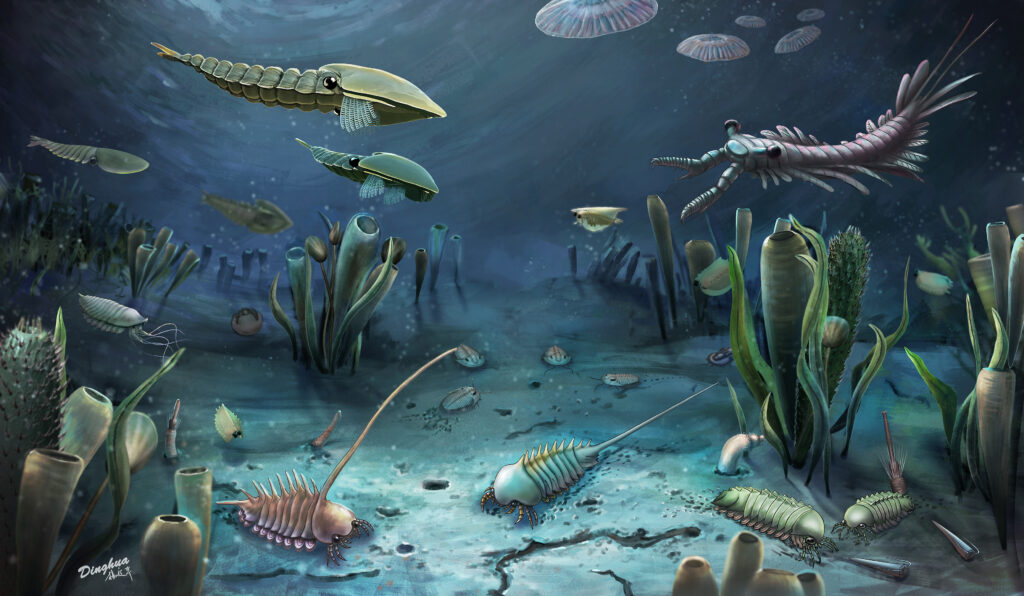
The study illuminated how middle Cambrian life navigated natural climate variability. Orbital-paced changes tested early animal groups, from trilobites to soft-bodied forms, amid rising diversity.
Findings underscore the role of astronomical forcing in pre-Pleistocene climates. They also equip paleontologists to probe cause-and-effect in ancient mass diversifications more rigorously.
Key Takeaways
- A cyclostratigraphic “rock clock” dates Cambrian events with new accuracy.
- DICE timing synchronized globally via Swedish shale core.
- Orbital cycles drove sea-level and dust shifts in a greenhouse era.
This advance not only refines our grasp of Cambrian timelines but also sets a template for dating other ancient intervals lacking volcanic markers. As correlations strengthen, the story of life’s dawn gains sharper resolution. What do you think this means for understanding evolution’s big leaps? Tell us in the comments.