Petrified Forest National Park, Arizona – A team of paleontologists uncovered the jawbone of a small flying reptile that glided through Late Triassic skies 209 million years ago. This specimen, the earliest pterosaur known from North America, belonged to a new species called Eotephradactylus mcintireae. Preserved in a remote bone bed rich with volcanic ash, the fossil provides crucial insights into an ecosystem on the brink of massive change.
A Jawbone That Rewrote History
A Jawbone That Rewrote History (Image Credits: Wikimedia)
In 2011, a research team co-led by curator Kay Behrensmeyer spotted a promising bone bed while hunting for early mammal precursors in the park’s rugged badlands. Volunteer preparator Suzanne McIntire later found the key fossil: a partial jaw with teeth still embedded. What excited her most was the intact dentition, which made identification straightforward.
Excavation proved arduous in the remote, snake-filled terrain. Workers encased blocks of sediment in plaster jackets and transported them to the National Museum of Natural History’s FossiLab. There, volunteers labored for thousands of hours under microscopes to reveal over 1,200 fossils from the site. Minerals in the ash layers allowed precise dating to 209.187 million years ago, placing the deposit in the late Norian stage.
Profile of a Tiny Aerial Predator
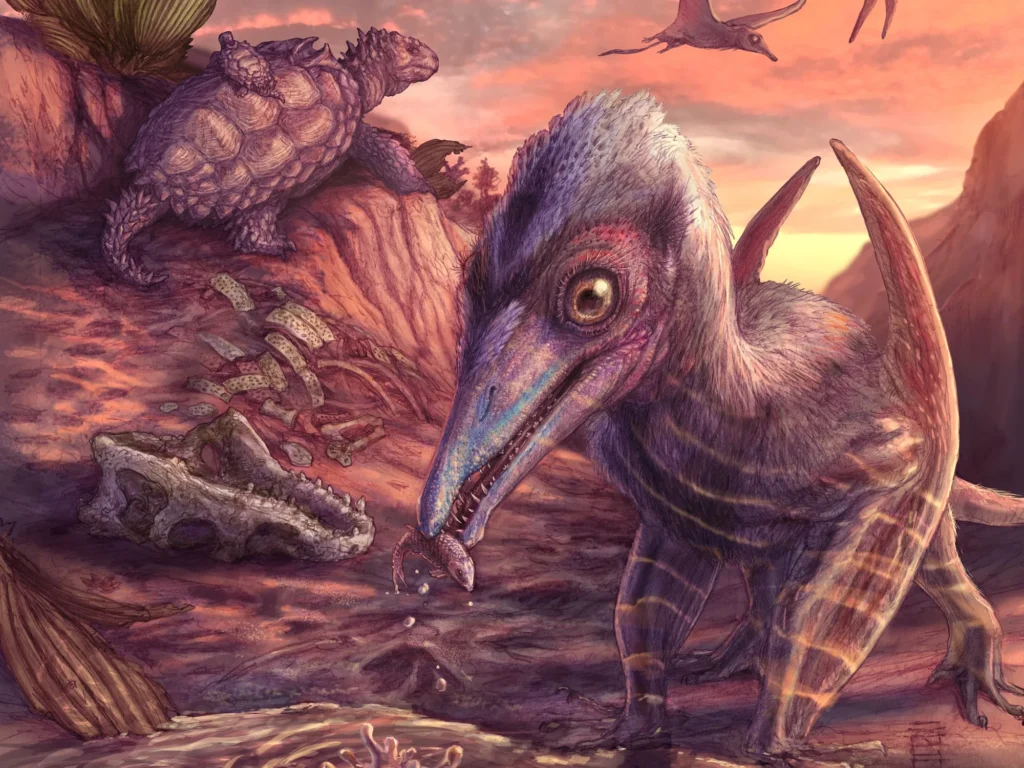
Eotephradactylus mcintireae earned its name from the ash preservation – “ash-winged dawn goddess” – and honors its discoverer. The holotype jaw featured heterodont teeth: triangular, multi-cusped front ones and a larger recurved rear tooth, many worn down to expose dentin. Such wear suggested a diet of tough prey, like fish with armored scales found nearby.
This pterosaur measured about the size of a seagull, small enough to perch on a human shoulder. A referred wing bone confirmed its non-pterodactyloid build, typical of early forms. Phylogenetic studies positioned it as an early branch outside advanced groups, blending ancestral traits like tooth ankylosis with novel features.
Advanced scans revealed tooth replacement patterns and jaw grooves, shedding light on mandibular evolution. Researchers noted its rarity: one of few Triassic pterosaurs beyond Europe, and the only one with a precise radiometric date.
A Vibrant Ecosystem on the Edge
The bone bed captured a flood-buried snapshot of life in equatorial Pangaea. Seasonal floods in braided river channels mixed aquatic and terrestrial remains across 16 vertebrate groups. Giant amphibians up to six feet long shared space with early frogs, tuatara relatives, and spike-armored turtles – one of the world’s oldest.
Predators included toothy crocodile-like phytosaurs and aetosaurs, while fish like coelacanths and freshwater sharks filled rivers. Pterosaurs and turtles represented newcomers amid Triassic holdouts. The semi-arid setting, dotted with mesic fluvial zones, showed resilience to aridification.
- Metoposaurid amphibians: Large, aquatic predators.
- Trilophosaurids: Armored herbivores.
- Doswelliids: Spiny reptiles.
- Revueltosaurus: Toothy plant-eaters.
- Vancleavea: Bizarre armored swimmers.
- Early turtles: Shoebox-sized with spikes.
- Salientians: Oldest frog-like bones with fused tibiofibulae.
Insights into Pterosaur Dispersal and Extinction
This find filled a 12-million-year gap in continental records before the end-Triassic extinction, which erased 75% of species around 201.5 million years ago. Pterosaurs had spread to low latitudes by then, enduring harsh conditions into the Jurassic. Turtles, too, dispersed rapidly across Pangaea despite slow movement.
Ben Kligman, lead author and NMNH postdoctoral fellow, highlighted the transition: “The site captures the transition to more modern terrestrial vertebrate communities where we start seeing groups that thrive later in the Mesozoic living alongside these older animals that don’t make it past the Triassic.” Fossil beds like this confirmed coexistence, he added.
The July 2025 Proceedings of the National Academy of Sciences paper detailed these dynamics, linking the assemblage to broader evolutionary shifts.
Though delicate pterosaur bones rarely fossilize, volcanic ash and floods preserved them here. The discovery underscores how such sites reveal hidden histories of flight’s origins.
Key Takeaways
- Eotephradactylus mcintireae is North America’s oldest pterosaur, dated precisely to 209 million years ago.
- The bone bed documents 16 species, blending Triassic endemics with future Mesozoic dominants.
- Worn teeth indicate a durophagous diet, advancing understanding of early pterosaur ecology.
This pterosaur’s story reminds us how fragile snapshots preserve ancient worlds. As research continues at sites like Petrified Forest, more pieces of pre-dinosaur life emerge. What surprises might the next flood deposit reveal? Share your thoughts in the comments.