ESA’s Solar Orbiter spacecraft captured rare footage of a powerful solar flare, revealing how small magnetic disturbances cascade into massive energy releases.
A Cascade of Tiny Triggers Builds to Catastrophe
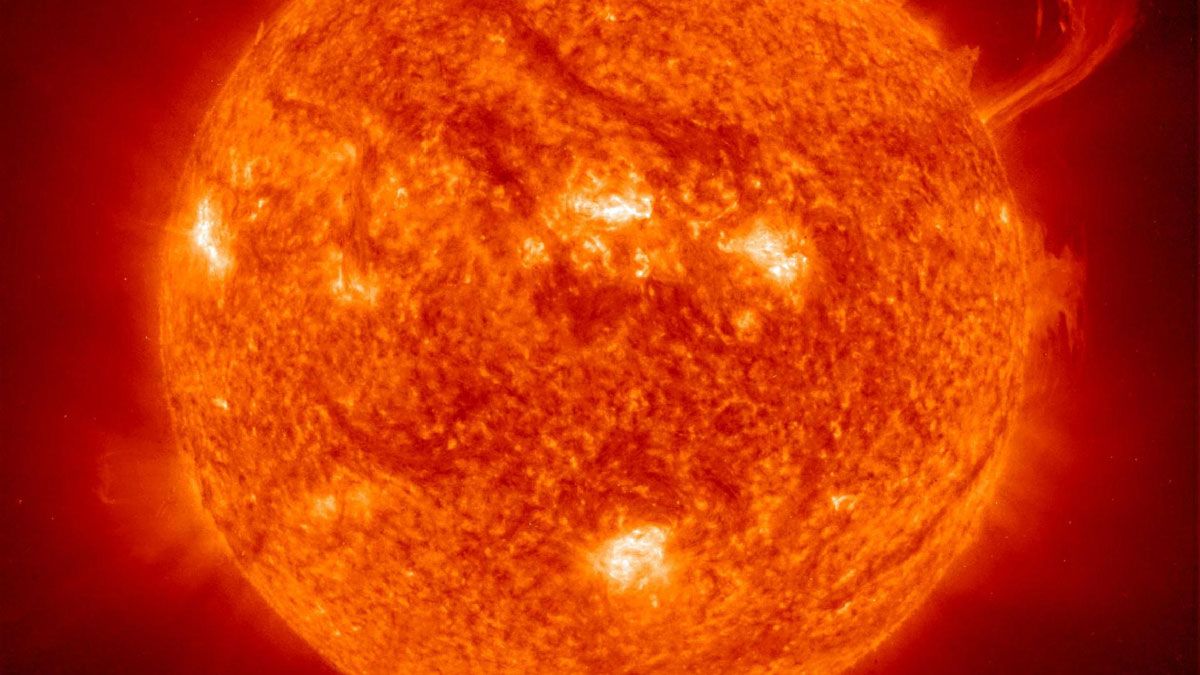
A Cascade of Tiny Triggers Builds to Catastrophe (Image Credits: Cdn.mos.cms.futurecdn.net)
Researchers analyzed data from an M7.7-class flare that erupted on September 30, 2024, in active region 13842. The event unfolded as twisted magnetic field lines in the sun’s corona began to destabilize.
Solar Orbiter’s instruments recorded the process over 40 minutes leading to the flare’s peak. Initial weak reconnections occurred on timescales of just seconds, producing bright flashes as field lines snapped and reformed. These disturbances grew rapidly, mimicking an avalanche where minor shifts trigger widespread collapse.
Lead author L. P. Chitta of the Max Planck Institute for Solar System Research noted, “Solar Orbiter’s observations unveil the central engine of a flare and emphasize the crucial role of an avalanche-like magnetic energy release mechanism at work.”
The spacecraft observed from 0.29 astronomical units away, providing resolution down to 210 kilometers – sharp enough to track individual magnetic strands twisting like ropes.
Step-by-Step Breakdown of the Avalanche Process
The sequence began with a filament of plasma suspended in a complex X-shaped magnetic structure. Subtle wobbles led to the first reconnections, releasing bursts of energy visible as pinpoint brightenings.
Each reconnection event destabilized neighboring fields, propagating outward. Bi-directional plasma flows reached speeds over 400 kilometers per second, unwinding loops and accelerating particles within the erupting flux rope.
- Pre-flare phase: Weak disturbances form new magnetic strands every two seconds.
- Build-up: Strands break and reconnect, creating energy outflows and bright spots.
- Impulsive phase: Cascade peaks, producing nonthermal electrons detected in X-rays.
- Aftermath: Plasma blobs rain down, forming ribbon-like patterns that persist post-flare.
This chain reaction explained the flare’s sudden intensity, challenging models that assumed a single large reconnection site.
Multi-Instrument View Pierces the Sun’s Atmosphere
Four Solar Orbiter instruments combined for a layered portrait of the event. The Extreme Ultraviolet Imager (EUI) delivered two-second snapshots of the corona, while the Spectrometer/Telescope for Imaging X-rays (STIX) mapped high-energy particles up to half the speed of light.
The Spectral Imaging of the Coronal Environment (SPICE) revealed multi-temperature plasma from 10,000 to 1 million Kelvin. Meanwhile, the Polarimetric and Helioseismic Imager (PHI) detected ripples on the sun’s photosphere, confirming energy deposition there.
| Instrument | Role |
|---|---|
| EUI | High-res corona imaging |
| STIX | X-ray particle acceleration |
| SPICE | Plasma temperatures |
| PHI | Surface effects |
ESA’s Solar Orbiter co-Project Scientist Miho Janvier called it “one of the most exciting results from Solar Orbiter so far.”
Broader Impacts on Solar Physics and Space Weather
The findings, detailed in Astronomy & Astrophysics, suggest avalanches may underpin flares across the sun and other stars. They also refine predictions for space weather events that disrupt satellites and power grids.
Chitta added, “We didn’t expect that the avalanche process could lead to such high energy particles.” Future missions could probe even finer details.
Co-author David Pontin highlighted how “a sequence of small events cascaded into giant bursts of energy.”
Key Takeaways
- Solar flares arise from cascading reconnections, not isolated blasts.
- Plasma rains form flare ribbons, observable before and after peaks.
- Particle acceleration occurs inside flux ropes, aiding space weather forecasts.
Solar Orbiter’s glimpse into this hidden dynamic promises sharper flare forecasts. What implications do you see for future space missions? Share in the comments.