Illinois – A fossil celebrated for decades as the earliest evidence of an octopus has met a dramatic reclassification. Pohlsepia mazonensis, unearthed from the Mazon Creek Lagerstätte, dates to the late Carboniferous period around 311-306 million years ago. Advanced imaging techniques exposed internal features that betrayed its true nature as a decayed nautiloid, a shelled relative of modern nautiluses. This discovery adjusts timelines in cephalopod evolution and highlights the power of cutting-edge paleontology.
A Fossil That Defied Evolutionary Timelines
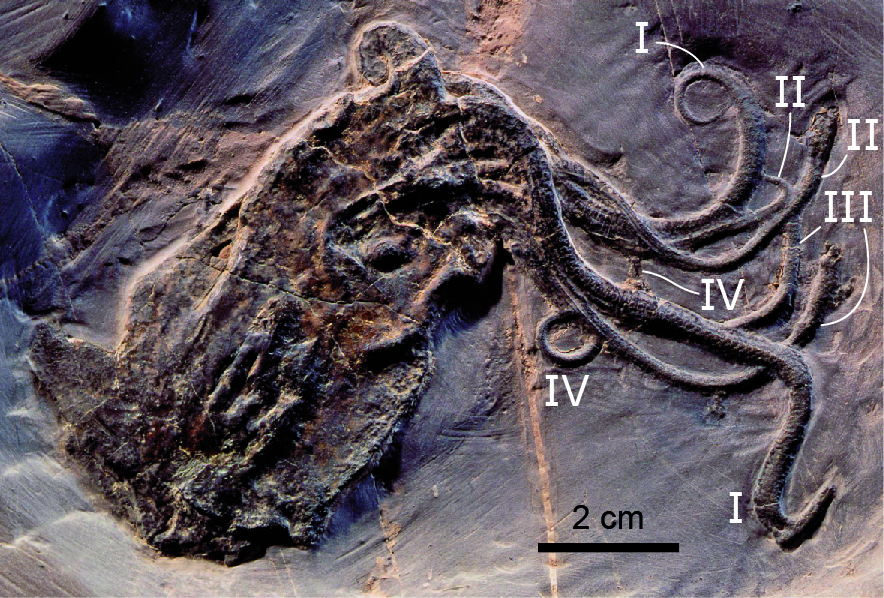
A Fossil That Defied Evolutionary Timelines (Image Credits: Wikimedia)
Paleontologists first described Pohlsepia mazonensis in 2000 after amateur collector James Pohl found it near Chicago. The specimen’s round body, apparent arm-like structures, fin outlines, and eye spots prompted its identification as a cirrate octopus, similar to today’s dumbo octopuses. This placed octopuses far earlier in the fossil record than other evidence suggested, creating a 150-million-year gap to the next known specimens.
The fossil even earned a spot in Guinness World Records as the oldest octopus. Yet doubts lingered because definitive octopus traits, like an ink sac with pigment or suckers, remained absent or ambiguous. Mazon Creek’s exceptional preservation in iron-rich siderite concretions fueled the intrigue, as the site often captured soft tissues from ancient marine life. Researchers attributed gaps to the creature’s deep-sea habits.
High-Tech Imaging Cracks the Case
A team led by Thomas Clements of the University of Reading applied synchrotron X-ray fluorescence, scanning electron microscopy, and micro-CT scans at the SOLEIL facility in France. These methods pierced the fossil’s rock encasement to map chemical signatures and microstructures invisible to the naked eye. The scans revealed no siphon, distinct tentacles, or biomineralized hooks typical of octopuses.
What emerged instead painted a picture of decay. Fin-like features traced the body outline rather than true fins, while eye spots proved to be mere mineral deposits. A clay-pyrite lump mimicked an ink sac, but lacked melanosomes. Clements noted, “Scientists identified Pohlsepia as an octopus 25 years ago, but using modern techniques showed us what was beneath the surface of the rock, which finally cracked the case.”
The Radula: Definitive Proof of Identity
Central to the reclassification stood the radula, a mollusk’s chitinous tooth ribbon used for rasping food. Synchrotron data uncovered at least 11 denticles per row in Pohlsepia, including a central rachidian tooth, lateral pairs, and marginal plates. This matched nautiloid patterns more closely than octopuses, which feature seven or nine elements.
| Feature | Octopuses | Nautiloids |
|---|---|---|
| Radula Teeth per Row | 7-9 | 11-13 |
| Ink Sac | Present with melanosomes | Absent |
| Shell | Internal or none | External (often lost in decay) |
The radula aligned precisely with Paleocadmus pohli, another Mazon Creek nautiloid. Decay likely separated the soft body from its shell weeks before fossilization, distorting the form into an octopus mimic.
Shifting the Cephalopod Family Tree
This finding refutes a Paleozoic origin for octobrachians—octopuses and vampire squids. True octopuses now trace to the Jurassic, over 100 million years later, aligning with molecular clocks and other fossils. Meanwhile, Pohlsepia provides the oldest soft-tissue evidence of a nautiloid, extending their record by 220 million years.
Cephalopod evolution gains clarity: nautiloids persisted as shelled survivors, while soft-bodied coleoids like octopuses diversified later. The Guinness record now awaits revision, underscoring how reinterpretations refine science.
Mazon Creek continues to yield surprises, from sharks to worms, thanks to its unique preservation. Future scans may reveal more from this site.
Key Takeaways
- Pohlsepia mazonensis represents a decayed nautiloid, likely Paleocadmus pohli, not a distinct octopus species.
- A radula with 11 teeth per row provided the crucial evidence against octopus classification.
- Octopus origins shift to the Mesozoic, closing a problematic evolutionary gap.
Reexaminations like this remind paleontologists that fossils hold secrets waiting for the right tools. As Clements reflected, tiny clues hidden for eons can transform our view of ancient oceans. What other misidentified treasures lurk in museum drawers? Share your thoughts in the comments.