Texas — Paleontologists recently identified a long-overlooked fossil from northwest Texas as a new species of aetosaur, a heavily armored reptile that roamed Earth 215 million years ago. Discovered in 1989, the specimen sat in a museum collection for decades before researchers recognized its uniqueness. This find sheds light on the diverse world of crocodile relatives that dominated before dinosaurs rose to prominence. The creature, named Garzapelta muelleri, offers a rare glimpse into Late Triassic life through its remarkably complete armor.
A Discovery Dusts Off After 35 Years
A Discovery Dusts Off After 35 Years (Image Credits: Facebook)
Paleontologist Bill Mueller unearthed the fossil in Garza County during 1989 excavations in the Cooper Canyon Formation of the Dockum Group. Local amateur collector Emmett Shedd assisted in the recovery. The specimen, primarily a carapace of bony armor, entered Texas Tech University collections, where it remained unstudied for over 30 years.
William Reyes, a doctoral student at the University of Texas at Austin’s Jackson School of Geosciences, revisited the fossil during a routine collection visit. He noted its exceptional preservation immediately. “We have elements from the back of the neck and shoulder region all the way to the tip of the tail. Usually, you find very limited material,” Reyes observed. Collaborators Jeffrey Martz and Bryan Small helped confirm it as Garzapelta muelleri, published in The Anatomical Record in January 2024.
Built Like a Prehistoric Fortress
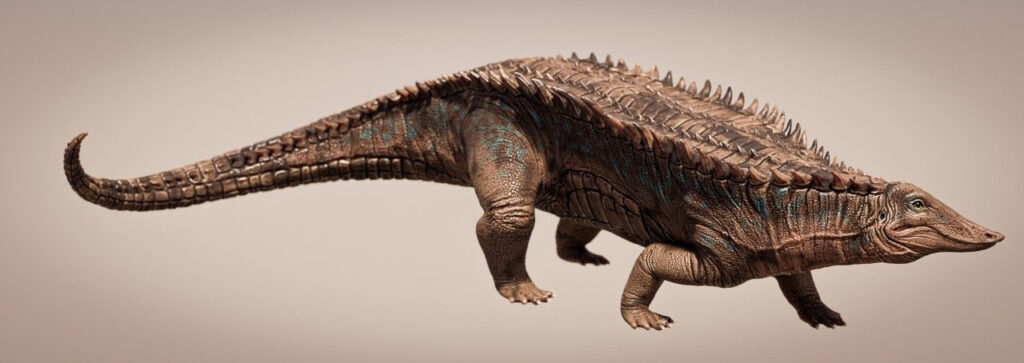
Garzapelta muelleri measured about 3.5 meters long, typical for many aetosaurs that ranged from 2 to 6 meters. Its body featured a mosaic of osteoderms — bony plates embedded in the skin — forming a carapace roughly 70 percent complete. Curved spikes flanked the sides, enhancing defense against predators.
These plates locked together tightly, covering the animal from neck to tail tip. Distinct ridges and bumps set its armor apart from relatives. Aetosaurs like this one walked on four stout legs, their low-slung bodies evoking modern crocodiles but far more fortified. Scientists infer an omnivorous diet, blending plants and small prey.
Armor That Fooled Evolution
The carapace blended traits from distant aetosaur branches, sparking debate on its family tree. Back plates mirrored those of Rioarribasuchus chamaensis from the Aetosaurinae group, while side spikes echoed Desmatosuchus of the Stagonolepidoidea lineage. Reyes explained, “Convergence of the osteoderms across distantly related aetosaurs has been noted before, but the carapace of Garzapelta muelleri is the best example of it.”
This convergent evolution — similar features arising independently — complicated placement but positioned Garzapelta as a sister to Desmatosuchini based on lateral osteoderms. Such patterns highlight aetosaur diversity in the Norian stage of the Late Triassic, around 215 to 218 million years ago.
- Osteoderms formed a flexible yet tough shield, unlike rigid turtle shells.
- Lateral spikes likely deterred attacks from above or the sides.
- Plates varied by body region, from cervical to caudal sections.
- Preservation included both left and right elements, aiding reconstruction.
- Size and shape suggest adaptations for terrestrial foraging.
Dominating a Dinosaur-Free World
Aetosaurs thrived across every continent except Antarctica and Australia during the Late Triassic. They filled niches as herbivores and omnivores in riverine and floodplain habitats like those in ancient Texas. Garzapelta inhabited a warm, semi-arid landscape teeming with early archosaurs.
These “tanks of the Triassic” outnumbered early dinosaurs, showcasing pseudosuchian success before a mass extinction around 201 million years ago wiped them out. The Texas find underscores regional variety in the Dockum Group, a hotspot for such fossils.
| Aetosaur Feature | Garzapelta muelleri | Typical Aetosaurs |
|---|---|---|
| Length | ~3.5 m | 2-6 m |
| Armor Coverage | 70% carapace preserved | Partial, often fragmented |
| Diet | Omnivorous | Herbivorous/omnivorous |
| Era | Middle Norian | Late Triassic |
Key Takeaways
- Garzapelta muelleri exemplifies how museum shelves hold untapped secrets.
- Convergent evolution challenges our maps of ancient lineages.
- Aetosaurs ruled pre-dinosaur ecosystems with superior armor tech.
This Texas aetosaur reminds us that the Triassic held more than nascent dinosaurs — armored giants like Garzapelta enforced a pseudosuchian reign. As studies continue, such rediscoveries refine our view of prehistoric balance. What do you think about these Triassic tanks? Tell us in the comments.