Mongolia – A fossil from the Gobi Desert, first discovered nearly five decades ago, has sparked fresh discussion among paleontologists about the purpose of certain dinosaurs’ reduced forelimbs. The specimen, belonging to the alvarezsaurid dinosaur Manipulonyx reshetovi, dates back 67 million years to the Late Cretaceous Period. Researchers recently analyzed its well-preserved arms, challenging traditional views on how these dog-sized, bipedal creatures navigated their world. This find highlights ongoing debates in dinosaur functional morphology, drawing parallels to behaviors observed in living animals today.
A Peculiar Fossil Emerges from the Desert
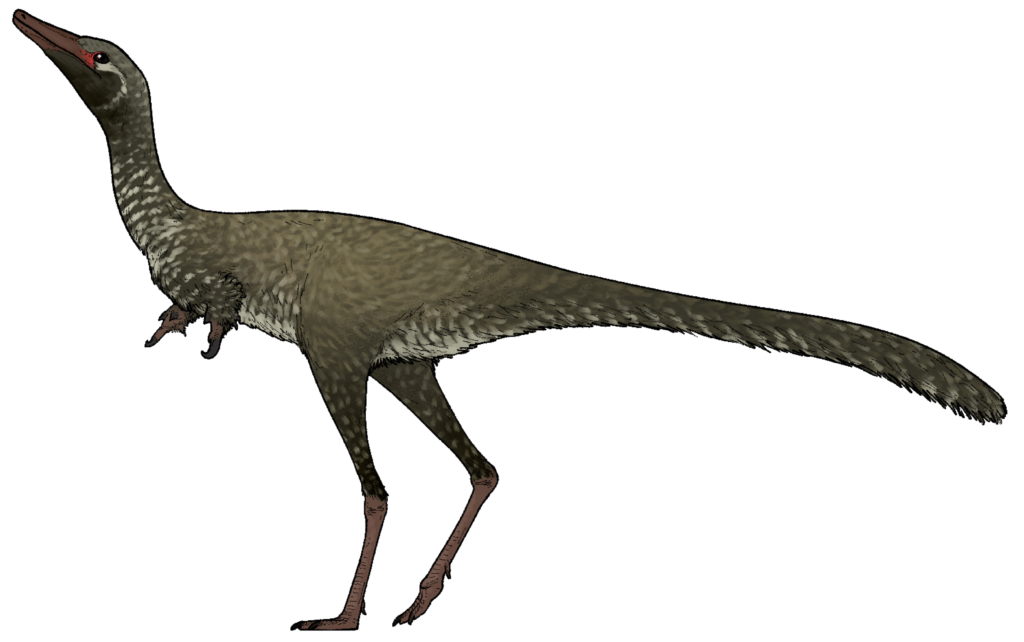
A Peculiar Fossil Emerges from the Desert (Image Credits: Wikimedia)
The partial skeleton of Manipulonyx reshetovi came to light in 1979 within Mongolia’s Nemegt Formation. Russian scientists formally described it in late 2025, noting its complete forelimb, including rudimentary side fingers and a series of proximal carpals. Alvarezsaurids like this one featured long hind legs suited for swift movement and notably stubby forearms. Across the family, forelimbs showed intriguing variations: some species bore a single prominent digit, while others had two, all markedly reduced yet uniquely shaped.
These differences puzzled experts. The initial study portrayed Manipulonyx as a nocturnal hunter, equipped with long claws on stubby digits ideal for grasping and puncturing eggs. Such a specialization would mark it as an egg pilferer targeting nests of larger dinosaurs. Yet this interpretation soon faced scrutiny from those favoring broader ecological roles.
Challenging the Egg-Thief Narrative
Paleontologists had long speculated that alvarezsaurid forelimbs aided in insect foraging or egg consumption. The Russian team leaned toward the latter, emphasizing the claw’s grip for piercing shells. However, Tracy Thomson, a research assistant at the University of California, Davis, questioned this during his Ph.D. work on vertebrate claw morphology.
Obligate egg-eating remains exceedingly rare among modern vertebrates, confined to just 19 snake species. Opportunistic feeders like mongooses, raccoons, and seriema birds break eggs through blunt force – hurling them against rocks or stomping them – without relying on specialized claws. “You don’t need limbs to eat eggs and snakes are the proof of that,” Thomson observed. He argued that behavioral adaptations, not structural ones, suffice for such diets.
Social Signaling Takes Center Stage
Thomson proposed an alternative: these forelimbs facilitated social interactions. Variations in claw size, shape, and digit count across alvarezsaurids suggested species-specific displays rather than uniform tool use. He is developing this idea in an upcoming paper, supported by a database cataloging claw functions in vertebrates.
Social signaling dominates animal behavior, enabling courtship, bonding, and rivalry. Thomson pointed to modern parallels that mirror the dinosaurs’ anatomy. Male pond turtles, for instance, deploy elongated forelimb claws in “titillation” rituals, stroking and vibrating them near a female’s head in precise patterns unique to each of 26 studied species.
Modern Analogs Unlock Ancient Behaviors
Birds offer further insights. At least 66 raptor species engage in “cartwheeling,” where rivals or mates lock talons mid-air, spiraling downward before separating. This aerial display serves multiple social purposes, from mate attraction to territorial disputes. “Throughout the animal kingdom, social signaling is all over the place,” Thomson noted. “And it can be multimodal. There’s visual, there’s audio, there’s touch, there’s smell.”
These examples underscore a key principle: diverse, reduced forelimbs likely evolved for communication, not predation. Thomson advocated defaulting to social functions given their prevalence. “I would propose that the default explanation should be social interaction, whatever that is, because there’s so much of it throughout the animal kingdom, and it’s so diverse and so complex,” he said.
- Pond turtles: Claw-based titillation for courtship.
- Raptors: Talon cartwheeling for bonding and confrontation.
- Mongooses and seriemas: Egg-breaking via behavior, no claws needed.
- Snakes: Limb-free egg consumption as obligate specialists.
What This Means for Dinosaur Societies
The hypothesis shifts focus from solitary foraging to communal dynamics. Alvarezsaurids may have greeted kin, vied for mates, or resolved conflicts through arm-waving or claw flourishes. Such behaviors align with evidence of sociality in other dinosaurs, enriching our view of Cretaceous ecosystems.
| Feature | Egg-Eating Theory | Social Signaling Hypothesis |
|---|---|---|
| Modern Parallels | Rare; mostly behavioral | Common; multimodal displays |
| Forelimb Variation | Uniform tool | Species-specific signals |
| Evidence Base | Fossil claws | Vertebrate database |
Thomson cautioned against untestable “just-so stories,” urging hypotheses rooted in observable biology. His work invites further scrutiny of fossil arms, potentially reshaping narratives around theropod lifestyles.
Key Takeaways
- Alvarezsaurid forelimbs varied widely, hinting at social rather than dietary roles.
- Egg-eating lacks strong modern analogs beyond snakes.
- Turtle and raptor behaviors provide compelling models for dinosaur displays.
As research progresses, Manipulonyx reshetovi reminds us that tiny limbs held big potential for connection. What behaviors do you envision for these ancient arm-wavers? Share your thoughts in the comments.