You walk out onto the high desert of eastern Arizona expecting a few colorful logs and some wide-open sky. Instead, the ground drops away into striped badlands, stone trees glitter at your feet, and the wind seems to whisper from a world more than two hundred million years old. Petrified Forest National Park is one of those places that looks simple on a postcard and then completely scrambles your sense of time when you’re actually standing in it. This park is not just about pretty rocks. Under your boots lies one of the most complete windows into the Late Triassic world anywhere on Earth, a fossil-rich geologic story layered like a cake, and an archaeological record that tracks people across thirteen thousand years. If you slow down, look closely, and let your imagination stretch a bit, you start to realize that the “forest” you see is only the surface of something much deeper and stranger than you’d expect from a quick roadside stop on Interstate 40.
The World-Building Geology Beneath Your Feet
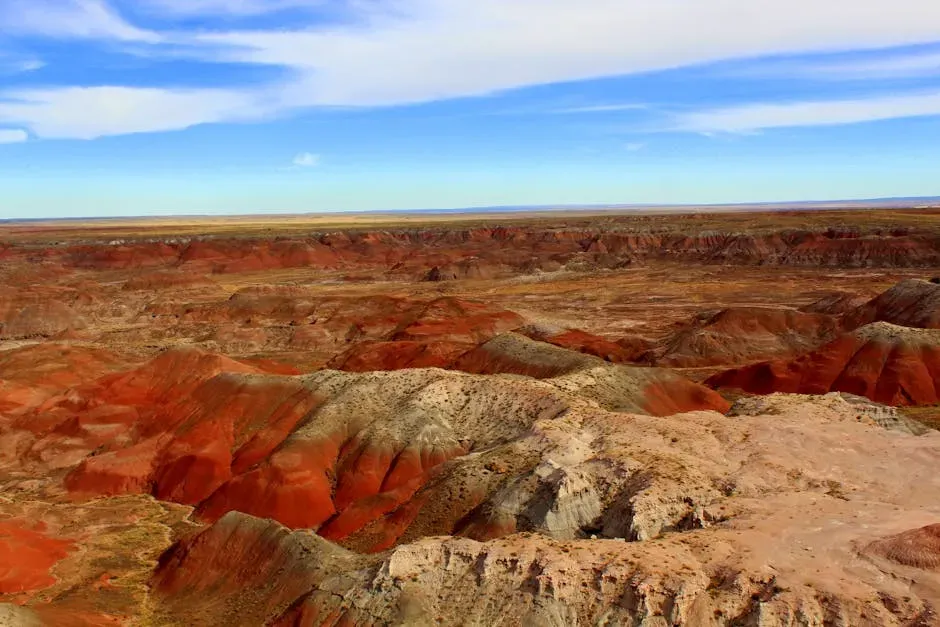
You might think you’re just walking on desert dirt, but beneath you is the Chinle Formation, a thick stack of mudstones, sandstones, and volcanic ash that captures roughly fifty million years of Earth’s history. These rocks were laid down in the Late Triassic Period, when this part of Arizona sat near the equator on the supercontinent Pangaea and looked more like a steamy river lowland than a dry plateau. Each colored band you see in the badlands is basically a chapter in an ancient environmental logbook: floodplains, river channels, lakes, and ash falls all frozen into stone.
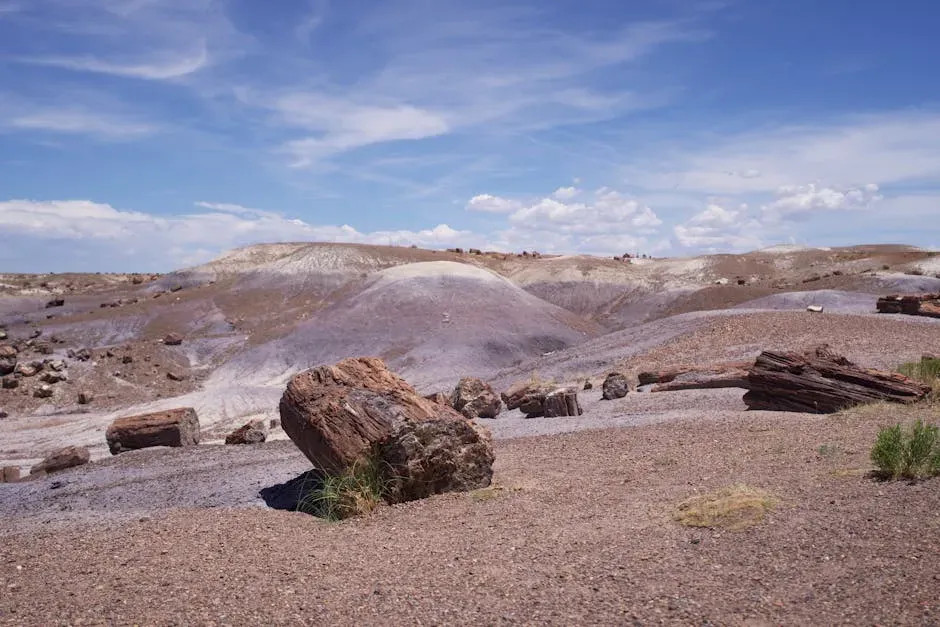
When you look out over the Painted Desert, you’re actually staring at the eroded edge of that logbook. Wind and water shave off layers grain by grain, revealing new fossils and petrified logs in slow motion. Instead of imagining geology as some abstract science, you can see it here as a living process: slopes slumping after a storm, chunks of petrified wood tumbling out of a hillside, fresh exposures appearing where yesterday there was just crusted soil. You’re literally watching the park uncover itself in real time.
How Living Forests Turned to Rainbow Stone
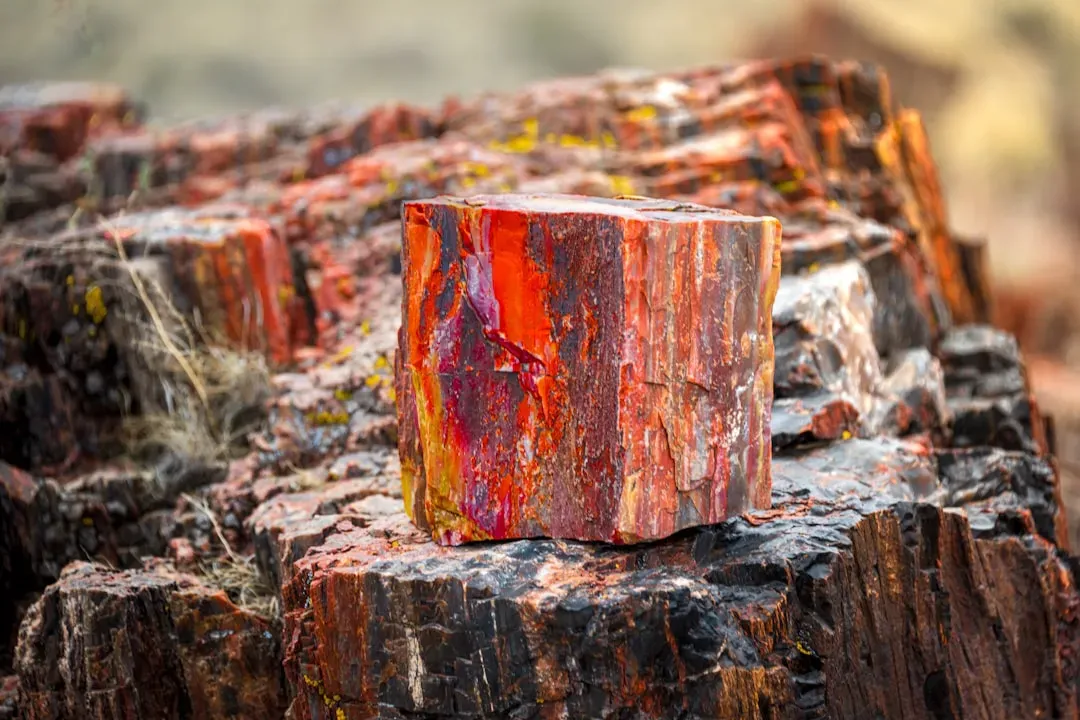
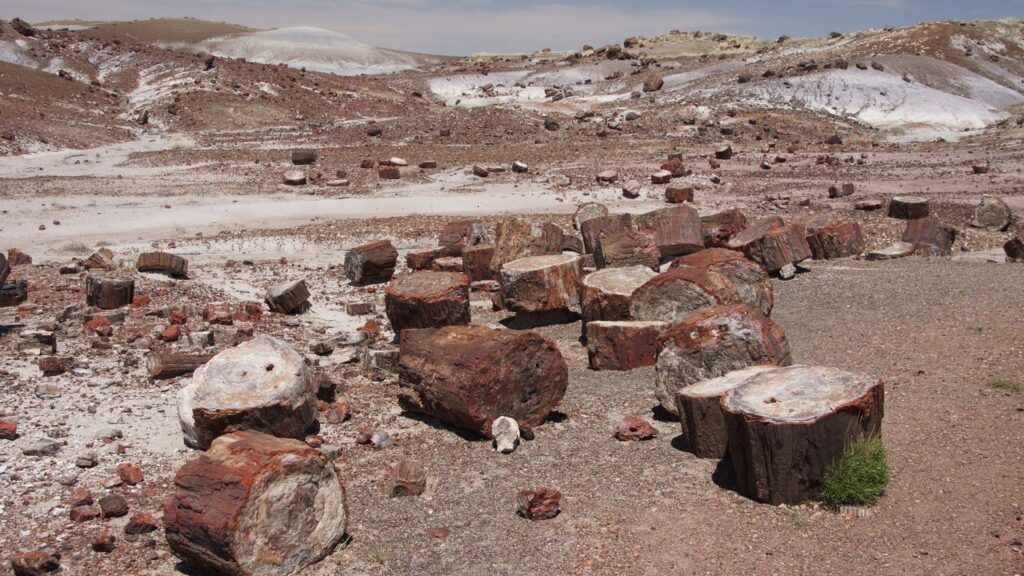
It’s tempting to imagine these petrified logs simply “turning to stone” where they stood, but the real story is messier and more fascinating. Over two hundred million years ago, huge conifer-like trees grew along rivers and swampy lowlands; when they fell, floods buried them quickly in sediment, cutting off oxygen and slowing decay. Silica-rich groundwater then seeped through those buried trunks, filling tiny cell spaces and replacing the original organic material with quartz over thousands to millions of years. What you see today are those mineral casts, often preserving bark textures and growth rings with almost eerie precision.
The wild colors – reds, purples, yellows, blues – come from trace elements like iron and manganese that snuck into the silica as it crystallized. That’s why one log can look like a slice of layered candy while another is smoky gray or deep wine. When you kneel close to a polished cross-section on a trail, you’re basically looking at a microscopic mineral painting created by chemistry that kept ticking away long after the original forest rotted. The “magic trick” is that most of that transformation happened underground, hidden, while the logs were still entombed in mud and ash.
A Fossil Time Capsule from the Age Before Dinosaurs Ruled
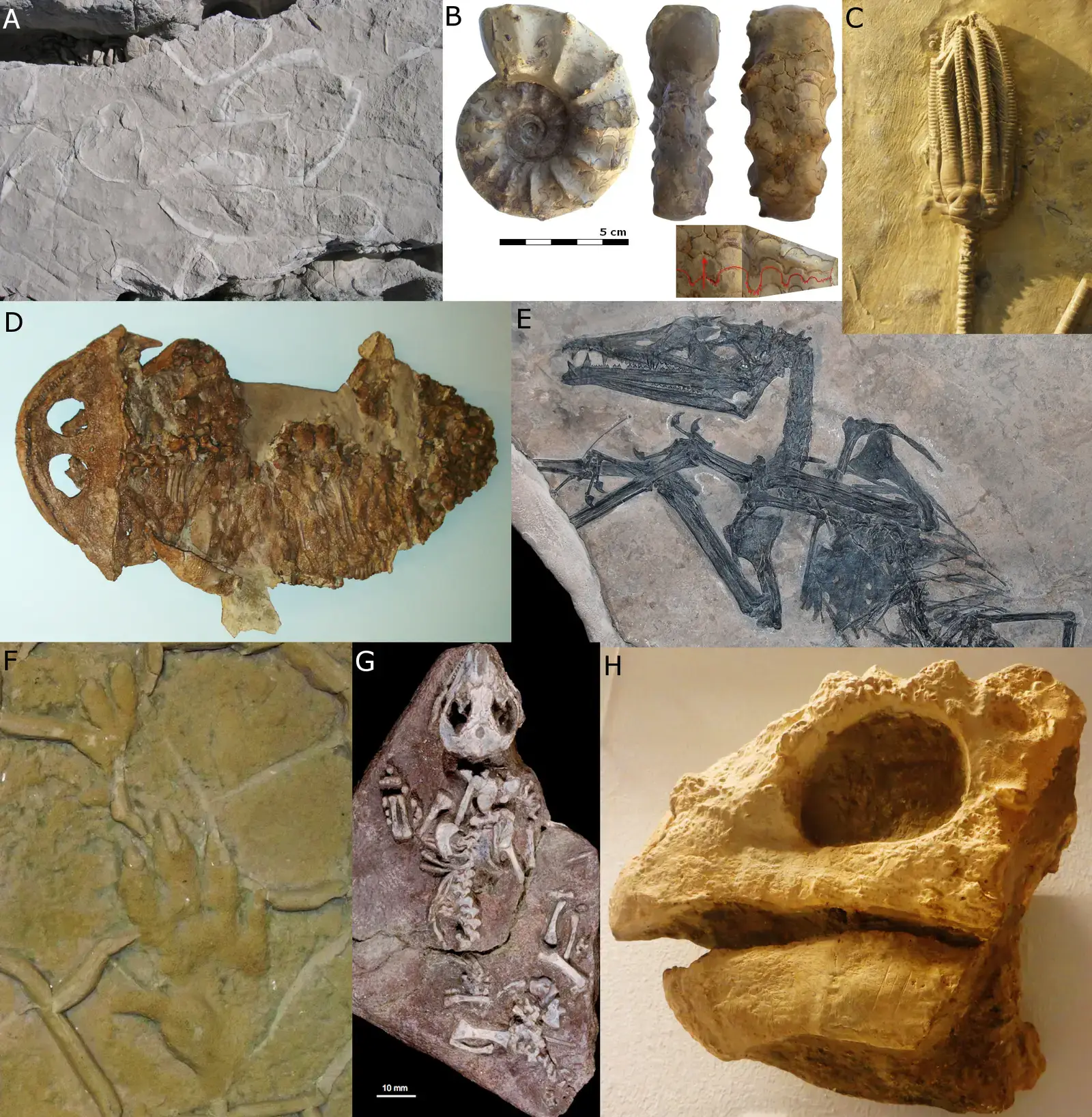
If you only focus on the stone wood, you miss the bigger secret: the park is one of the richest Late Triassic fossil sites in the world, recording an ecosystem that existed long before giant dinosaurs took over. In the same rocks that hold the logs, you find fossil ferns, cycads, seed ferns, and early ginkgo relatives that tell you these floodplains were lush, humid environments. Scattered among them are bones and teeth of strange reptiles, early relatives of crocodiles and birds, armored herbivores, and large amphibians that lurked in rivers and swamps. You’re looking at a world in which dinosaurs were minor players, not the main event.
In recent decades, paleontologists working in the park have uncovered sites that push back the timeline for when modern-style animal communities came together. You get evidence of early versions of the “living tetrapod fauna” you recognize today: animals along the same broad lineages as mammals, birds, reptiles, and amphibians all sharing the same habitats. When you stand at a quiet overlook, it’s a little jarring to realize that beneath that silence lies the record of a noisy, crowded landscape of predators, scavengers, and grazers. The bones may be gone from your view, but the rocks are still narrating who ate whom, and where.
The Painted Desert’s Hidden Climate Story
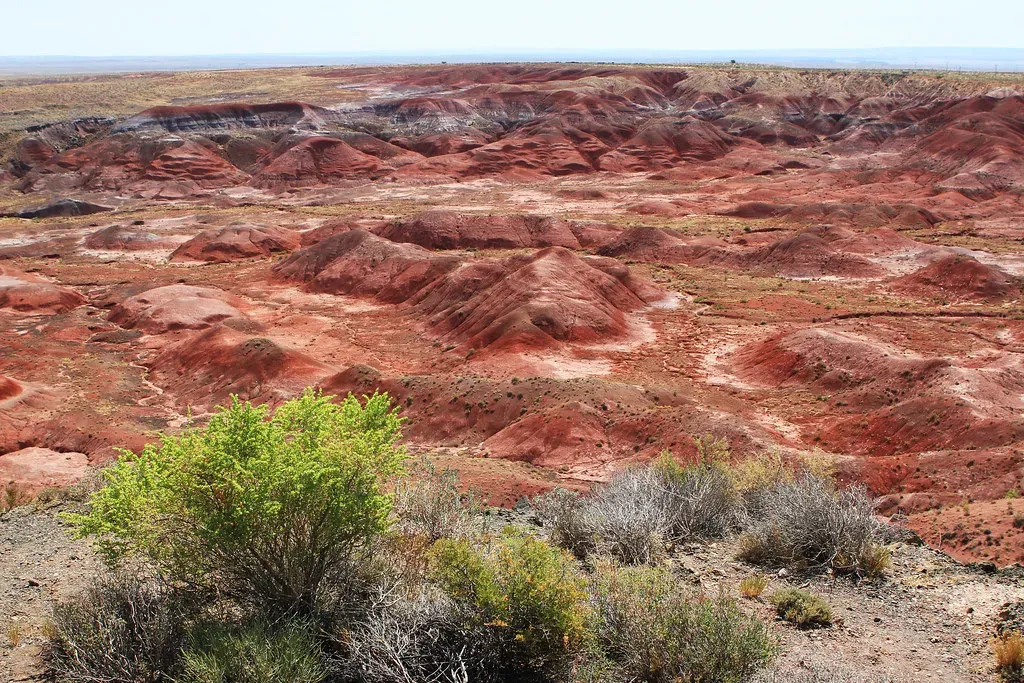
The Painted Desert is so beautiful that it’s easy to treat it as pure scenery: rolling badlands washed in red, lavender, and salmon, like someone spilled watercolors over a clay model. But those colors are not just for show; they encode the chemistry of ancient climates. The purplish and bluish layers tend to form from mudstones rich in certain iron minerals that weather differently than the rusty reds and oranges above them. You’re really looking at variations in ancient soils and sediments – wet periods, drier intervals, times when volcanic ash fell and mixed into the mud. Each shift tells you something about changing rainfall, river behavior, and even atmospheric conditions during the Triassic.
When you trace those bands across the landscape, you’re following surfaces that used to be actual ground under living animals’ feet. A layer where you see lots of petrified logs might mark an old river channel belt; another with mostly fine mud and few fossils could be a quiet lake bottom or floodplain. It’s like walking into a stripped-down climate archive, where the usual instruments are replaced by rock chemistry and the pattern of stripes on a distant ridge. If you let that sink in, a sunset over the Painted Desert stops being just pretty and starts feeling like a glimpse into the beating heart of an ancient Earth.
Ancient Footsteps: Pueblos, Petroglyphs, and Desert Farmers
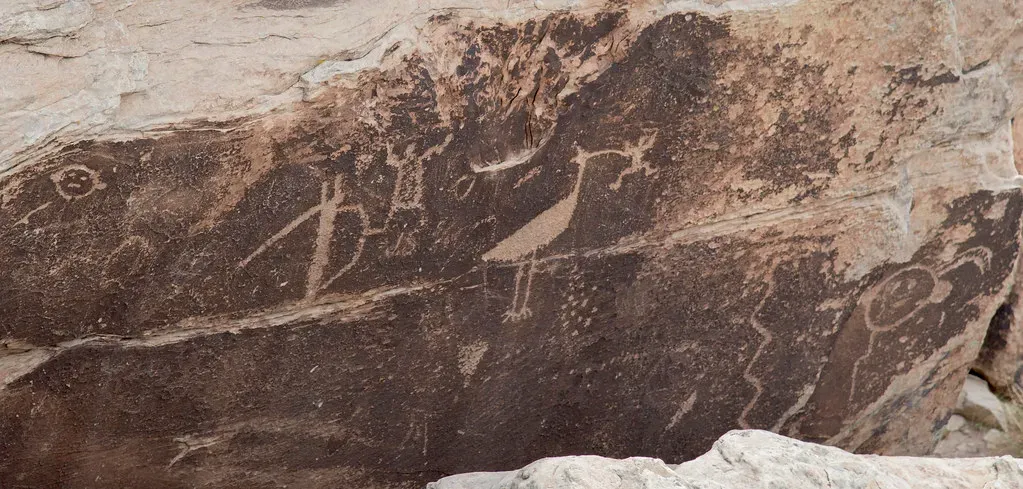
The park is not only about creatures that vanished hundreds of millions of years ago; people have called this region home for at least thirteen thousand years. When you follow the short trail to Puerco Pueblo, for example, you’re stepping into the remains of a large masonry village that once held roughly two hundred people. These Ancestral Puebloan families built multi-room structures around a central plaza, farmed corn, beans, and squash along the Puerco River, and traded with communities far beyond the horizon. The walls may be low now, but when you walk among them you’re threading your way through what was essentially a stone apartment complex in the middle of a challenging environment.
Nearby rock panels carry petroglyphs – spirals, animal figures, human shapes, and abstract designs pecked into the dark desert varnish of boulders and cliff faces. Some mark seasonal events like the summer solstice; others are thought to record migrations or clan symbols. When you stand in front of those images, you’re bridging a time gap of hundreds to thousands of years, trying to interpret messages that were never meant for you. Yet even without knowing every meaning, you can feel the continuity: people watching the same sun arcs, the same horizon lines, the same storms rolling in over the badlands, using art to map their place in a landscape that still feels big and uncertain today.
Structures Made of Stone Trees: Agate House and Beyond
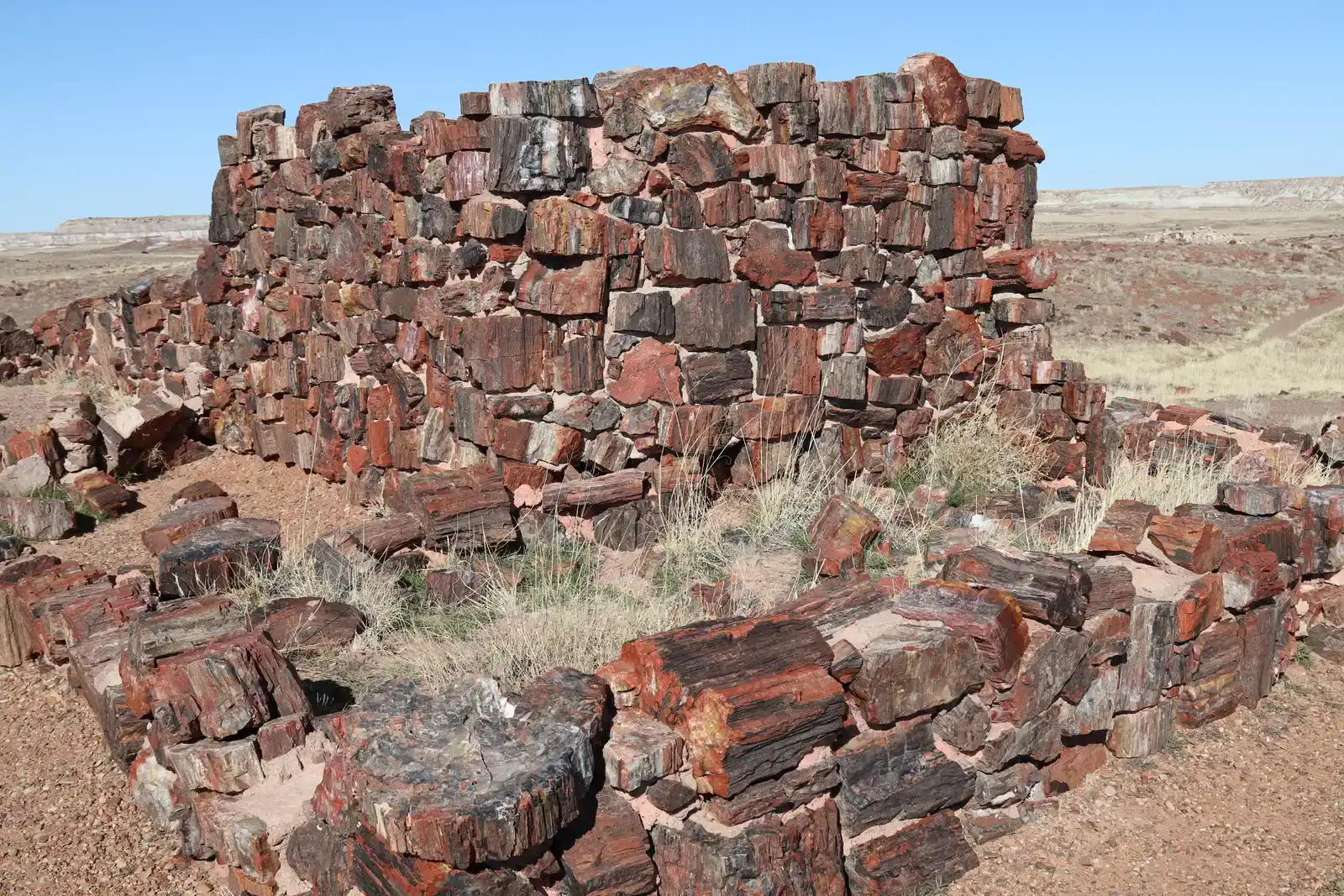
One of the most mind-bending sights in the park is Agate House, a small pueblo structure built almost entirely from blocks of petrified wood. When you see those rainbow logs used like bricks, it forces you to rethink the way you categorize “natural resource” and “building material.” To the people who built it between roughly the eleventh and thirteenth centuries, these stone logs were not museum pieces behind railings; they were durable, available, and probably even symbolically meaningful. You’re looking at a building where each block started life as an ancient tree, then became a fossil, and finally turned into a wall segment for a family home.
Agate House is partly reconstructed, but the concept is real: humans here have long interacted with petrified wood in practical, creative ways. As you walk the trail, you can imagine someone selecting pieces for size and color, fitting them together the way you might pick stones for a garden wall today. It’s a small reminder that the park’s “treasures” were part of everyday life for earlier residents, not just scientific specimens. That blurred line between artifact and fossil, between natural and cultural, is one of the quiet secrets of Petrified Forest that you only notice if you stop seeing the logs as untouchable relics and start seeing them as part of a lived-in landscape.
Science in Slow Motion: Ongoing Discoveries Beneath the Surface
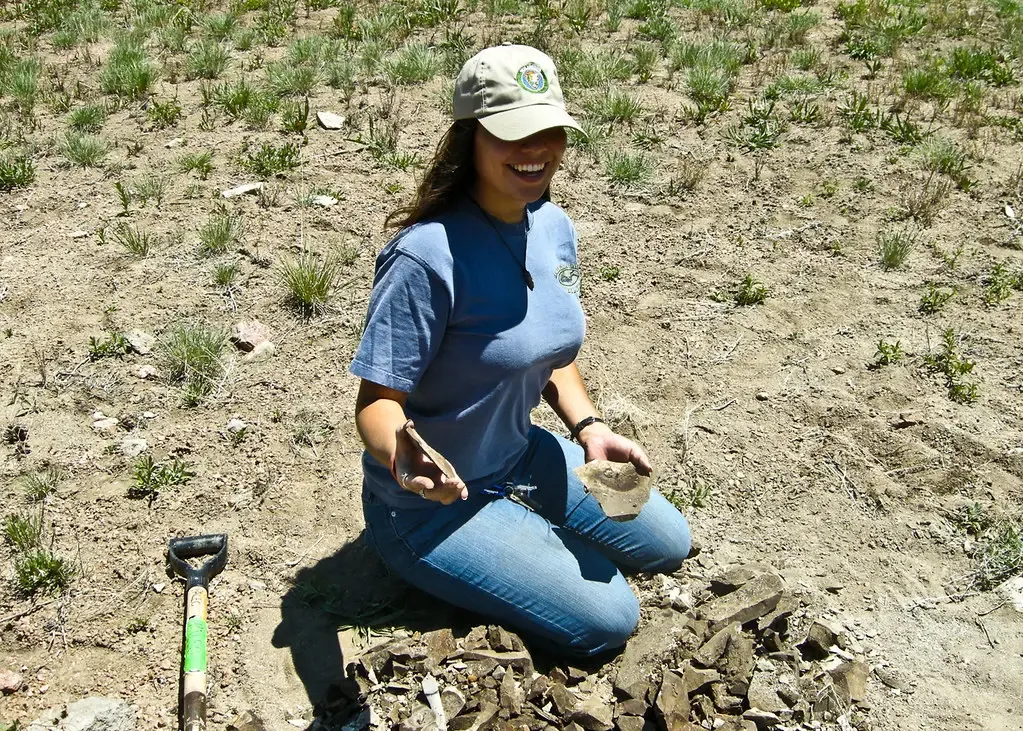
You might assume that in a park this famous, the big scientific questions were answered long ago, but researchers keep proving that assumption wrong. Paleontologists still regularly discover new fossil sites within the park and its expanded boundaries – sometimes in recently acquired ranchlands that had never been closely surveyed. These digs can reveal small bones, teeth, and even microscopic remains that fill in gaps about early reptiles, amphibians, and other Triassic creatures. The park’s rocks include some of the most continuous Triassic sections anywhere, which means scientists can track ecological changes layer by layer instead of relying on scattered fragments from far-flung locales.
From your point of view as a visitor, the science can feel almost invisible, but it quietly shapes what you see and how trails are designed. Areas rich in fossils may be kept more remote or accessed only through ranger-guided programs to protect delicate sites and allow careful study. When interpretive signs mention that certain animals once lived here, they’re not making educated guesses; they’re distilling years of fieldwork, lab preparation, and technical analysis that happen far from the scenic overlooks. So even if you never see a researcher at work, you’re walking through an active outdoor laboratory where new pieces of the Triassic puzzle are still being unearthed.
Protecting a Landscape People Tried to Carry Away
If you’ve ever wanted to slip a small piece of petrified wood into your pocket, you’re not alone – and that urge is precisely why the park was protected in the first place. In the late nineteenth and early twentieth centuries, visitors, collectors, and commercial operations were hauling away large quantities of petrified wood, sometimes loading wagonfuls or even cutting logs into decorative slabs. That steady drain threatened to strip the most visible deposits, and the area was eventually set aside as a national monument in 1906 to protect its scientific value. Today, the rules about leaving everything in place are strict, and rangers find that even small pieces removed by thousands of people could add up to serious loss over time.
When you resist the temptation to take a piece home, you’re participating in a quiet, collective act of preservation. You’re making sure that someone decades from now can walk the same trail and feel that same jolt of wonder at a hillside littered with stone logs. The park’s conservation work goes beyond wood theft, too, including protecting fragile archaeological sites, managing off-trail erosion, and monitoring impacts from nearby development and highways. The secret here is that the landscape you admire is not just naturally durable; it survives because of deliberate choices, rules, and everyday restraint from people just like you.
Experiencing the Park as a Layered Story, Not a Drive‑Through Stop
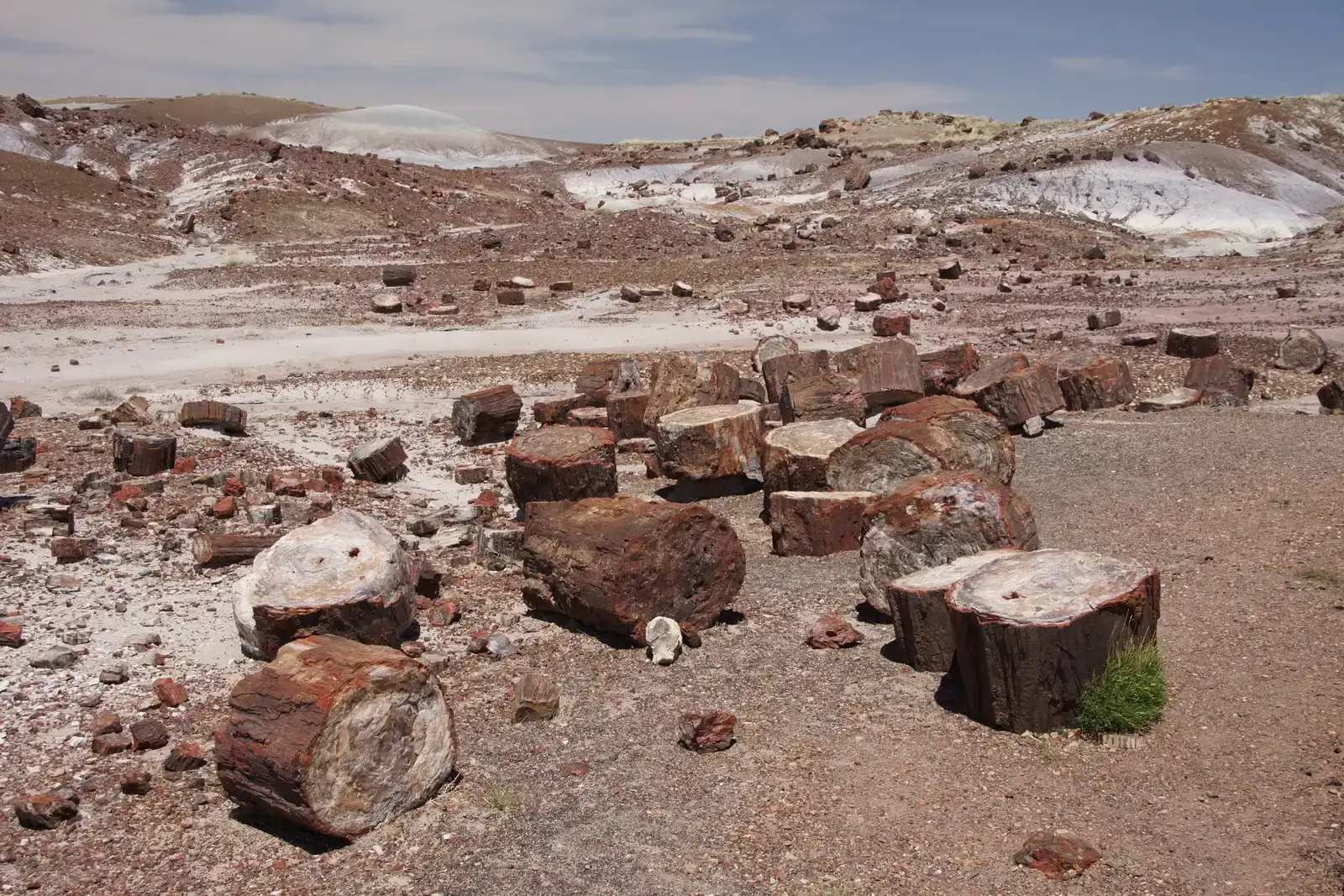
Because Petrified Forest sits right along a major interstate and historic Route 66, it’s easy to treat it as a quick detour: drive the park road, snap a few photos, buy a postcard, and move on. But the place reveals its real secrets when you slow down. Short hikes like Blue Mesa, Crystal Forest, or the trails in the Painted Desert backcountry let you drop below the rim and feel the scale of the badlands around you. When you walk up close to a hillside of eroding mudstone, you can see tiny fragments of fossils, bits of petrified wood, and subtle color layering you’d never notice from a pullout.
Spending even one full day lets you connect the dots between deep time and human history. You can watch sunrise over striped hills, wander among stone logs by midmorning, stand in an ancient pueblo at midday, and finish the day reading old Route 66 signs and admiring a historic inn built as an oasis for motorists. Each stop adds another layer to your mental map: Triassic river lowlands, Ancestral Pueblo farmers, Spanish travelers, early twentieth-century road trippers, and you, all stacked in one landscape. The park stops being just a “rock place” and starts feeling like a time machine you can actually walk through.
Conclusion: Standing on the Edge of Deep Time
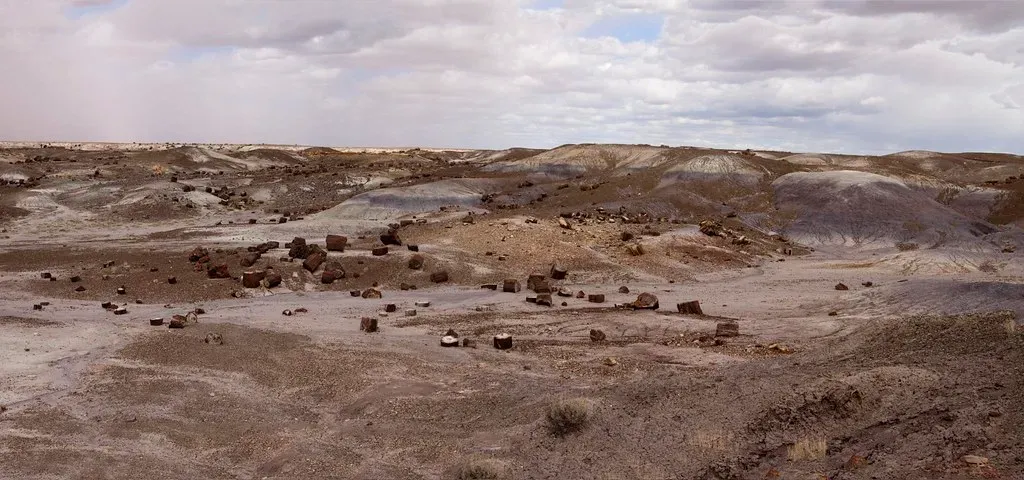
By the time you drive out of Petrified Forest National Park, it can feel like your sense of time has been stretched in every direction. You came in expecting a scattering of fossil logs and discovered a place where ancient forests, vanished reptiles, desert farmers, and modern travelers all overlap. Under the simple surface of a high desert park, you’ve walked across riverbeds hundreds of millions of years old, traced the outlines of long-gone villages, and watched a landscape slowly reveal its own buried archives. It’s humbling to realize that what you see in a single visit is just a snapshot in an ongoing process of erosion, discovery, and preservation.
What lies beneath the Petrified Forest is not a single secret but an entire stack of them: geologic, biological, cultural, and personal. The next time you find yourself there, maybe you’ll pause a little longer at a quiet overlook, imagining the rain forests that once grew where your car is parked, or the hands that chipped symbols into a rock now fenced off beside the trail. You cannot dig into every layer in one lifetime, but you can choose to look beyond the surface and let the place change how you think about time, memory, and your own brief footprint on the planet. Standing on that rim, how far back does your imagination let you travel?