Northern New Mexico’s Ghost Ranch yielded a remarkable fossil in 1948 amid a mass of dinosaur bones, but the specimen languished in Yale University’s Peabody Museum basement for decades. Researchers recently confirmed it belonged to a previously unknown relative of modern crocodiles, named Eosphorosuchus lacrimosa. This finding illuminates the early evolutionary steps of crocodylomorphs toward specialized land hunting around 210 million years ago.
A Deadly Snapshot from the Triassic
A Deadly Snapshot from the Triassic (Image Credits: Facebook)
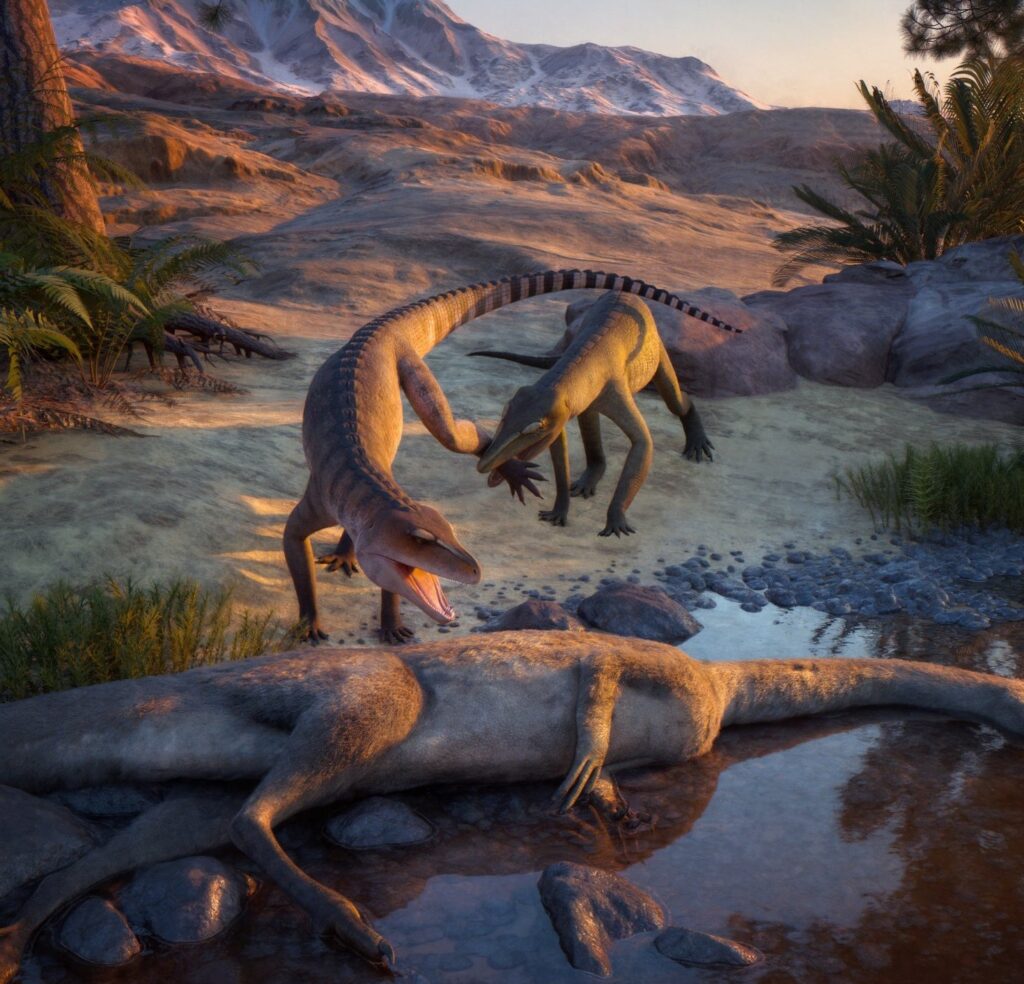
Two early crocodylomorphs met their end together approximately 210 million years ago in what paleontologists call the Ghost Ranch Bone Bed, part of New Mexico’s Chinle Formation. A sudden flash flood or mudslide likely buried them rapidly, preserving their remains alongside hundreds of Coelophysis dinosaurs and other reptiles. The Yale specimen, cataloged as YPM VP 41198, arrived at the Peabody Museum in the mid-1960s after initial collection by an American Museum of Natural History team.
Curators long assumed it represented Hesperosuchus agilis, a slender, long-snouted contemporary found nearby. Yet subtle differences in facial structure hinted at something unique. For 75 years, the fossil gathered dust in storage, overlooked amid vast collections.
CT Scans Unlock Hidden Secrets
Modern technology transformed the overlooked rock block when researchers applied high-resolution CT scans at Yale’s imaging center. Former Peabody preparator Marilyn Fox conducted the scans, allowing Ph.D. student Miranda Margulis-Ohnuma to digitally dissect the crushed bones virtually. This process revealed distinct cranial features separating it from Hesperosuchus.
The team, led by Yale’s Bhart-Anjan Bhullar, published their analysis in Proceedings of the Royal Society B in April 2026. Margulis-Ohnuma noted the specimen’s potential to reshape understandings of early croc diversity. “Eosphorosuchus is one of only a handful of well-preserved early crocodile relatives,” she stated.
Built for Power on Land
Eosphorosuchus lacrimosa stood out with its short, robust snout and heavily reinforced skull, adaptations for a formidable bite. A large triangular postorbital bone and jaw ridges anchored powerful muscles, enabling it to tackle larger or tougher prey than its long-snouted neighbor. Sharp, recurved teeth filled the jaws, while a reduced antorbital fenestra and large eye orbit added to its predatory toolkit.
About the size of a jackal or large dog, the creature relied on long, gracile hindlimbs for speed across terrestrial landscapes near rivers. Preserved elements included the partial skull, lower jaw fragment, a cervical vertebra, pubes, most of the left hindlimb – marked by a healed bite injury from an embedded tooth – and three distinctive osteoderms. These armored scales, circular with keels, likely ran along its back.
- Short, tall snout for crushing bites
- Gracile hindlimbs suited for running
- Healed injury on foot, evidence of fierce encounters
- Three osteoderms indicating dorsal armor
- Overall build: low-slung, four-legged hunter
Early Signs of Croc Diversification
The coexistence of Eosphorosuchus and Hesperosuchus at Ghost Ranch marked an early split in crocodylomorph lifestyles during the late Triassic. While Hesperosuchus chased agile fish or small game with its elongated snout, Eosphorosuchus specialized in bulkier terrestrial prey. Bhullar described the era: “The crocodiles were fast-running, four-legged predators, low-slung and more heavily built – analogous to a jackal, a big fox, or a dog.”
This discovery challenges views of proto-crocs as uniform underdogs to rising dinosaurs. Instead, it shows functional partitioning and ecological specialization arose swiftly, setting the stage for modern crocodilians.
| Feature | Eosphorosuchus lacrimosa | Hesperosuchus agilis |
|---|---|---|
| Snout Shape | Short and robust | Long and slender |
| Skull Reinforcement | Heavy, for powerful bite | Lighter build |
| Primary Habitat | Land near water | Rivers/streams |
Key Takeaways
- Eosphorosuchus reveals Triassic crocs diversified into land specialists early.
- CT scans proved museum fossils still hold untapped secrets.
- Powerful anatomy suggests competition drove rapid evolution.
This “dawn crocodile” offers a frozen moment of Triassic drama, where proto-crocs carved niches amid dinosaur hordes. As Bhullar put it, these rivals “were quite possibly looking at each other when they died.” What do you think this says about prehistoric competition? Tell us in the comments.