
You probably grew up imagining dinosaur times as a world ruled only by giant reptiles, with little else worth noticing scurrying between their feet. But if you could actually step into the late Jurassic or Cretaceous and look around, you’d see a shockingly busy ecosystem packed with creatures that don’t fit the stereotypical dinosaur picture at all. Some looked like crocodiles on stilts, some like overgrown armadillos, and at least one would make you think of a vulture and a dragon mashed together.
What makes this even more surprising is that many of these animals were not dinosaurs at all, even though they lived right alongside famous names like Stegosaurus and Tyrannosaurus. You’re talking about ancient cousins of birds and crocodiles, early relatives of mammals, and marine reptiles that turned the oceans into something like a prehistoric horror movie. As you move through these five creatures, try to picture yourself walking on that landscape, because once you do, your mental image of “the age of dinosaurs” will never look simple again.
1. Dimetrodon – The Sail-Backed “Dino” That Wasn’t One
When you first look at Dimetrodon, your brain probably tags it as a dinosaur immediately: big body, huge head, dramatic sail on its back, and a look that screams “Jurassic Park extra.” But if you walked back in time and saw one stalking around, you’d actually be visiting a world long before the classic dinosaurs ever turned up. Dimetrodon lived during the early Permian Period, roughly dozens of millions of years before dinosaurs appeared, yet in popular culture it still gets thrown in with them, and that confusion alone hints at how tangled prehistoric life really is.
Here’s the twist that really bends your mind: you’re more closely related to Dimetrodon than any dinosaur ever was. It belongs to a group called synapsids, early relatives of mammals, which means that in a very distant and abstract way, you share more of a family tree with this sail-backed predator than with Triceratops or Velociraptor. So while it did not literally walk alongside dinosaurs in time, you can think of it as part of the deep evolutionary cast that set the stage for the dino era and eventually for you. Once you know that, every toy store figure of Dimetrodon sitting next to a T. rex feels like a small, entertaining lie that actually hides a much cooler story.
2. Pteranodon – Giant “Sky Reptile” Skimming Cretaceous Seas
If you stood on a Cretaceous shoreline and looked up, you wouldn’t just see flying dinosaurs; you’d see pterosaurs like Pteranodon ruling the skies. You’d probably mistake it for a bird at first, but this animal was a different kind of flying reptile with wings of skin stretched over an elongated finger and a long, backward-pointing crest on its head. With a wingspan that could reach as long as a small car, it would have been impossible to ignore as it glided over the waves looking for fish.
What really grabs you about Pteranodon is how specialized it was for a lifestyle you can still recognize today in seabirds. You’d watch it soar on ocean breezes, dive or skim for fish, and then haul itself onto cliffs to rest and breed, just like modern albatrosses or pelicans do. Despite living alongside dinosaurs like Tyrannosaurus and Triceratops, it was not a dinosaur itself, but part of a separate lineage that perfected powered flight in a completely different way. When you picture the age of dinosaurs only as a land of lumbering giants, you miss scenes like this: an ancient coastline buzzing with wings, squawks, and splashdowns that would feel oddly familiar to you.
3. Mosasaurus – The Marine Monster Sharing the Cretaceous Oceans
Now imagine you leave the Cretaceous shore, wade into the water, and keep going until you can no longer see land. Beneath the surface, you’re not going to find dinosaurs with flippers, but you would meet Mosasaurus, a huge marine reptile that looked more like an oversized komodo dragon turned into a torpedo. It swam through warm inland seas during the late Cretaceous, the same time iconic dinosaurs roamed the continents, turning those waters into a deadly hunting ground you’d never want to fall into.
What really unsettles you about Mosasaurus is how modern it feels despite being ancient. It had a long, streamlined body, powerful tail, and paddle-like limbs that let it accelerate like a submarine, and it hunted fish, sharks, other marine reptiles, and pretty much anything it could overpower. If you’ve seen a crocodile launch itself in a river, you’ve got a hint of the sudden violence this predator could unleash in three dimensions. So while dinosaurs ruled the land, if you were brave or foolish enough to swim, you’d be entering a parallel empire of reptiles where Mosasaurus sat very close to the top of the food chain.
4. Quetzalcoatlus – A Flying Giant Taller Than a Giraffe
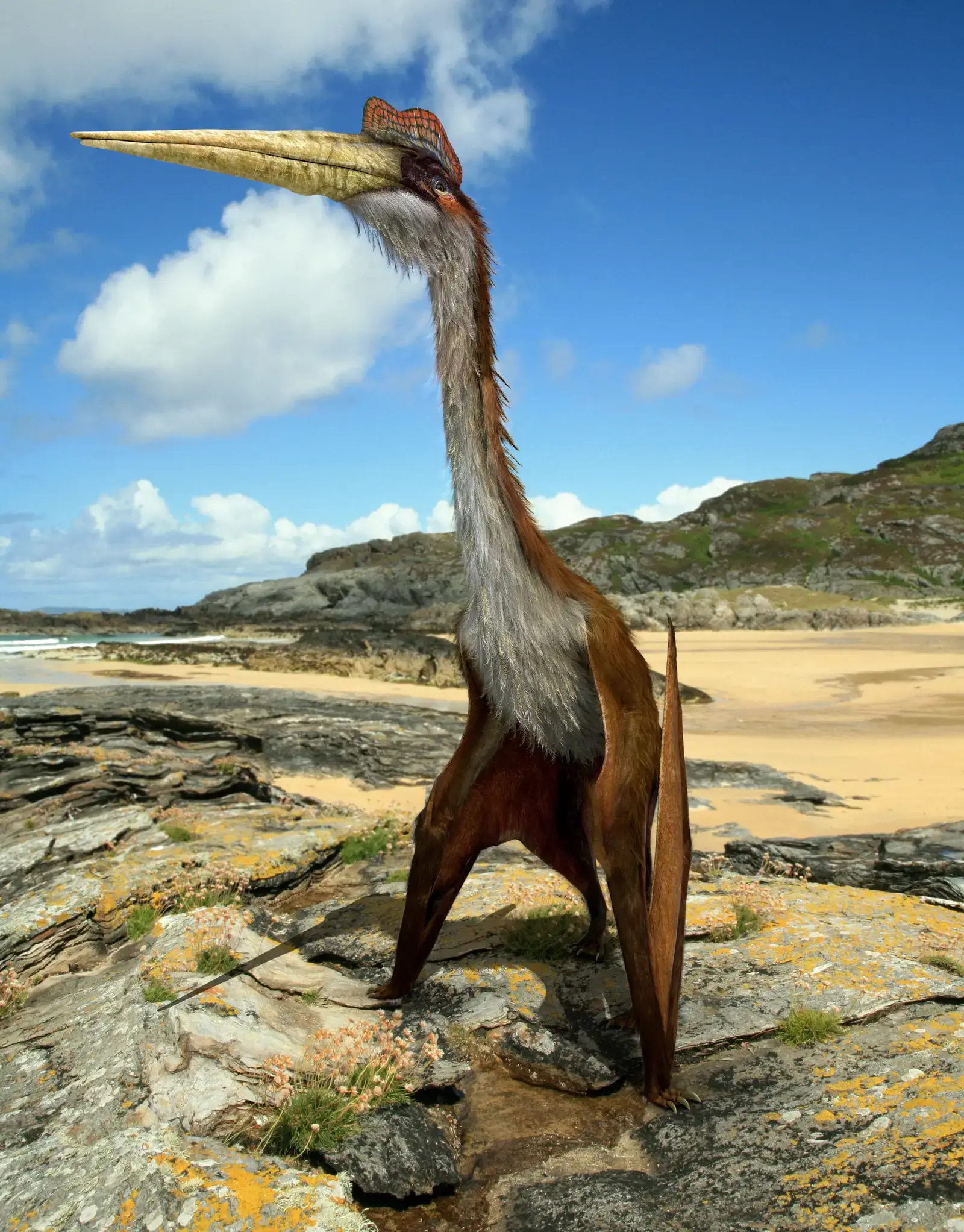
Picture yourself walking across a Cretaceous floodplain and suddenly realizing the “tree” ahead of you just folded its wings. That image gets you close to Quetzalcoatlus, one of the largest flying animals ever known, which lived at the very end of the age of dinosaurs. When it stood on the ground, it could reach heights similar to a modern giraffe, with a long pointed beak and massive wings ready to lift it into the air. You’d feel less like you were looking at a bird and more like you’d stumbled into a myth made real.
Scientists think you would have seen Quetzalcoatlus stalking across open ground like a giant stork, snapping up small animals, carcasses, or anything it could swallow, then launching into flight with powerful strides and wing beats. It shared the landscape with the last generation of dinosaurs, including Tyrannosaurus, which means the sky above those famous predators may have been patrolled by creatures even more astonishing. If you tend to imagine the dinosaur world as vertically flat, with everything important happening on the ground, this animal forces you to look up and picture a sky owned by something so large it almost seems impossible to fly.
5. Deinosuchus – The “Terrible Crocodile” Lurking by Dinosaur Waterholes
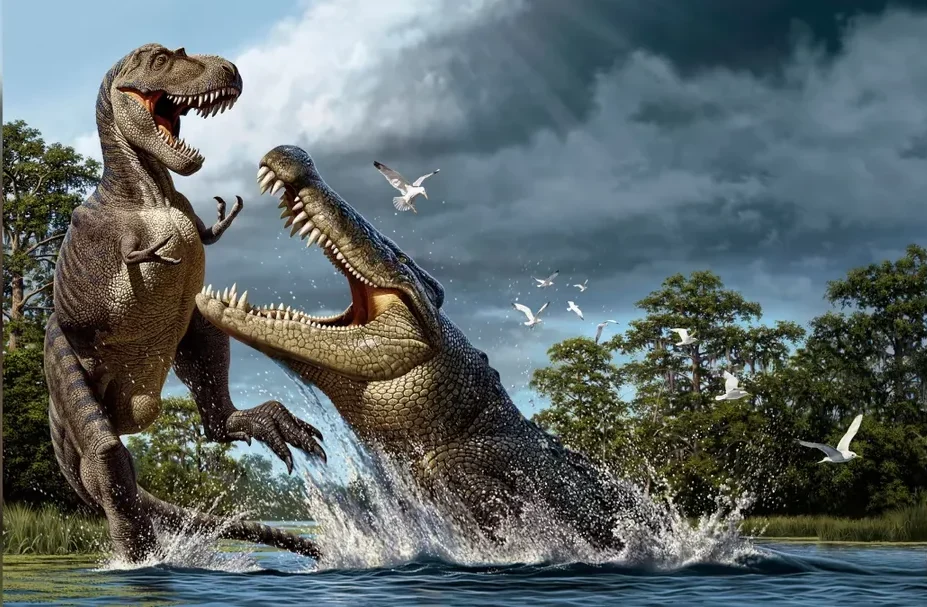
Now shift your focus from the sky to a quiet riverbank in the late Cretaceous, where herds of duck-billed dinosaurs come down to drink. If you were standing close by, you might not notice anything unusual until the water exploded and a reptilian jaw bigger than your entire body clamped around one of those dinosaurs. That attacker would likely be Deinosuchus, a colossal ancient crocodile relative whose name basically means “terrible crocodile,” and it lived in the same ecosystems as many well-known dinosaurs.
Fossil evidence suggests this animal could grow to lengths far beyond most modern crocodiles, giving it the size and power to drag even large dinosaurs into the water. You can imagine it as a supersized version of the ambush hunters you see today in Africa and Australia, only sharing its world with giants instead of antelope or zebras. Bite marks on dinosaur bones that match its teeth tell you that interactions between Deinosuchus and dinosaurs were not polite coexistence; they were violent and deadly. So when you picture a Cretaceous riverside, you should feel the same quiet dread you might feel near a crocodile-infested river today, only dialed up to an almost unimaginable level.
Conclusion
When you stitch all these creatures together in your mind, the age of dinosaurs suddenly stops being just a parade of big names like Tyrannosaurus and Brachiosaurus. You start to see a fully packed world with skies full of pterosaurs, seas ruled by marine reptiles, and rivers guarded by monstrous crocodile kin. Some of the animals you instinctively called dinosaurs turn out to be closer to you than to any reptile, and others were distant cousins that carved out their own incredible paths alongside the famous giants. Once you let that complexity sink in, the prehistoric world feels less like a simple kids’ book and more like a layered, messy, living planet you could almost step into. Which of these creatures changes your mental picture of dinosaur times the most?