Scientists examining fossils from Venezuela have uncovered evidence that ancient anacondas grew to their impressive modern dimensions more than 12 million years ago. These serpents, dwelling in the vast wetlands of the Miocene epoch, matched today’s giants in length despite expectations of even larger prehistoric forms. The discovery challenges assumptions about reptile evolution amid shifting climates and ecosystems.
Unexpected Sizes in Ancient Bones
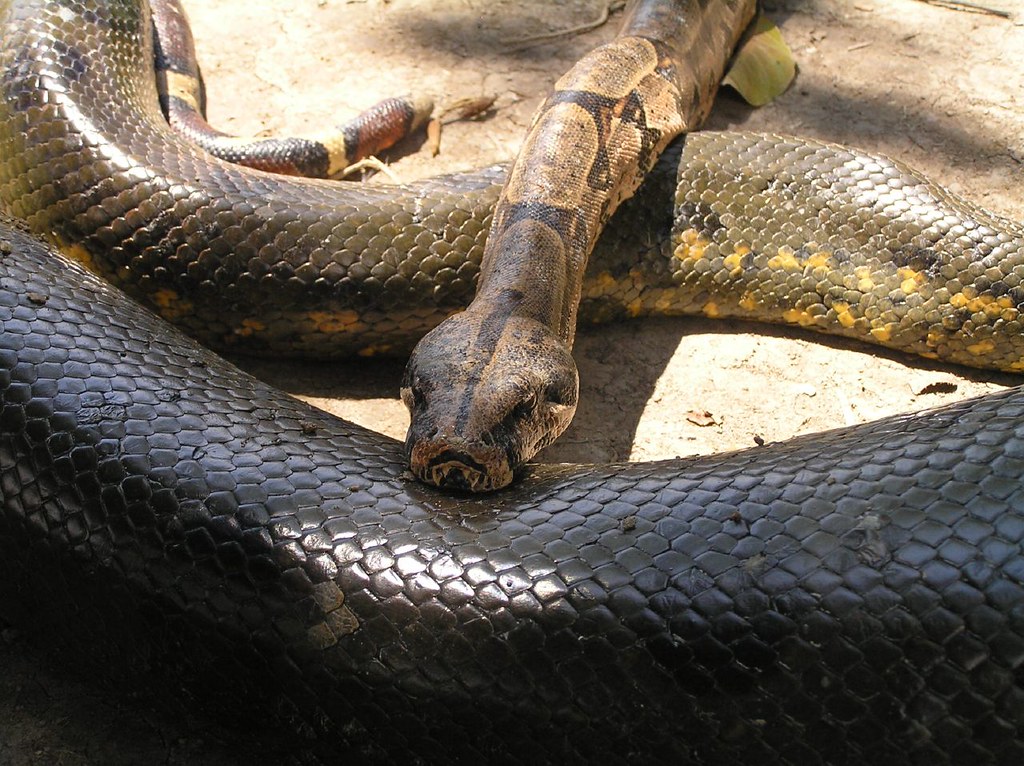
Unexpected Sizes in Ancient Bones (Image Credits: Flickr)
Researchers anticipated fossils revealing supersized snakes from a warmer era, perhaps stretching seven or eight meters. Instead, measurements showed ancient anacondas consistently reached four to five meters, with some individuals up to 5.2 meters – figures nearly identical to contemporary specimens. This revelation came from 183 fossilized vertebrae belonging to at least 32 snakes unearthed in Falcón State’s Urumaco region.
Lead researcher Andrés Alfonso-Rojas noted the surprise: “This is a surprising result because we expected to find the ancient anacondas were seven or eight metres long. But we don’t have any evidence of a larger snake from the Miocene when global temperatures were warmer.” The team combined direct vertebral analysis with ancestral state reconstruction, building a phylogenetic tree from related species like tree boas to confirm early gigantism.
Methods Behind the Measurements
Anacondas possess over 300 vertebrae, making individual fossils reliable indicators of total body length. Paleontologists from the University of Cambridge, University of Zurich, and Venezuela’s Museo Paleontológico de Urumaco gathered these specimens over multiple field seasons. They cross-referenced findings with additional South American fossils spanning 12.4 to 5.3 million years ago.
Alfonso-Rojas explained: “By measuring the fossils we found that anacondas evolved a large body size shortly after they appeared in tropical South America around 12.4 million years ago, and their size hasn’t changed since.” Modern anacondas typically measure four to five meters, occasionally reaching seven meters, thriving in swamps, marshes, and rivers teeming with prey like capybaras and fish.
| Era | Average Length | Maximum Length |
|---|---|---|
| Miocene (12.4 Ma) | 4-5 meters | 5.2+ meters |
| Modern | 4-5 meters | 7 meters (rare) |
The Miocene’s Giant Menagerie
During the Middle to Upper Miocene, northern South America resembled an expanded Amazon basin, with warmer temperatures fostering widespread wetlands and abundant resources. Many creatures ballooned to extraordinary sizes under these conditions. Yet anacondas diverged from the pattern of unchecked growth.
Other behemoths included the 12-meter caiman Purussaurus and the 3.2-meter turtle Stupendemys, both now extinct. Global cooling and habitat contraction after the Miocene felled these giants, but anacondas endured. Alfonso-Rojas highlighted their adaptability: “Other species like giant crocodiles and giant turtles have gone extinct since the Miocene, probably due to cooling global temperatures and shrinking habitats, but the giant anacondas have survived – they’re super-resilient.”
- Purussaurus: 12-meter prehistoric caiman, apex predator of rivers.
- Stupendemys: 3.2-meter turtle, armored giant of swamps.
- Capybaras and fish: Reliable prey sustaining anaconda populations then and now.
- Warmth sensitivity: Snakes grow larger in heat, yet anacondas plateaued early.
What Kept Them Giant?
Anacondas first slithered into the fossil record around 12.4 million years ago, achieving maximum size almost immediately. Stable predator-prey dynamics and niche mastery likely prevented further evolution in length. Their watery habitats persisted, even as continental changes narrowed ranges.
Unlike competitors that oversized themselves into vulnerability, anacondas struck a balance. Food availability in flooded forests and rivers supported their bulk without demanding escalation. This evolutionary stasis underscores resilience in a dynamic world.
Key Takeaways
- Anacondas hit 4-5 meter lengths 12.4 million years ago and maintained them.
- Fossils from Venezuela match modern sizes, defying warmer-climate growth predictions.
- While caimans and turtles vanished, anacondas proved “super-resilient” amid climate shifts.
The anaconda’s unchanging form reveals a winning formula: size perfected in the Miocene’s lush swamps, enduring through epochs of upheaval. This rare stability offers lessons on adaptation’s subtleties. What explains their enduring success? Share your thoughts in the comments.