Articles for author: Lovely Aquino

Illustration of a Utahraptor with a feathered body and open mouth, displaying sharp teeth and claws. Its expressive eyes and poised stance convey alertness.

How Did Tiny Theropods Evolve Into Mighty Raptors?

From humble beginnings to apex predators, the evolutionary journey of raptors represents one of nature’s most fascinating transformations. The story of how small, seemingly unremarkable theropod dinosaurs evolved into the formidable hunters we know as raptors spans millions of years of adaptation and specialization. This remarkable transition wasn’t just about increasing size—it involved precise modifications ...

Close-up of a curious white chicken with a red comb in a grassy field, surrounded by other chickens under a clear blue sky. The scene conveys a lively farm atmosphere.

Why Some Scientists Call Chickens “Mini Dinosaurs”

In the world of paleontology and evolutionary biology, one of the most fascinating revelations in recent decades has been the reclassification of birds as living dinosaurs. Among our feathered contemporaries, chickens hold a special place as some of the most accessible examples of this evolutionary legacy. Far from being just farm animals or food sources, ...

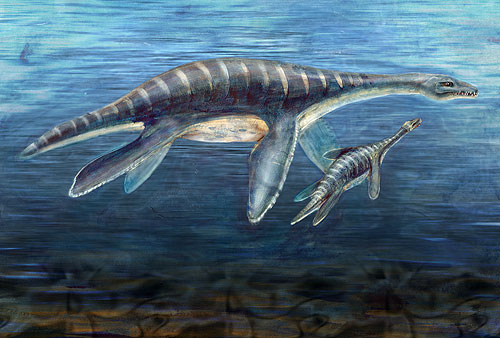
Shastasaurus altispinus, an ichthyosaur

How Ichthyosaurs Gave Birth: Prehistoric Insights into Live Birth

In the depths of ancient oceans, remarkable marine reptiles called ichthyosaurs once dominated the prehistoric seas. These dolphin-like creatures have fascinated paleontologists not just for their streamlined bodies and extraordinary adaptations to aquatic life, but also for a particularly intriguing aspect of their biology: they gave birth to live young underwater. Unlike most reptiles that ...

Dakota skin impression

The Texture of Dinosaur Skin: What Fossils Reveal About Scales and Wrinkles

For centuries, dinosaurs have captivated our imagination, appearing in countless books, movies, and museum displays. Yet until relatively recently, our understanding of their external appearance—particularly their skin—was largely speculative. Today, thanks to exceptional fossil discoveries and advanced scientific techniques, paleontologists can now paint a more accurate picture of dinosaur skin textures, patterns, and colors. These ...

Edward Hicks, American - Noah's Ark - Google Art Project

Did Noah’s Flood Leave Dinosaur Fossils Behind? The 19th-Century Debate

The 19th century was a pivotal period in the history of science, witnessing the collision between traditional biblical interpretations and emerging geological discoveries. As paleontologists unearthed increasingly numerous dinosaur fossils across Europe and North America, a fascinating intellectual battle ensued. Religious scholars, naturalists, and early geologists engaged in heated debates about whether these prehistoric remains ...

The Spiked Defender of the Late Cretaceous

Could Dinosaurs Have Developed Mammal-Like Traits if They Survived?

Dinosaurs dominated Earth for over 165 million years before their sudden extinction approximately 66 million years ago. This cataclysmic event, caused by an asteroid impact, dramatically altered Earth’s evolutionary trajectory, allowing mammals to diversify and eventually dominate terrestrial ecosystems. But what if dinosaurs had survived this mass extinction? The question of whether non-avian dinosaurs could ...

Cyanobacteria

How Microbial Blooms in Ancient Oceans May Have Triggered Mass Extinction

Earth’s history is punctuated by moments of dramatic biological upheaval. Among these, mass extinctions stand as stark reminders of our planet’s capacity for wholesale ecological reorganization. While asteroid impacts and volcanic eruptions often capture the public imagination as extinction drivers, emerging research points to a more subtle yet equally devastating mechanism: microbial blooms in ancient ...