Articles for author: Awais Khan

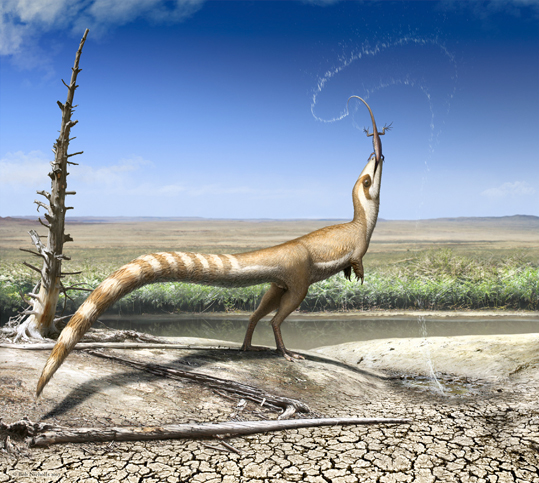
Velociraptor Mongoliensis Painting

The Split Between Bird-Hipped and Lizard-Hipped Dinosaurs Explained

The dinosaur family tree represents one of paleontology’s most fascinating classification challenges. At its core lies a fundamental division that has shaped our understanding of dinosaur evolution for over a century: the split between bird-hipped (Ornithischia) and lizard-hipped (Saurischia) dinosaurs. This division, established in 1887 by Harry Govier Seeley, remains central to dinosaur taxonomy despite ...

A dinosaur skeleton model stands in a display case. It's bird-like with a long tail, sharp beak, and bipedal stance on a green base.

The Dinosaur That Couldn’t Decide: Half-Bird, Half-Beast

In the vast narrative of Earth’s prehistoric past, few creatures embody evolutionary transition as dramatically as those caught between dinosaur and bird classifications. These fascinating animals lived during a pivotal moment in evolutionary history, displaying characteristics of both their dinosaurian ancestors and the birds they were becoming. The story of these transitional species offers a ...

Reading Between the Footprints

Fossil Footprints: How Dinosaur Tracks Reveal Behavior in Motion

Millions of years before humans walked the Earth, dinosaurs left their mark on our planet—quite literally. Their fossilized footprints, preserved in ancient mud and stone, offer paleontologists a rare glimpse into prehistoric life in motion. Unlike skeletal remains that show what dinosaurs looked like in death, tracks reveal how these magnificent creatures moved, interacted, and ...

Advantage of Beaks

How the Evolution of Beaks Helped Dinosaurs Survive Through Birds

In the dramatic story of life on Earth, few evolutionary tales are as fascinating as how dinosaurs survived extinction through their avian descendants. The asteroid impact 66 million years ago wiped out all non-avian dinosaurs, yet their legacy continued through birds—the only dinosaur lineage that persists today. Central to this survival story is the evolution ...

A rare gem from the past: Barb Beasley’s discovery of a Tyrannosaurus rex tooth during a 2012 Passport in Time excavation in the iconic Hell Creek Formation.

How a Single Tooth Changed What We Know About Raptor Evolution

When it comes to paleontological discoveries, sometimes the smallest fossils yield the most significant insights. In 2012, a single tooth found in Japan revolutionized our understanding of raptor dinosaurs, challenging long-held assumptions about their evolution and geographic distribution. This tiny fossilized tooth, measuring just a few millimeters in length, provided evidence that would rewrite scientific ...

Crocodiles and alligators, alongside birds, are the closest living kin to dinosaurs.

How the Ancestors of Dinosaurs Diverged from Crocodile-Like Reptiles

The evolutionary journey that led to dinosaurs dominating the Mesozoic Era represents one of the most fascinating chapters in the history of life on Earth. Around 250 million years ago, a critical evolutionary split occurred among archosaurs—the “ruling reptiles”—that would forever alter the course of terrestrial vertebrate evolution. On one branch, the lineage leading to ...

Deccan Traps volcano

How the End of the Dinosaurs Opened the Door for Modern Mammals

The catastrophic event that ended the reign of dinosaurs approximately 66 million years ago represents one of the most pivotal turning points in Earth’s biological history. When a massive asteroid struck the Yucatán Peninsula, it triggered a chain of environmental disasters that wiped out approximately 75% of all species, including the non-avian dinosaurs that had ...

View of Earth from space with a satellite in the foreground; the globe displays swirling clouds over blue oceans, under a vast expanse of space.

The Role of Drones and Satellites in Modern Fossil Hunting

The landscape of paleontology has undergone a remarkable transformation in recent decades. While the traditional image of fossil hunting involves painstaking fieldwork with brushes and picks, today’s paleontologists increasingly rely on cutting-edge technology from the skies above. Drones and satellites have revolutionized how researchers locate, document, and analyze fossil sites around the world. This technological ...

A lifelike dinosaur statue, resembling a Tyrannosaurus rex, stands in a lush, green forest. It has an open mouth displaying sharp teeth, conveying a fierce expression.

Did Gigantic Size Help or Hinder Dinosaur Survival?

For over 160 million years, dinosaurs dominated Earth’s terrestrial ecosystems, evolving into a remarkable diversity of forms. Among their most striking characteristics was the tremendous size many species achieved—from the 85-foot Brachiosaurus to the 40-foot Tyrannosaurus rex. These dimensions far exceed those of most modern land animals, raising fascinating questions about how size influenced dinosaur ...

The dinosaur era concluded with one of the most dramatic climate catastrophes in Earth’s history, triggered by the impact of a massive asteroid approximately 10 kilometers in diameter in what is now the Yucatán Peninsula of Mexico.

What If Dinosaurs Had Never Gone Extinct? The Theories That Might Surprise You

Approximately 66 million years ago, a cataclysmic event forever changed Earth’s evolutionary trajectory. The mass extinction that wiped out non-avian dinosaurs redirected the course of life on our planet, eventually allowing mammals to diversify and humans to emerge. But what if that asteroid had missed Earth or the dinosaurs had somehow survived? This tantalizing alternative ...