Articles for author: Mitul Biswas

Theories on Their Social Behavior

Could Dinosaurs Feel Emotions Theories on Their Social Behavior

When we gaze upon the fossilized remains of dinosaurs in museums, it’s easy to view them as merely ancient biological machines—creatures that walked, hunted, and reproduced without the complex emotional lives we associate with modern animals. However, recent paleontological discoveries and comparative studies with living dinosaur descendants have begun to challenge this perspective. The question ...

What If Dinosaurs Had not Gone Extinct

What If Dinosaurs Had not Gone Extinct A Look at Alternate Evolution

Approximately 66 million years ago, a catastrophic asteroid impact near Mexico’s Yucatán Peninsula triggered the fifth mass extinction event in Earth’s history, wiping out roughly 75% of all species—including the non-avian dinosaurs that had dominated terrestrial ecosystems for over 160 million years. This cataclysmic event dramatically altered evolution’s trajectory, allowing mammals to diversify and eventually ...

The Respiratory Constraint

Tiny Wings, Big Role Insects in the Mesozoic Ecosystem

The Mesozoic Era, spanning from 252 to 66 million years ago, was a transformative period in Earth’s history marked by the dominance of dinosaurs, the emergence of mammals, and dramatic shifts in global ecosystems. While dinosaurs often steal the spotlight in our imaginations of this distant time, the insect world was experiencing its own remarkable ...

12 Dinosaurs You Did not Know Had Feathers

When we picture dinosaurs, many of us still envision the scaly, reptilian creatures popularized by films like Jurassic Park. However, paleontological discoveries over the past few decades have dramatically transformed our understanding of these ancient animals. One of the most revolutionary findings has been the widespread presence of feathers among dinosaurs, particularly theropods (the group ...

Imprints Inside Dinosaur Bones

When Fossils Fossilize Fossils Imprints Inside Dinosaur Bones

The world of paleontology occasionally reveals phenomena so peculiar they seem almost recursive—fossils within fossils. When examining ancient dinosaur remains, scientists sometimes discover remarkable traces of other organisms preserved inside the bones themselves. These “nested fossils” provide extraordinary windows into ancient ecosystems and interactions between prehistoric creatures. This fascinating phenomenon, where one fossil contains another, ...

gray dinosaur skeleton figurine

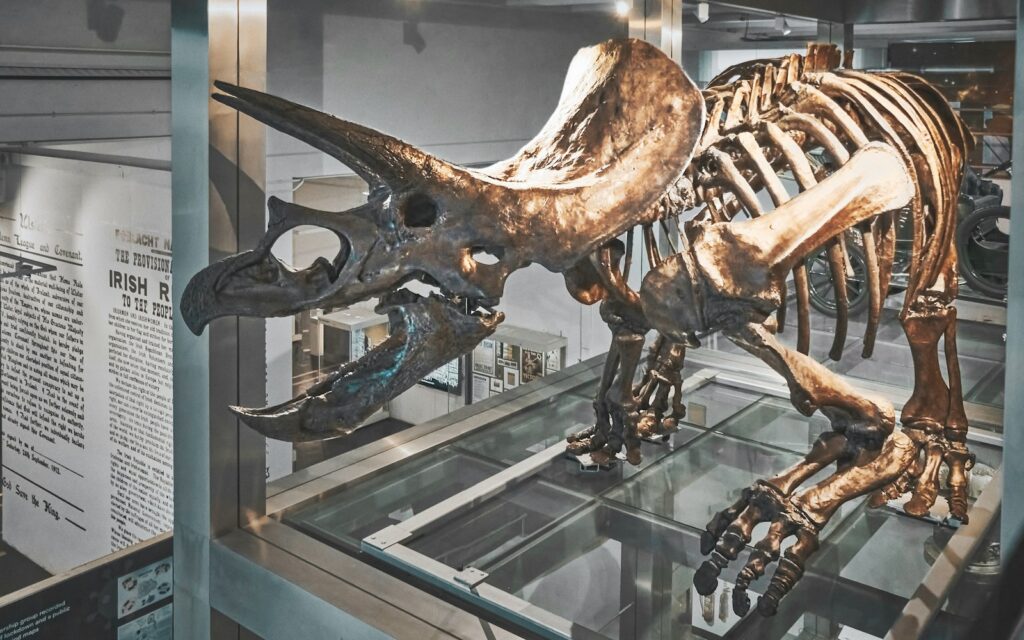
How Do We Reconstruct Dinosaur Skeletons in Museums

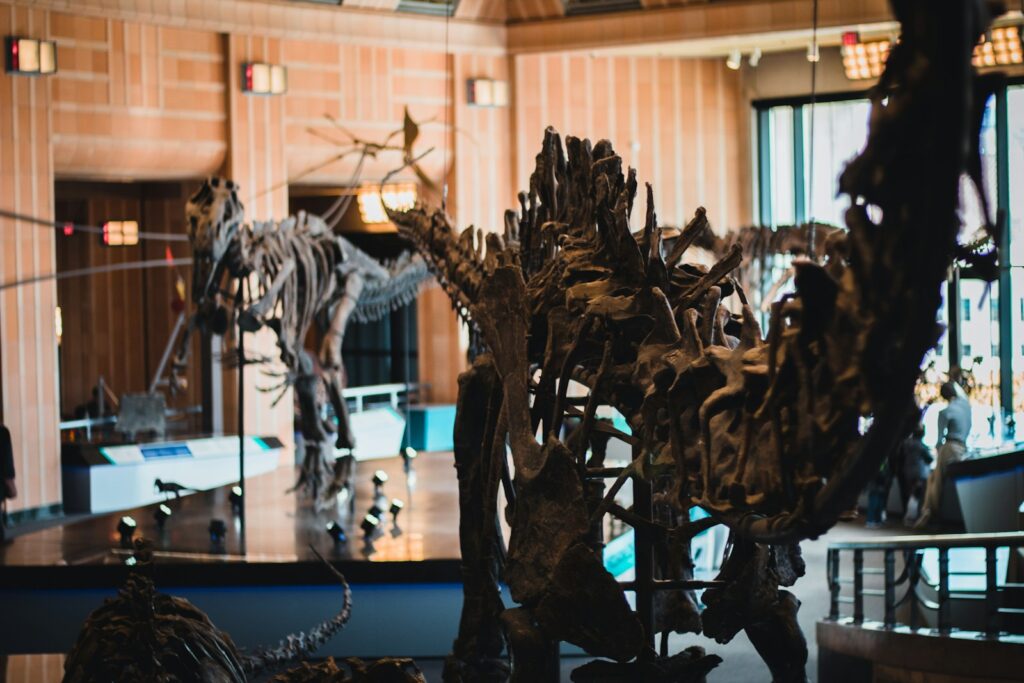
From the first moment you walk into a natural history museum and encounter a towering Tyrannosaurus rex or a magnificent Diplodocus, there’s an undeniable sense of wonder. These massive prehistoric creatures, brought back to life through meticulous scientific reconstruction, connect us to Earth’s distant past. But have you ever wondered how scientists and museum professionals ...

Fossils Are Glued Together

When Fossils Are Glued Together Science or Scam

The world of paleontology sits at a fascinating intersection of scientific discovery and public wonder. For centuries, fossil discoveries have captivated our imagination and expanded our understanding of Earth’s ancient past. However, behind museum displays of complete dinosaur skeletons and prehistoric creatures lies a complex reality that many visitors don’t realize: very few fossils are ...

Continental Drift

How Continental Drift Split Dinosaur Species Apart

The ancient supercontinent Pangaea began breaking apart approximately 180 million years ago, triggering one of the most significant evolutionary experiments in Earth’s history. This massive geological process, known as continental drift, created natural barriers that isolated dinosaur populations from one another, leading to divergent evolution across separate landmasses. Once-connected species began developing along independent evolutionary ...

Brachiosaurus The High-Browsing Giant

Brachiosaurus The High Browsing Giant With a Giraffe Like Neck

Among the most iconic dinosaurs that ever walked the Earth, Brachiosaurus stands tall with its distinctive upright posture and extraordinarily long neck. This massive sauropod roamed the late Jurassic landscape approximately 154-153 million years ago, leaving paleontologists and dinosaur enthusiasts fascinated by its unique adaptations and lifestyle. Named for its notably long forelimbs (the name ...