Articles for category: Dinosaur Science & Theories

Fossil evidence indicates dinosaurs were continuously adapting and evolving

What If Dinosaurs Had Never Gone Extinct Alternate Evolution Theories

Imagine a world where the Chicxulub asteroid never struck Earth 66 million years ago. The dinosaurs that dominated our planet for over 165 million years would have continued their evolutionary journey, potentially altering the course of life on Earth dramatically. This fascinating counterfactual scenario has captivated scientists, paleontologists, and science fiction enthusiasts alike. What creatures ...

Dinosaurs in a Warmer World

When Antarctica Was a Rainforest Dinosaurs in a Warmer World

Today, Antarctica is Earth’s coldest, windiest, and most desolate continent—a frozen wilderness where only specialized organisms survive. Yet beneath its ice sheets lies evidence of a dramatically different past. Roughly 90 million years ago, during the mid-Cretaceous period, Antarctica was located in the same position but experienced a climate so warm that rainforests flourished and ...

The Meteor That Changed Everything

The Meteor That Changed Everything

Sixty-six million years ago, our planet experienced a moment that fundamentally altered the course of life on Earth. Picture this: giant reptiles ruled the land, the climate was warm and humid, and flowering plants had just begun to flourish. Then, in a single catastrophic instant, changed. The story begins with a space rock, roughly ten ...

A lifelike T-Rex model stands menacingly in a misty forest, showing sharp teeth and detailed scales. Tall green trees surround, adding a prehistoric feel.

What Is the Difference Between Theropods, Sauropods, and Ornithopods?

When we think of dinosaurs, most of us conjure images of massive, long-necked creatures grazing on treetops, fierce predators with razor-sharp teeth, or peculiar herbivores with beaks and frills. These mental images represent three major groups of dinosaurs that dominated the Mesozoic Era: theropods, sauropods, and ornithopods. Each group evolved distinct anatomical features, dietary preferences, ...

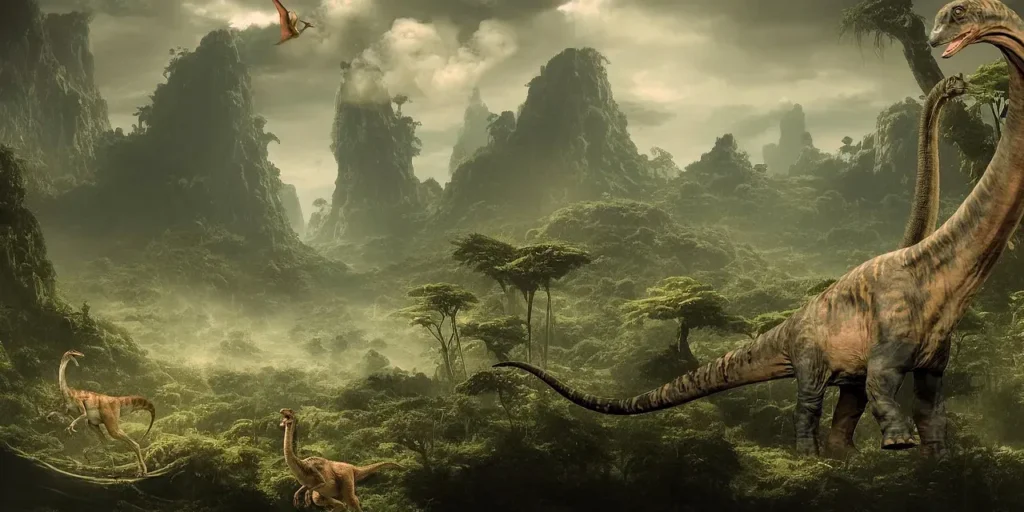
Illustration of large dinosaurs with long necks walking in a sandy landscape. A pterosaur flies in the blue sky, and grass grows near a water body.

When Scientists Thought Dinosaurs Were Just Giant Lizards

Long before we understood dinosaurs as the diverse group of animals that dominated Earth for over 165 million years, these prehistoric creatures were grossly misinterpreted. For much of the 19th and early 20th centuries, the scientific community viewed dinosaurs simply as enormous reptiles that dragged their massive bodies across primordial landscapes. This mistaken view shaped ...

Supercontinents and Dinosaurs

Supercontinents and Dinosaurs: How Pangaea Shaped Evolution

The story of Earth’s ancient supercontinent, Pangaea, and the dinosaurs that roamed its vast, connected landmass is a fascinating chapter in our planet’s history. Approximately 335 million years ago, Earth’s continents began a slow migration toward one another, eventually creating a single landmass that would dramatically influence the course of evolution. This continental congregation set ...

A cartoon dinosaur playfully rides an orange-feathered dinosaur on a sandy surface. The scene conveys a lighthearted, humorous tone.

What Dinosaurs Ate—and What Ate Them

The prehistoric world was a complex ecosystem where dinosaurs occupied various niches across the food chain. For 165 million years, these remarkable creatures evolved diverse feeding strategies, from massive plant-eaters that consumed tons of vegetation daily to fearsome predators that hunted with precision and power. The dietary habits of dinosaurs reveal not just what they ...

stegosaur

Dinosaurs With Horns, Spikes, and Sails: Nature’s Strangest Designs

When we look at the fossil record of dinosaurs, we’re confronted with some of evolution’s most spectacular experiments. From the dramatic three-horned face of Triceratops to the imposing sail of Spinosaurus, prehistoric reptiles evolved remarkable ornaments and defensive structures that continue to captivate scientists and the public alike. These extraordinary anatomical features weren’t merely for ...