Articles for author: Awais Khan

A dinosaur model with an open mouth, resembling a T. rex, stands among lush green foliage and plants.

What Dinosaurs Couldn’t Eat—And Why

When we think of dinosaurs, we often imagine voracious predators like Tyrannosaurus rex devouring anything in their path, or gentle giants like Brachiosaurus stripping trees of their foliage. However, the reality of dinosaur diets was much more complex and constrained than many popular depictions suggest. Despite their diversity and dominance for over 165 million years, ...

Fossilized dinosaur skull with sharp teeth and hollow eye sockets. The weathered gray bone highlights intricate jaw and cranial features against a beige background.

How Fast Did Dinosaurs Digest?

Dinosaurs, those magnificent prehistoric creatures that roamed Earth for over 165 million years, continue to captivate our imagination despite being extinct for 65 million years. While we’ve learned much about their appearance, behavior, and habitats through fossil records, some aspects of dinosaur physiology remain less understood. One such fascinating aspect is their digestive processes. How ...

Illustration of a large, armored prehistoric reptile with a striped shell, moving across a rocky terrain, surrounded by lush green ferns and plants.

Typothorax: The Strange Armored Reptile From the American Southwest

Beneath the rust-colored rocks and windswept mesas of the American Southwest lies a prehistoric legacy that continues to captivate paleontologists worldwide. Among the many fossil treasures discovered in this region, few are as distinctive as Typothorax, an armored reptile that roamed the landscape during the Late Triassic period, approximately 230-200 million years ago. With its ...

A vibrant prehistoric scene depicts various dinosaurs in a lush forest. Diverse species, including armored and herbivorous, roam amidst dense greenery.

Kosmoceratops: The Dinosaur With the Most Horns—Straight Out of Utah

In the vast pantheon of dinosaurs that once roamed our planet, few capture the imagination quite like Kosmoceratops richardsoni. This spectacular ceratopsian dinosaur, discovered in the rugged terrain of southern Utah, stands as a testament to the incredible diversity of prehistoric life. With its record-breaking 15 horns adorning an elaborate frill, Kosmoceratops wasn’t just another ...

Microraptor's aerodynamic feathers hint at gliding or even early flight, soaring through prehistoric skies.

The Rise of Miniaturization: Why So Many Tiny Dinosaurs Evolved in the Cretaceous

The Cretaceous period, spanning from approximately 145 to 66 million years ago, witnessed a fascinating evolutionary trend that continues to captivate paleontologists and dinosaur enthusiasts alike: the proliferation of miniaturized dinosaur species. While popular culture often portrays dinosaurs as towering behemoths, the fossil record reveals a different story—one where diminutive dinosaurs thrived and diversified across ...

A realistic dinosaur statue, with an open mouth and sharp teeth, against a blue sky. The large sculpture conveys a sense of power and ferocity.

Could Dinosaurs Wink, Blink, or Cry?

Dinosaurs have captivated human imagination since their fossils were first discovered. While we’ve made tremendous advances in understanding their anatomy, behavior, and evolution, certain aspects of their biology remain shrouded in mystery. Among these enigmas are questions about their ocular capabilities and expressions: Could dinosaurs wink playfully at each other? Did they blink to protect ...

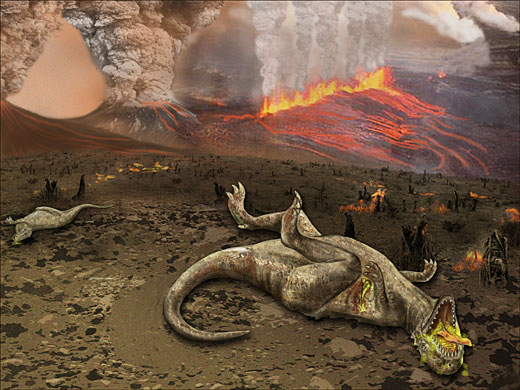
Eruptions triggered warming, acidification, and toxic oceans.

Did Volcanic Eruptions Help Wipe Out the Dinosaurs?

The extinction of dinosaurs approximately 66 million years ago marks one of the most dramatic turning points in Earth’s biological history. While a massive asteroid impact has been widely accepted as the primary cause of this mass extinction event, recent scientific research has increasingly highlighted the potential role of volcanic activity in this global catastrophe. ...

Microraptor's aerodynamic feathers hint at gliding or even early flight, soaring through prehistoric skies.

Could Dinosaurs Blush or Change Skin Color?

Dinosaurs, those magnificent creatures that once ruled our planet for over 165 million years, continue to captivate our imagination despite having vanished approximately 66 million years ago. While paleontologists have made remarkable strides in understanding dinosaur anatomy, behavior, and even some aspects of their appearance through fossil evidence, certain physiological capabilities remain shrouded in mystery. ...

Dinosaur skeleton exhibit under blue and purple lighting at the Museum of Mongolian Dinosaurs. The setting is dramatic and educational.

How Fossils Get Lost in Museum Basements for Decades

In the vast network of museum collections worldwide, millions of precious fossils lie carefully preserved – yet many remain unstudied and essentially lost to science for decades or even centuries. Behind the gleaming public exhibits that draw visitors, museums house enormous research collections in their basement storage areas, containing specimens that often outnumber displayed items ...